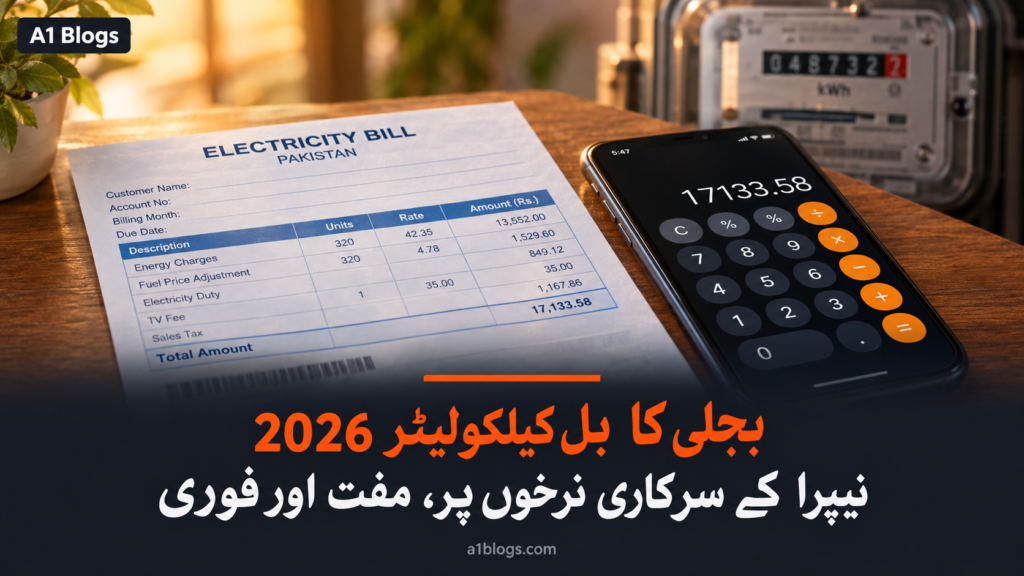
Use this calculator to estimate your electricity bill with the rates NEPRA notified in February 2026. It follows the billing rules printed with the official tariff, including the one most online calculators get wrong: for most households, the bill is not worked out slab by slab.
یہ کیلکولیٹر اردو میں استعمال کریں
Enter the units from your bill. Energy and fixed charges follow the official tariff exactly; the monthly adjustments and tax are yours to copy from your bill.
Adjustments and tax from your bill (optional)
These change from month to month. Copy them from your latest bill for the closest estimate. GST is applied here to energy, fixed charges and adjustments together, which is an approximation.
Source: NEPRA S.R.O. 279(I)/2026, tariff A-1 (residential), as published by IESCO. Figures checked 29 September 2026. This is an estimate, not an official bill.
How your electricity bill is calculated
Every ex-WAPDA distribution company (LESCO, IESCO, MEPCO, FESCO, GEPCO, PESCO, HESCO, SEPCO, QESCO, TESCO and HAZECO) bills residential customers on the same national tariff, called A-1. Its rates were last changed by NEPRA in S.R.O. 279(I)/2026, in force since 12 February 2026. What you pay per unit depends on which of three consumer types you fall into.
Unprotected consumers: every unit at the rate of the band you reach
Most households are unprotected. For them, the whole month is charged at the rate of the band the month reaches. If you use 250 units, all 250 are charged at Rs 33.10, not the first 100 at one rate and the next 100 at another. The notes to the tariff are explicit that only protected consumers get the benefit of a previous slab.
This creates a cliff at every band boundary. At 200 units an unprotected household pays Rs 5,782 in energy charges. At 201 units it pays Rs 6,653.10, because every unit moves up to Rs 33.10. One extra unit adds about Rs 871 before tax, and more once the higher fixed charge is included. The calculator warns you when you are close to one of these boundaries.
Protected consumers: the benefit of one previous slab
You are protected if you have used 200 units or less in every one of the last six months. Protected consumers pay much lower rates, and their bill does get the benefit of one previous slab: at 150 units, the first 100 units are charged at Rs 10.54 and the remaining 50 at Rs 13.01. A household with a sanctioned load of 5 kW or more cannot be protected, because such connections are billed on Time-of-Use rates.
Lifeline consumers
Lifeline rates are for single-phase connections with a sanctioned load of up to 1 kW whose usage has not gone above 100 units in the last 12 months. They pay Rs 3.95 per unit up to 50 units and Rs 7.74 up to 100, with no slab benefit and no fixed charge, but a minimum monthly charge of Rs 75 (single-phase) applies.
Time-of-Use and prepaid meters
Connections with a sanctioned load of 5 kW or more are billed on Time-of-Use rates: Rs 46.85 per unit at peak and Rs 34.53 off-peak, plus a fixed charge on half the sanctioned load or the recorded maximum demand, whichever is higher. Prepaid residential meters pay a flat Rs 42.12 per unit.
NEPRA residential tariff 2026 (A-1, sanctioned load below 5 kW)
| Consumer type and monthly units | Rate per unit | Fixed charge |
|---|---|---|
| Lifeline, up to 50 units | Rs 3.95 | None (minimum charge applies) |
| Lifeline, 51 to 100 units | Rs 7.74 | None (minimum charge applies) |
| Protected, 1 to 100 units | Rs 10.54 | Rs 200 per kW |
| Protected, 101 to 200 units | Rs 13.01 | Rs 300 per kW |
| Unprotected, 1 to 100 units | Rs 22.44 | Rs 275 per kW |
| Unprotected, 101 to 200 units | Rs 28.91 | Rs 300 per kW |
| Unprotected, 201 to 300 units | Rs 33.10 | Rs 350 per kW |
| Unprotected, 301 to 400 units | Rs 36.46 | Rs 400 per kW |
| Unprotected, 401 to 500 units | Rs 38.95 | Rs 500 per kW |
| Unprotected, 501 to 600 units | Rs 40.22 | Rs 675 per kW |
| Unprotected, 601 to 700 units | Rs 41.85 | Rs 675 per kW |
| Unprotected, above 700 units | Rs 47.20 | Rs 675 per kW |
Fixed charges are per kilowatt of sanctioned load per month, which is printed on your bill. The minimum monthly charge of Rs 75 (single-phase) or Rs 150 (three-phase) applies only where no fixed charge does.
What else appears on your bill
The energy and fixed charges above are only part of the bill. Several other items change from month to month, which is why the calculator lets you enter them from your own bill:
- Fuel price adjustment (FPA): a per-unit charge or credit that NEPRA sets each month to reflect the actual cost of fuel used to generate electricity.
- Quarterly tariff adjustment (QTA): a temporary per-unit adjustment for a few billing months. For example, NEPRA applied +Rs 0.3504 per unit to the March to May 2026 bills and −Rs 1.9857 per unit to the June to August 2026 bills; both have now expired.
- Surcharges: some bills carry per-unit surcharges such as the financing cost surcharge. Check the lines on your own bill.
- General sales tax: charged on top of the electricity charges, usually at 18%.
Two items that used to appear are gone. The Rs 35 PTV fee was abolished from July 2025, and the federal government asked the provinces to stop collecting electricity duty through bills from the same month.
Worked examples
All three examples assume a sanctioned load of 2 kW and leave out the monthly adjustments.
Unprotected household, 250 units. Energy: 250 × Rs 33.10 = Rs 8,275. Fixed: 2 kW × Rs 350 = Rs 700. With 18% GST the estimate is about Rs 10,590.
The 200-unit cliff. At 200 units the energy and fixed charges come to Rs 6,382. At 201 units they come to Rs 7,353.10, so one extra unit costs about Rs 971 before tax.
Protected household, 150 units. Energy: 100 × Rs 10.54 + 50 × Rs 13.01 = Rs 1,704.50. Fixed: 2 kW × Rs 300 = Rs 600. With 18% GST the estimate is about Rs 2,719. The same 150 units on the unprotected tariff would cost Rs 2,632 more before tax, which is why staying at or below 200 units matters.
How to lower your bill
The biggest savings usually come from staying just below a band boundary, keeping protected status if you are close to it, and cutting the heaviest loads such as air conditioners, water pumps and old refrigerators. Our Urdu guide covers 12 practical ways to reduce your electricity bill.
Frequently asked questions
Is my bill calculated slab by slab?
Only if you are a protected consumer, and then only with the benefit of one previous slab. Unprotected consumers pay the rate of the band their month reaches on every unit, and lifeline consumers get no slab benefit.
How do I become a protected consumer?
Use 200 units or less in every month for six months in a row, on a connection with a sanctioned load below 5 kW. Going above 200 units even once means the six-month count starts again.
Why did my bill jump when I used only a few more units?
You probably crossed a band boundary. Every unit is then charged at the higher rate, and the fixed charge per kW may rise too. Enter your units in the calculator to see how far you are from the next boundary.
Are the rates the same for LESCO, IESCO, MEPCO and the other companies?
Yes. The same consumer-end rates apply across the ex-WAPDA distribution companies. K-Electric customers in Karachi are billed under a separate NEPRA determination, so this calculator is not designed for them.
Is the PTV fee still charged?
No. The Rs 35 PTV fee was removed from electricity bills from July 2025.
Sources and updates
The rates on this page come from NEPRA’s S.R.O. 279(I)/2026 and were checked against the tariff guide published by IESCO on 29 September 2026. We update this page when NEPRA notifies new rates. If you spot a figure that no longer matches your bill, please tell us.
You are welcome to share this calculator or link to it from your own website or article.