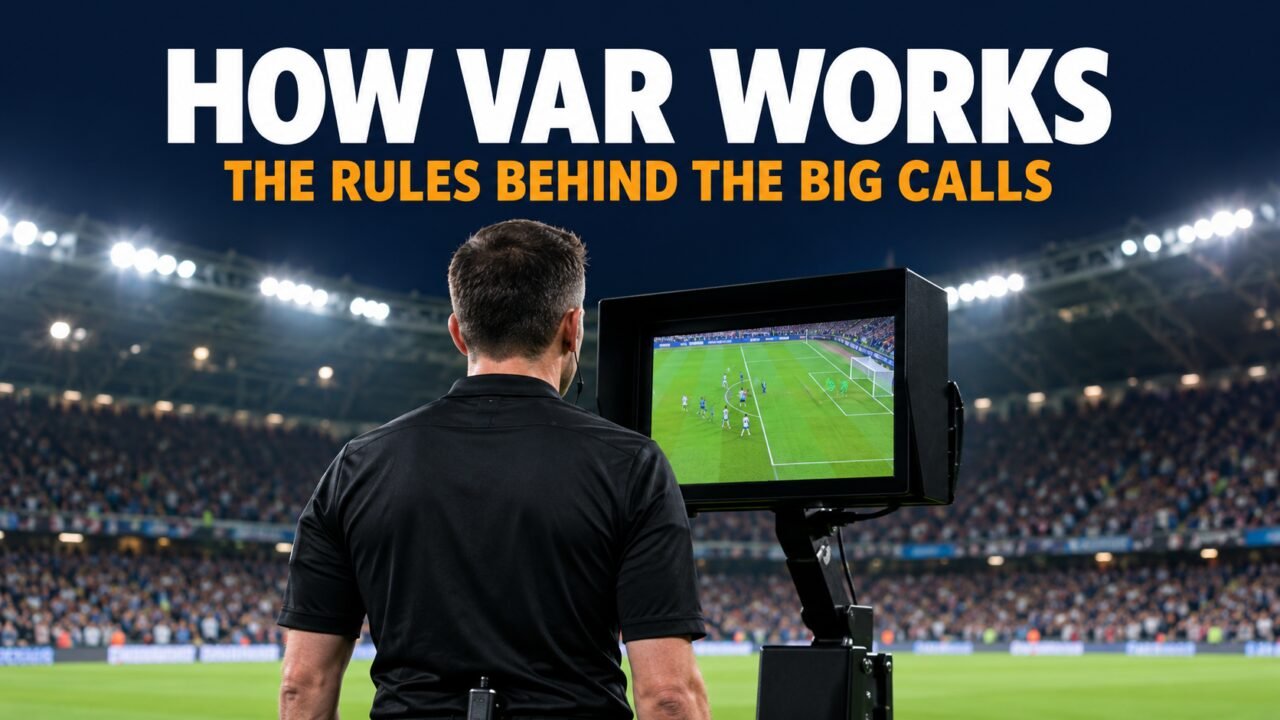
Understanding how VAR works will not stop you shouting at the television, but it will help you understand why a goal is disallowed after a two-minute wait, why some handballs are penalties and others are not, and why the referee sometimes jogs to a pitchside monitor and sometimes does not. The video assistant referee has been part of the Premier League since the 2019 to 2020 season, and it remains the most argued-about part of English football.
This guide explains who runs VAR, which decisions it can and cannot review, the difference between a factual and a subjective call, and how the system has changed since it arrived. It also compares VAR with replay systems in American sports.
Table of Contents
What is VAR?
VAR stands for video assistant referee. It is a team of match officials who watch every Premier League game on screens, with access to multiple camera angles and replays. Their job is to help the on-field referee avoid clear mistakes in a small number of important situations.
The idea is not to re-referee every moment of the match. The on-field referee remains in charge, and VAR is meant to step in only when something has gone clearly wrong, or when something serious has been missed entirely.
The rules for VAR are set by the International Football Association Board, known as IFAB, which writes the Laws of the Game. Competitions such as the Premier League then decide how to apply them.
Who runs VAR in the Premier League?
Premier League referees and VAR officials are employed by the Professional Game Match Officials Limited, or PGMOL. For Premier League matches, VAR is operated from a central hub at Stockley Park in west London, rather than from inside each stadium.
For every match, the hub has a VAR, who leads the review, an assistant VAR, who keeps watching the live game while the VAR checks an incident, and a replay operator, who finds the best camera angles. The VAR is usually a referee who also officiates matches on the pitch.
PGMOL’s chief refereeing officer, Howard Webb, a former World Cup final referee, has made communication a priority, including releasing audio of some VAR conversations on television so fans can hear how decisions are made.
How VAR works: the 4 situations it can review
Under the Laws of the Game, VAR can only intervene in four types of match-changing situation:
- Goals, and whether there was an offence in the build-up, such as a foul, handball or offside
- Penalty decisions, whether a penalty was wrongly given or wrongly missed
- Direct red cards, but not second yellow cards
- Mistaken identity, when the referee cautions or sends off the wrong player
Everything else is outside VAR’s remit. That includes most free kicks, corners, throw-ins and yellow cards. If a corner is wrongly awarded and a goal comes from it, VAR cannot usually overturn the goal on that basis alone.
“Clear and obvious error” explained
The phrase you hear most often is “clear and obvious error.” VAR is only supposed to overturn the referee’s decision when the replay shows that the original call was clearly wrong, not when the VAR simply sees it differently.
This is where most arguments start. Whether a tangle of legs in the penalty area is a clear foul, or a hand in the air is a clear handball, involves judgement. Two experienced officials can look at the same replay and reach different views. The Premier League has set a relatively high bar for VAR intervention in subjective decisions, which means some calls that look wrong to fans are left alone.
There is a second test: a “serious missed incident.” If the referee did not see something at all, such as a punch off the ball, VAR can alert them.
Factual and subjective decisions
VAR decisions fall into two broad groups. Factual decisions are about things that can be measured, such as whether a player was offside, whether the ball crossed the goal line, or whether a foul happened inside or outside the penalty area. For these, the VAR can tell the referee the answer directly, and the referee changes the decision without watching the replay.
Subjective decisions involve judgement, such as whether contact was enough for a foul or whether a tackle deserves a red card. For these, the VAR normally recommends an on-field review. The referee goes to the pitchside monitor, watches the footage and makes the final call.
That is why sometimes the referee changes a decision straight away, and sometimes they walk to the screen.
How offside checks work
Offside has produced some of VAR’s most frustrating moments, with goals ruled out for a toe or a shoulder being fractions of a centimetre beyond the defender. In the early seasons, VAR officials drew lines on still images by hand to find the exact point.
The Premier League has since introduced semi-automated offside technology. Cameras around the stadium track players’ bodies and the ball, and software identifies the moment the ball is played and where each player’s relevant body parts are. The VAR checks the result, and a 3D graphic is produced to show fans. The aim is to make offside decisions faster and more consistent.
Remember that only the parts of the body a player can legally score with count for offside. Arms and hands up to the bottom of the armpit do not.
Handball: the rule behind many VAR decisions
Handball decisions cause more confusion than almost anything else. The law has been rewritten several times in recent years. In broad terms, it is an offence if a player deliberately handles the ball, or makes their body “unnaturally bigger” with their arm and the ball hits it.
Whether an arm position is natural depends on the player’s movement, which is a matter of judgement. VAR can review handball in the build-up to a goal or in the penalty area, but it is still applying a subjective law, which is why handball VAR decisions often divide opinion.
An accidental handball by an attacker that leads directly to a goal is treated differently from one by a defender, which adds another layer of complexity.
What fans in the stadium see
One common complaint is that fans in the ground have far less information than people watching on television. When a VAR check is happening, stadium screens show a message saying a check is under way and what it is for, such as a possible penalty or offside.
Once a decision is made, the screen confirms the outcome. In some competitions, referees now announce the reason for a VAR decision to the crowd over the stadium’s sound system, as happens in some other sports. Supporters’ groups have pushed for more of this kind of explanation in English football.
The biggest VAR controversies
VAR has had some memorable failures. One of the most discussed came in 2023, when a Liverpool goal against Tottenham was wrongly ruled out for offside because of a communication mistake between the VAR and the on-field officials. PGMOL admitted a significant human error and later released the audio.
Other controversies have been about consistency, with fans pointing to similar incidents treated differently in different games. Long delays for checks, goal celebrations cut short and the loss of spontaneity have also led some supporters to question whether VAR is worth it.
In 2024, Wolverhampton Wanderers proposed scrapping VAR altogether. The other Premier League clubs voted overwhelmingly to keep it, while agreeing to work on improvements such as faster checks and better communication.
Has VAR made refereeing more accurate?
PGMOL publishes figures suggesting that the proportion of correct decisions on key match incidents has improved since VAR arrived. That fits with the basic idea: an extra set of eyes with replays should catch more clear mistakes.
The debate is really about the costs. Critics argue that small gains in accuracy are outweighed by the delays, the confusion in stadiums and the arguments that follow when subjective decisions go either way. Supporters say that even one serious error prevented, such as a wrongly awarded goal in a title race or relegation battle, justifies the system.
How VAR compares with replay in American sports
For American readers, VAR is a cousin of the replay systems used in US sports, but with some important differences. In the NFL, coaches can challenge certain calls by throwing a red flag, and every scoring play is automatically reviewed. In Major League Baseball, managers can challenge calls such as safe or out on the bases, with reviews carried out by officials at a central replay centre in New York.
Football’s approach does not allow coaches to challenge decisions. VAR checks every goal, penalty and red card automatically, but it only intervenes for clear errors in those four areas. Major League Soccer in the US uses the same VAR system under IFAB rules.
If you follow American sports, our explainer on the MLB playoff format shows how baseball’s own replay-reviewed postseason works.
Why VAR checks take so long
A simple offside check can take less than a minute. A complex incident can take much longer, because the VAR team may need to look at several angles, identify the exact moment of contact or the ball being played, and then explain the situation clearly to the referee.
The Premier League and PGMOL have tried to speed things up, with more technology for offside and guidance to limit the number of replays for subjective decisions. There is a trade-off: faster checks can mean more mistakes.
A short history of the video assistant referee
The video assistant referee grew out of trials in the Netherlands in the mid-2010s, where the Dutch football association pushed for technology to help referees with major decisions. After live trials in several countries, IFAB wrote VAR into the Laws of the Game in 2018.
The 2018 World Cup in Russia was the first World Cup to use the video assistant referee, and it produced several high-profile penalty decisions. English football tested VAR in FA Cup and League Cup matches before the Premier League adopted it for the 2019 to 2020 season.
Understanding that history helps explain how VAR works today. It was designed as a safety net for big mistakes, not as a way to guarantee that every decision is perfect.
VAR in other leagues and competitions
The Premier League was not an early adopter. Germany’s Bundesliga and Italy’s Serie A both introduced VAR in 2017, and the Champions League began using it in the knockout rounds soon after. The Scottish Premiership introduced VAR in 2022.
Not every English competition uses it. Most Football League matches do not have VAR, largely because of the cost of cameras and officials. In cup competitions, its use depends on the round and the stadium, so a match at a Premier League ground may have VAR while a tie at a lower-league ground does not.
This patchwork means VAR decisions can feel different from one competition to another, which adds to the confusion for fans.
How VAR checks work on penalties
Penalty incidents are among the most common VAR checks. The VAR looks at whether there was a foul or handball, whether it happened inside or outside the penalty area, and whether the attacker was offside or committed an offence first in the build-up.
Whether contact happened inside the area is treated as a factual question, so the VAR can advise the referee directly. Whether the contact was a foul is subjective, so it usually leads to an on-field review if the VAR believes the referee has made a clear and obvious error.
VAR checks also look at what happens when the penalty is taken. If the goalkeeper steps off the line too early and saves the kick, or players encroach into the area and affect the outcome, the kick can be ordered to be retaken.
What referees say about VAR decisions
Referees often describe VAR as a mixed blessing. It can save them from a career-defining mistake, but it also means every decision is examined in slow motion by millions of people, with every replay shared online within seconds.
Former referees working as pundits often point out that slow-motion replays can make contact look worse than it was at full speed, which is one reason officials are encouraged to watch replays at normal speed when judging the intensity of a challenge. Knowing this is part of understanding how VAR works in practice.
PGMOL has also increased training for VAR officials, who now specialise in the role more than they did when the system first arrived.
Could VAR change again?
The rules around VAR are still evolving. IFAB regularly approves trials of new ideas, such as referees explaining decisions to the crowd and changes to how often officials use the pitchside monitor. Some competitions around the world have tested a challenge system, where coaches can ask for a limited number of reviews.
The Premier League has shown it is willing to adopt new technology, as the move to semi-automated offside shows. Whether it goes further, for example by letting managers challenge decisions, is an open question.
Tips for making sense of VAR decisions
If you want to follow VAR decisions more calmly, a few questions help:
- Is this one of the four types of incident VAR can review?
- Is it a factual decision, like offside, or a subjective one, like a foul?
- Did the referee see the incident, or was it missed?
- Is the original decision clearly wrong, or just debatable?
Most of the time, when VAR does not intervene, it is because the incident falls outside its remit or the original decision was judged not to be clearly wrong.
Where to learn the Laws of the Game
If you want to understand decisions in more depth, the Laws of the Game are published free of charge by IFAB, both online and in an app, with illustrations and explanations of recent changes. Reading the sections on offside, fouls and handball is the quickest way to understand why many VAR decisions are made the way they are.
For a practical route, many county football associations run introductory refereeing courses. Even a basic course, and a few matches refereeing children’s games, will change how you see the job, and make you far more sympathetic to the officials under the spotlight every weekend.
How VAR works: common questions
When did VAR start in the Premier League?
VAR was introduced in the Premier League at the start of the 2019 to 2020 season.
Where is VAR based?
Premier League VAR is operated from a central hub at Stockley Park in west London.
Can VAR give a yellow card?
No. VAR cannot review yellow cards, including second yellows. It can only review direct red cards.
Why does the referee sometimes go to the monitor?
For subjective decisions, the VAR recommends an on-field review so the referee can see the footage and make the final call.
Can managers challenge VAR decisions?
No. In the Premier League, managers cannot request reviews. VAR checks incidents automatically.
Next time a goal is checked, ask which of the four situations applies, and you will be ahead of most people in the pub. For more sports explainers, see our sports section and the official Premier League website.