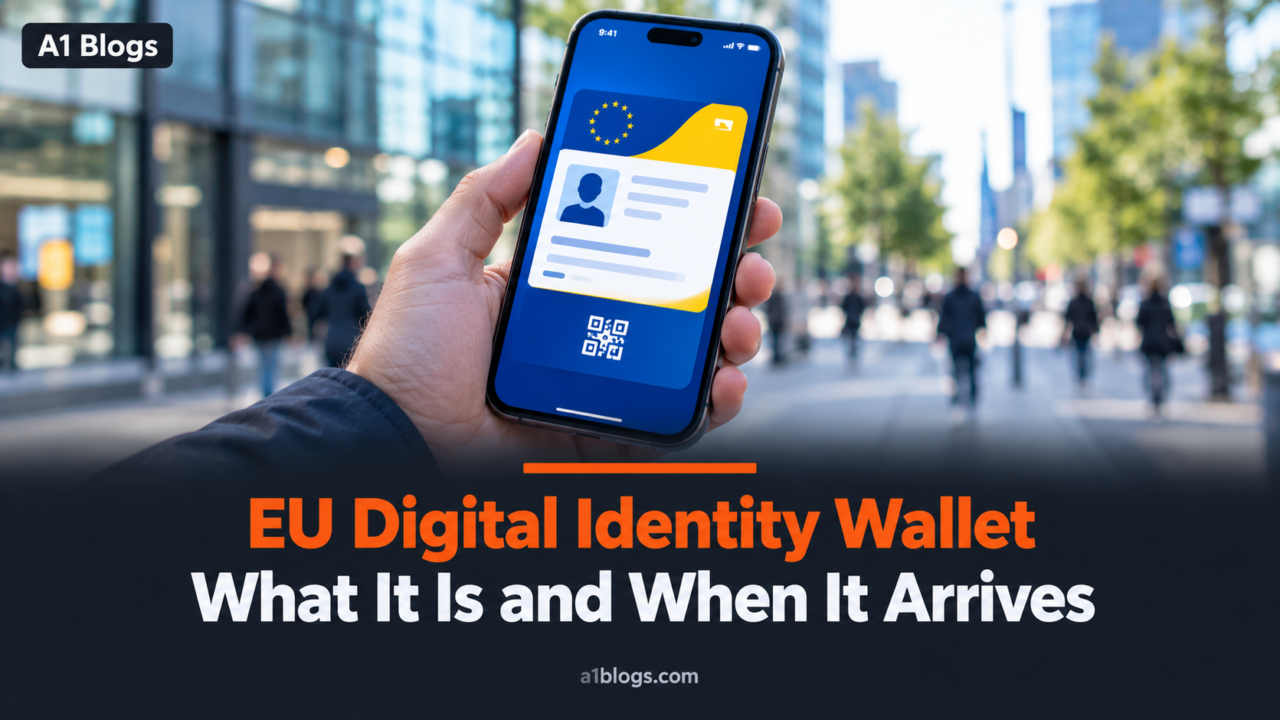
By the end of 2026, every EU country is supposed to offer its citizens and residents a free app that can prove who they are, online and in person, anywhere in the EU. It is called the EU Digital Identity Wallet, and it could eventually hold your ID card, driving licence, diplomas and more on your phone.
The legal deadline falls in late December 2026, and most countries will miss it. This guide explains what the EU Digital Identity Wallet is, what you will be able to do with it, which countries are ready, what the privacy rules promise, and what critics are worried about.
Table of Contents
What the EU Digital Identity Wallet is
The wallet is a phone app issued or approved by your national government. It is built on common EU technical rules, so a wallet from one country works in every other. The legal basis is Regulation (EU) 2024/1183, usually called eIDAS 2.0, which entered into force on 20 May 2024 and updated the EU’s earlier rules on electronic identification.
The first eIDAS regulation, from 2014, made national digital ID schemes recognisable across borders, but take-up was patchy and each country built something different. eIDAS 2.0 goes further. Every member state must offer at least one wallet, the wallets must meet the same standards, and many public and private services will be required to accept them.
Three principles run through the rules:
- **It is voluntary.** You cannot be forced to use the wallet, and you must not be treated worse for choosing not to.
- **It is free for individuals.** Getting, using and cancelling the wallet costs nothing for private use.
- **You stay in control.** Your data is stored in the wallet on your device, and you decide what to share and with whom.
What you will be able to do with it
The wallet holds two kinds of data. The first is your core identity data, issued by your government: name, date of birth, nationality and similar. The second is what the rules call attestations: other documents issued by public bodies or private organisations, which can be added over time.
Planned and piloted uses include:
- logging in to government services at home and in other EU countries;
- opening a bank account or signing up for a mobile phone contract without visiting a branch;
- proving your age online without revealing your date of birth;
- showing a digital driving licence, a university diploma or a professional qualification;
- signing documents with a qualified electronic signature, which has the same legal value as a handwritten one and is free for non-professional use;
- sharing a prescription or health information with a pharmacy or doctor in another country;
- checking in at hotels, car rental desks and airports.
The feature that sets the EU Digital Identity Wallet apart from a photo of your ID card is selective disclosure. A website that needs to know you are over 18 can receive a yes-or-no answer instead of your full identity. A landlord who needs proof of residence does not also need your ID number. The wallet shares only what a service is allowed to ask for.
Over the next few years more documents are expected to follow. The EU’s revised driving licence rules plan a digital licence on your phone as the standard format by around 2030, and the Commission has proposed a digital version of travel documents for border checks.
When your country gets one: status in September 2026
The regulation gave member states 24 months after the adoption of the detailed technical rules to offer a wallet, which puts the deadline in late December 2026. At the end of September 2026, national progress is very uneven.
- **Furthest ahead:** Italy, France, Denmark, Finland and Bulgaria. Italy has built its wallet into IO, the government services app that millions of Italians already use, under the name IT-Wallet. France, Denmark and Italy had reached the stage of production wallets waiting for formal EU notification, according to industry trackers.
- **Launching soon after the deadline:** Germany has set 2 January 2027 as its launch date, just after the legal deadline.
- **Building in public:** Romania has launched a website for its RO Wallet and published technical documentation.
- **Behind:** most other member states. Euronews reported in September 2026 that 24 of the 27 countries had not yet made a wallet available and were expected to miss the deadline.
Large-scale pilots since 2023 have tested the technology with more than 350 public bodies and companies in 26 member states, plus Norway, Iceland and Ukraine. The pilots issued more than 1,500 digital credentials and completed over 8,000 cross-border transactions, according to Euronews. That shows the technology works. Rolling it out to whole populations is a different task.
The practical upshot: if you live in Italy, France or Denmark, you may be able to use an EU Digital Identity Wallet around the turn of the year. In many other countries, expect 2027 or later, often starting with a limited version.
Who will have to accept it
The wallet is only useful if services accept it, so eIDAS 2.0 makes acceptance compulsory in several areas:
- **Public services** that require electronic identification must accept wallets from all member states.
- **Regulated private services** where the law already requires strong identity checks, such as banks, payment services, telecoms, transport, energy and healthcare, must accept the wallet within about a year of wallets becoming available, which points to late 2027.
- **Very large online platforms** that ask users to log in must accept the wallet if you choose to use it.
Any business that wants to request data from the wallet must register first and state what data it asks for. The wallet can then show you who is asking and check whether the request matches the registration.
Privacy and security: what the rules promise
Digital ID raises obvious fears about surveillance and data leaks, and the regulation contains specific protections:
- **Selective disclosure.** You share only the data a service needs.
- **No tracking by issuers.** The government or company that issued a credential must not be able to see where and when you use it.
- **A transaction log.** The wallet keeps a record of what you shared with whom, and you can ask a service to delete data you gave it.
- **Complaints built in.** You can report a service to your national data protection authority directly from the wallet if you think a request was unlawful.
- **Open source.** The wallet’s source code must be published, with limited exceptions, so independent experts can check it.
- **Certification.** Wallets must be certified against EU security requirements before launch.
These are legal requirements. How well each national wallet meets them in practice will only become clear once independent security researchers can test the apps.
The concerns critics raise
Not everyone is convinced. Thomas Lohninger of the digital rights group epicenter.works told Euronews that very few member states would meet the deadline, and that some might launch systems that resemble the wallet without being fully functional or interoperable at first. A delayed, uneven start could leave travellers with wallets that work at home but not abroad.
Other concerns come up regularly:
- **Exclusion.** People without a modern smartphone, older people and those who struggle with apps could be left behind if services start to treat the wallet as the default. The rule that the wallet is voluntary, and that non-users must not be disadvantaged, is meant to prevent this, but it will need enforcing.
- **Over-asking.** Selective disclosure only protects you if services ask for the minimum. Registration of what each service requests is the safeguard.
- **Phone dependency.** A lost, stolen or broken phone should not lock you out of your identity. Wallets need robust recovery processes, which vary by country.
- **Security.** Putting identity documents on a phone makes the phone a more attractive target. Certification and open-source code reduce the risk but cannot remove it.
How it differs from what you use today
Many Europeans already have some form of digital ID: BankID in Sweden and Norway, itsme in Belgium, DigiD in the Netherlands, or Estonia’s long-running ID card system. These work well at home but were built separately and are often not recognised across borders.
The EU Digital Identity Wallet is meant to work in the same way everywhere. Some countries will build their wallet on top of an existing app, as Italy did with IO, while others are starting from scratch. Existing national digital ID schemes are not being switched off; in many countries they will sit alongside the new wallet for years.
Age checks are one area where the wallet may appear first. The Commission has piloted an age verification app based on the same technology, and several countries are expected to start with this kind of limited wallet. If you want to know how age checks work in a country that already enforces them strictly, our guide to the UK’s Online Safety Act age checks explains the British approach.
How to get ready
- **Check your ID card.** In several countries you will set up the wallet by scanning the chip in your national ID card or passport with your phone, so make sure yours is valid and has a chip.
- **Keep your phone up to date.** Wallet apps will require a recent operating system and a phone with a secure chip.
- **Watch your national government’s announcements.** The wallet will come from, or be approved by, your government. Download it only from official links, never from an advert or a text message.
- **Expect a phased start.** Early versions may offer only your core digital ID and one or two documents, with more added over time.
Be wary of scams. Wherever a new government app launches, fake apps and phishing messages follow. No genuine wallet provider will ask for your PIN by phone or email.
What a digital ID check will look like
The details differ by country, but a typical online check with the EU Digital Identity Wallet is designed to take a few seconds. Say you are opening a bank account with a bank in another EU country:
- On the bank’s website you choose to identify yourself with your wallet, and the page shows a QR code. On your phone, a link opens the wallet directly.
- The wallet shows you who is asking, whether that service is registered, and exactly which data it wants: for example, your name, date of birth and address, but not your ID number.
- You approve the request with your PIN, fingerprint or face scan.
- The wallet sends only the approved data, signed so that the bank can check it is genuine and has not been altered.
- The transaction appears in your wallet’s log, so you can see later what you shared.
In person, the flow is similar. At a car rental desk or a hotel reception you would show a QR code or tap your phone on a reader, check the request on your screen and approve it. For an age check at a shop, the wallet can confirm that you are over 18 without showing your name at all.
Compare that with today, where a digital ID check across borders often means uploading a photo of your ID card and a selfie to a company you have never heard of, and hoping it deletes them afterwards.
What eIDAS 2.0 means for businesses
For companies, eIDAS 2.0 brings both obligations and opportunities.
Businesses in regulated sectors, such as banks, payment providers, telecoms and energy suppliers, will have to accept the EU Digital Identity Wallet when customers choose to use it. Before they can request data, they must register with the national authority and declare what they intend to ask for. Asking for more than they registered for will be blocked or flagged by the wallet.
The opportunity is cheaper, faster identity checks. Verifying a customer with signed digital ID data from a government-issued wallet should be quicker and more reliable than checking uploaded photos, and it should reduce fraud. Businesses that are not required to accept the wallet can still choose to, and many online services may decide it is the easiest way to verify age or identity.
Companies that issue documents, such as universities, professional bodies and employers, can also issue digital certificates into the wallet. A university could issue a digital diploma that an employer in another country can verify in seconds, without contacting the university.
The practical advice for businesses is to start planning integration in 2027, and to follow national announcements closely, because launch dates and technical details differ from country to country.
Key dates
- **20 May 2024:** eIDAS 2.0 enters into force.
- **Late 2024:** the first detailed technical rules for wallets are adopted.
- **Late December 2026:** legal deadline for every member state to offer at least one EU Digital Identity Wallet.
- **Late 2027:** regulated private services must accept the wallet.
- **Around 2030:** digital driving licences on phones are due to become the standard format.
Frequently asked questions
Is the EU Digital Identity Wallet compulsory?
No. Using it is voluntary, and services covered by the rules must not treat you worse for not using it. Physical ID cards and existing ways of proving your identity remain valid.
Will it replace my ID card or passport?
Not for now. It is an additional, digital way to prove your identity. For crossing borders you will still need your physical passport or ID card.
Does it cost anything?
No. The wallet is free for individuals, and qualified electronic signatures made with it are free for non-professional use.
Can the government see where I use it?
The rules forbid issuers from tracking how and where you use your credentials. The wallet keeps a log for you, on your device, of what you have shared.
Can I use my wallet in another EU country?
That is the main point of eIDAS 2.0. Wallets are built to common standards and must be accepted across the EU for the services covered by the rules, although in practice this will take time as countries launch at different speeds.
Can foreign residents get one?
Yes. The European Commission says wallets are for citizens, residents and businesses. How a resident with non-EU nationality sets up an EU Digital Identity Wallet will depend on the documents their country of residence issues, such as a residence permit with a chip, so check your national rules once the wallet launches.
What happens if I lose my phone?
You will be able to revoke the wallet and set it up again on a new device. The details depend on your country’s wallet, so check the recovery process when you install it.
The December 2026 deadline is a legal milestone rather than a launch date for most Europeans. The rules are in place; whether the EU Digital Identity Wallet becomes something people use every day depends on how well national governments deliver in 2027.