
Working for yourself in the United States comes with an unpleasant surprise the first time you file a federal return without a W-2 employer withholding taxes from your paycheck. When you earn $100,000 as an independent contractor, consultant, gig worker, or creator, the Internal Revenue Service taxes your net profit twice: once for ordinary federal income tax and a second time for the 15.3% self-employment tax. Claiming every legitimate expense on your 1099 tax deductions checklist is the single most effective legal way to lower both tax bills at the same time.
Thank you for reading this post, don't forget to subscribe!This guide explains how 1099 tax deductions work on IRS Form 1040 Schedule C, walks through the nine highest-value write-offs for US freelancers, shows the exact dollar savings on a worked $95,000 freelance income, and gives you the quarterly estimated payment calendar so you never pay an underpayment penalty.
Table of Contents
1099 tax deductions and self-employment tax at a glance
When you work as a traditional W-2 employee, your employer pays half of your Social Security and Medicare taxes (7.65%), and you pay the other half (7.65%) straight out of your paycheck. When you work as an independent contractor receiving Form 1099-NEC or Form 1099-K, the IRS treats you as both the employer and the employee. That means you owe the combined 15.3% self-employment tax (12.4% Social Security up to the annual wage base plus 2.9% Medicare on all net earnings) on 92.35% of your net business profit.
| Tax Rule | W-2 Employee | 1099 Independent Contractor |
|---|---|---|
| Tax Forms Received | Form W-2 | Form 1099-NEC, Form 1099-K, or direct client invoices |
| FICA / Medicare Share | 7.65% withheld automatically | 15.3% self-employment tax via Schedule SE |
| Business Expense Write-Offs | None (unreimbursed employee expenses eliminated) | Full Schedule C write-offs against gross revenue |
| QBI Deduction (Section 199A) | Not eligible | Up to 20% deduction on qualified net business income |
| Payment Schedule | Every paycheck via employer payroll | 4 quarterly estimated payments (Form 1040-ES) |
Because 1099 tax deductions are subtracted directly from your gross freelance revenue on Schedule C *before* the IRS calculates your self-employment tax or your income tax bracket, every $1,000 in valid business expenses typically saves a mid-bracket US freelancer between $300 and $370 in combined federal and state taxes. If you are looking for higher-paying contracts this year, see our directory of remote job websites and our beginner guide to freelancing on Fiverr.
What the IRS counts as a valid business deduction
According to Section 162 of the Internal Revenue Code and the official IRS Self-Employed Individuals Tax Center, any expense you deduct on Schedule C must pass two simple tests:
- Ordinary: The expense is common and accepted in your specific trade, profession, or industry (such as Adobe Creative Cloud or Figma for a designer, or mileage between job sites for a real estate photographer).
- Necessary: The expense is helpful and appropriate for developing, maintaining, or running your business. An expense does not have to be strictly indispensable to count as necessary.
If an item is used partly for business and partly for personal life, such as your smartphone or laptop, you can only deduct the documented business percentage.
9 best 1099 tax deductions for US freelancers (Schedule C write-offs)
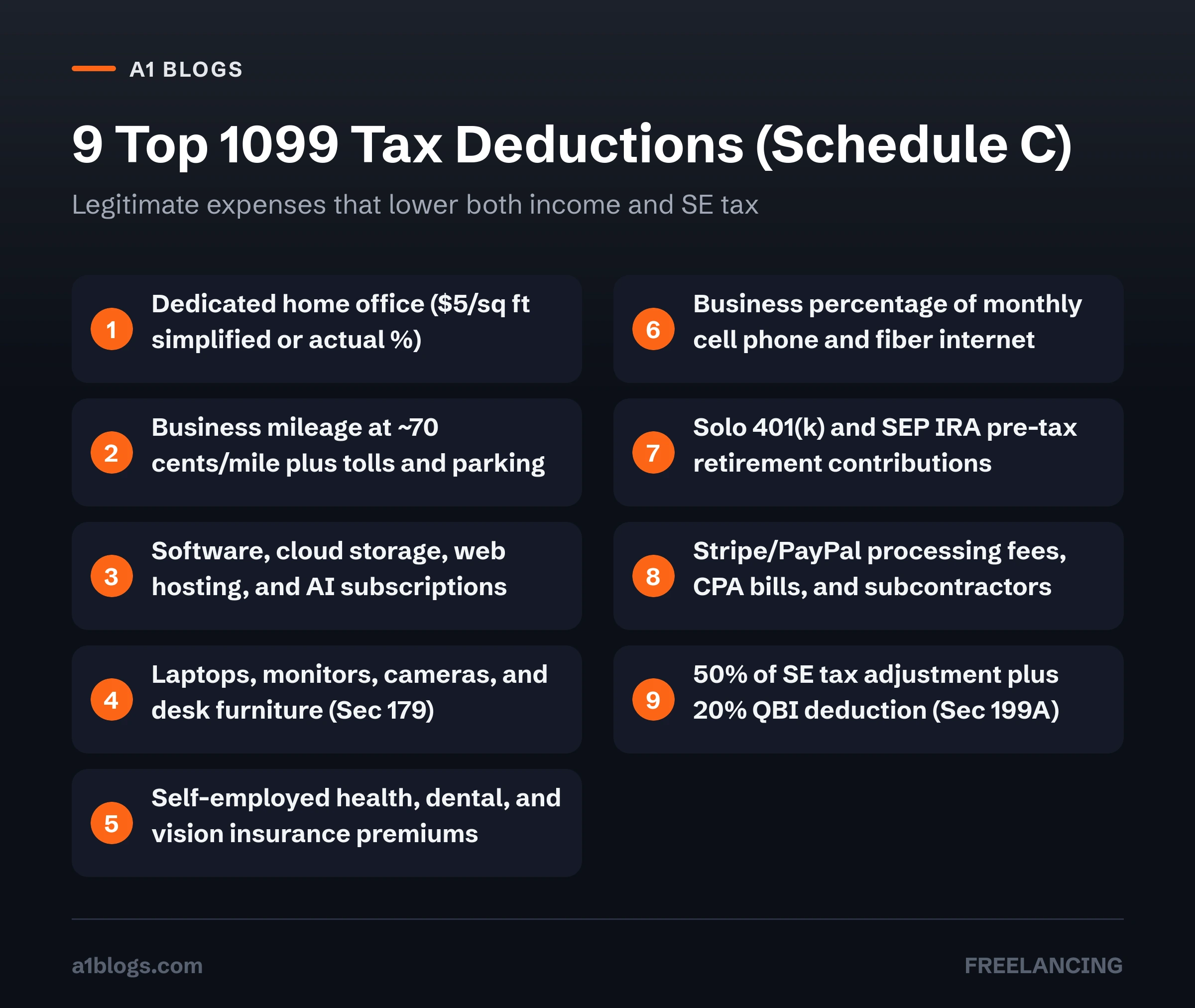
Review these nine core categories against your bank and credit card statements before closing your books for the year.
1. The home office deduction (simplified vs actual expense method)
If you use a dedicated room or clearly defined area of your home regularly and exclusively as your principal place of business, you qualify for the home office write-off. A kitchen table where your family eats dinner at night fails the exclusive-use test, but a spare bedroom or corner desk used solely for client work passes.
You can calculate this deduction two ways:
- Simplified method: Deduct $5 per square foot of your dedicated office space, up to a maximum of 300 square feet ($1,500 maximum deduction), with zero utility receipts required.
- Actual expense method (Form 8829): Measure the exact percentage of your home’s square footage occupied by your office (for example, a 180-square-foot room inside a 1,800-square-foot apartment equals 10%). You then deduct 10% of your full-year rent or mortgage interest, property taxes, renters or homeowners insurance, electric and gas bills, and home maintenance.
2. Business mileage and vehicle expenses (70 cents per mile)
Driving to meet a client, picking up office supplies at Staples, or traveling between project properties counts as deductible business driving. Commuting from your house to a permanent daily co-working desk generally does not count unless you already maintain a qualifying principal home office.
Most solo freelancers get a larger write-off with far less paperwork by choosing the IRS standard mileage rate, which sits around 70 cents per mile (verify the exact annual IRS notice for your filing year). If you drive 6,000 documented business miles in a year, that equals a $4,200 deduction plus parking fees and highway tolls. Keep a contemporaneously dated log showing the date, destination, client purpose, and odometer readings.
3. Software subscriptions, web hosting and AI tools
Every recurring digital tool required to run your business is 100% deductible on Schedule C. That includes cloud accounting software (QuickBooks, FreshBooks, Wave), domain renewals, WordPress hosting, project management suites, and the API or subscription costs you pay for AI workflow automation pipelines.
4. Computers, cameras, office furniture and Section 179 expensing
When you buy a MacBook, dual monitors, an ergonomic chair, a podcast microphone, or a camera lens for work, you do not have to wait five years to depreciate the equipment bit by bit. Under Section 179 expensing or the De Minimis Safe Harbor election (for items costing up to $2,500 per invoice item), you can write off 100% of the business-use portion in the exact tax year you place the gear into service.
5. Self-employed health, dental and vision insurance premiums
If you pay for your own medical, dental, or vision insurance policy and neither you nor your spouse was eligible to participate in an employer-subsidized health plan during that month, you can deduct 100% of your premiums on Schedule 1 of Form 1040. While this is an above-the-line adjustment to income rather than a line item on Schedule C, it directly lowers your Adjusted Gross Income (AGI) dollar for dollar.
6. Cell phone and high-speed home internet bills
Even if you do not qualify for a dedicated home office, you can still deduct the business-use percentage of your monthly cell phone plan and home fiber internet bill under utilities or office expenses. If you use your smartphone 70% of the time for client calls, Slack messages, and two-factor authentication on a $110 monthly bill, that adds $924 per year to your 1099 tax deductions.
7.Solo 401(k) and SEP IRA retirement contributions
Self-employed retirement accounts allow you to shelter far more income from the IRS than a standard $7,000 personal IRA. With a Solo 401(k), you can contribute both as the employee (up to the annual elective deferral limit of $23,500+, or more with catch-up contributions) and as the employer (up to 20% of your adjusted net self-employment income), up to a combined ceiling near $70,000. Every pre-tax dollar contributed cuts your federal income tax bill immediately.
8. Contract labor, legal, CPA and payment processing fees
Do not overlook the invisible friction costs of getting paid:
- Merchant and platform fees: The 2.9% + $0.30 Stripe fee, PayPal commissions, or Upwork and Fiverr service fees taken out of your gross invoices are 100% deductible.
- Professional services: Fees paid to a Certified Public Accountant (CPA) to prepare your Schedule C, an attorney to draft your client master service agreement, or your state LLC annual report fee.
- Subcontractors: Payments made to virtual assistants, video editors, or sub-consultants (remember to collect a Form W-9 before paying any US contractor $600 or more via check, ACH, or cash so you can issue them a 1099-NEC in January).
9. Half of your self-employment tax and the 20% QBI deduction
The IRS gives every sole proprietor two automatic tax breaks on Form 1040 once Schedule C is complete:
- 50% of self-employment tax deduction: You automatically deduct half of your calculated self-employment tax as an adjustment to income on Schedule 1, mirroring the tax break traditional corporations get for paying employer FICA taxes.
- Qualified Business Income (QBI) deduction (Section 199A): Most US freelancers below the upper income phase-out thresholds can deduct an additional 20% of their qualified net business income before calculating federal income tax.
Worked example: how $18,500 in Schedule C write-offs saves $6,100+
See how Schedule C write-offs change the real math for a single US graphic designer or consultant who collects $95,000 in gross 1099 client invoices during the year:
- Without tracking deductions: If the freelancer fails to log expenses, all $95,000 is treated as net profit. Their self-employment tax alone (15.3% on 92.35% of $95,000) equals $13,423, plus roughly $9,200 in federal income tax after the standard deduction and QBI adjustment, for a total federal bill of $22,623.
- With $18,500 in documented Schedule C write-offs: The freelancer logs a 150 sq ft home office ($750), 4,500 business miles ($3,150), a new laptop and monitor ($2,800), software and web hosting ($2,400), 75% of phone and internet ($1,600), Stripe and platform fees ($2,900), a subcontractor editor ($3,900), and CPA fees ($1,000).
- New net profit: $95,000 minus $18,500 equals $76,500.
- New tax bill: Self-employment tax drops from $13,423 down to $10,809 (saving $2,614 immediately). Federal income tax drops by another $3,520, putting $6,134 back into the freelancer’s pocket before even counting state income tax savings.
Quarterly estimated tax deadlines and how to avoid IRS penalties
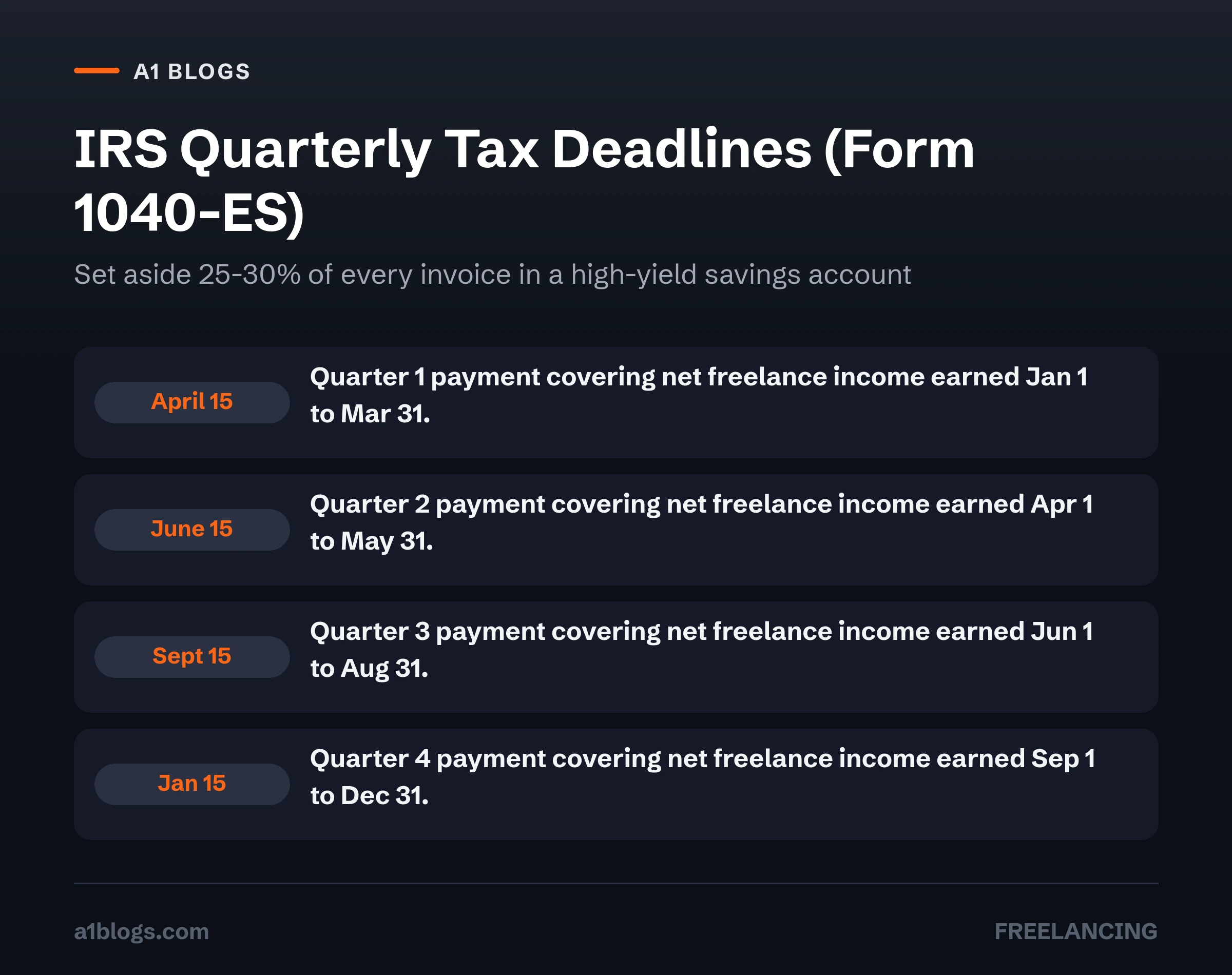
Because the US tax system is pay-as-you-go, the IRS expects anyone who will owe $1,000 or more in federal tax at year-end to make four estimated payments using Form 1040-ES or IRS Direct Pay:
- Quarter 1 (Jan 1 to Mar 31 income): Due April 15
- Quarter 2 (Apr 1 to May 31 income): Due June 15
- Quarter 3 (Jun 1 to Aug 31 income): Due September 15
- Quarter 4 (Sep 1 to Dec 31 income): Due January 15 of the following year
Smart cash management tip: Every time a client pays an invoice, immediately transfer 25% to 30% of that check into a dedicated high-yield savings account. Your tax money earns 4.50%+ APY for three months until the quarterly IRS deadline arrives, so you actually earn interest on your tax reserve before sending it to the Treasury.
Bookkeeping habits that survive an IRS audit
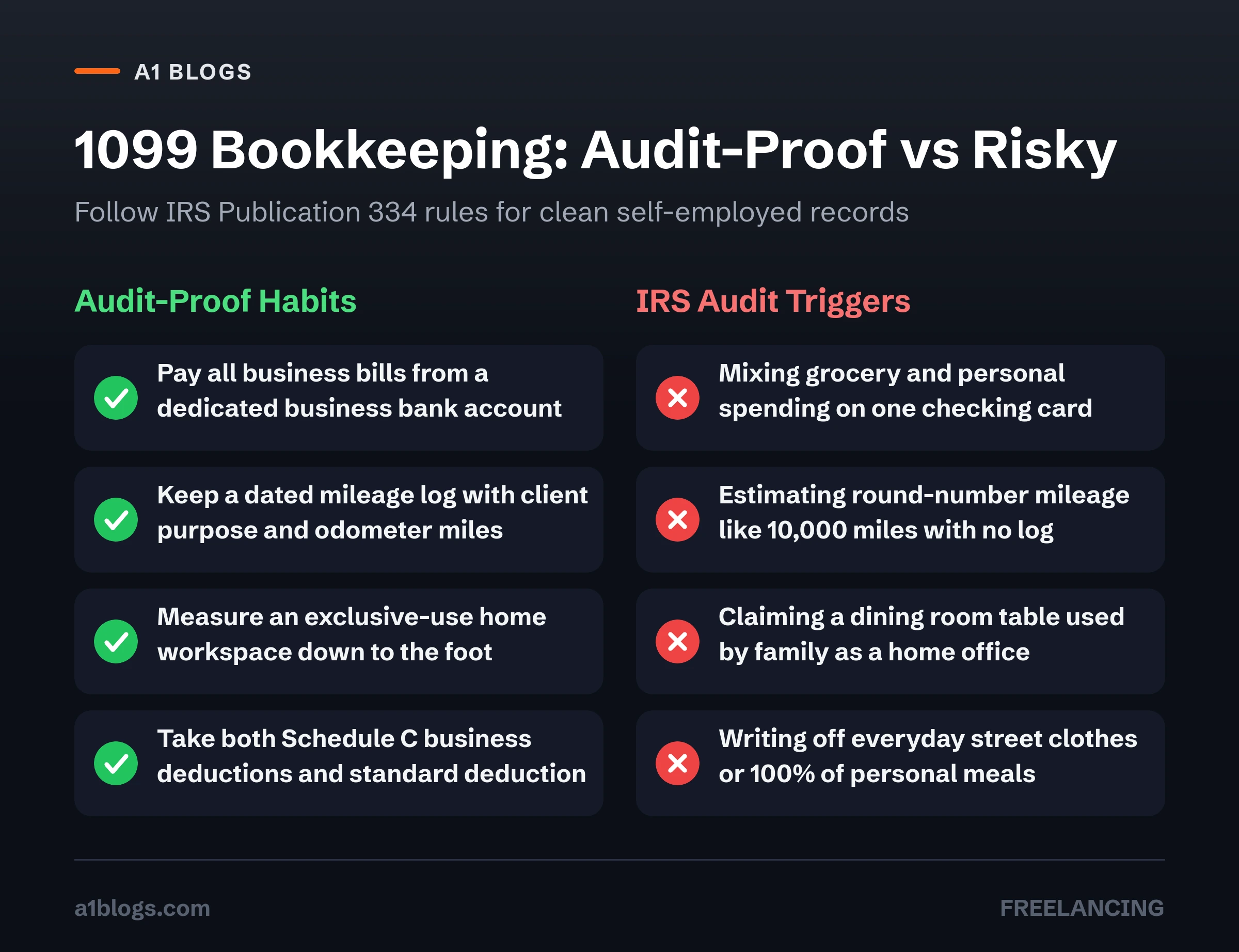
You do not need a shoebox stuffed with faded thermal paper receipts. Follow the rules in IRS Publication 334 (Tax Guide for Small Business) to keep your books clean:
- Open a separate business checking account and credit card: Never buy groceries on your business card or pay software bills from your personal checking account. Clean bank separation is the first thing an examiner checks.
- Snap digital receipts for anything over $75 (and all lodging): Save PDF invoices and receipt photos inside a cloud folder organized by year and month (`2026-04-Receipts`).
- Write the business purpose on meal and travel receipts: Business meals with a client or while traveling away from your tax home are 50% deductible, provided you record who attended and what business topic was discussed.
Frequently asked questions
Can I take both 1099 tax deductions on Schedule C and the standard deduction on Form 1040?
Yes. This is the single most common misconception among new US freelancers. Schedule C write-offs reduce your business gross revenue to arrive at your net business profit. Afterwards, on Form 1040, you still claim your full personal standard deduction ($15,000+ for single filers or $30,000+ for married couples filing jointly) against your personal adjusted gross income.
Do I still have to report 1099 income if a client paid me less than $600 and did not send a 1099-NEC?
Yes. The $600 threshold only governs when a client is legally required to mail out a Form 1099-NEC paper slip. As a self-employed business owner, federal law requires you to report 100% of your business gross receipts on Schedule C, whether or not you received a tax form in the mail.
Can I deduct clothing I bought for client meetings or Zoom calls?
Almost never. The IRS only allows clothing deductions if the attire is a mandatory uniform or safety gear (such as steel-toed boots or medical scrubs) that is not suitable for everyday street wear. A business suit, blazer, or dress shirt worn for a client presentation or video shoot is considered personal attire and is not deductible.
What is the safe harbor rule for avoiding IRS quarterly underpayment penalties?
You will never owe an IRS estimated tax penalty if your four timely quarterly payments (plus any W-2 withholding) equal at least 100% of the total tax shown on your prior year’s federal return (or 110% if your prior-year Adjusted Gross Income exceeded $150,000), or at least 90% of your current year’s final tax bill.
Does forming a single-member LLC give me extra 1099 tax deductions?
No. By default, the IRS treats a single-member LLC as a “disregarded entity” taxed identically to a sole proprietorship on Schedule C. Forming an LLC provides state-level legal liability protection between your business debts and personal assets, and it lets you deduct your state LLC filing fees, but all your ordinary 1099 tax deductions remain identical whether you operate as a sole proprietor or a single-member LLC.
When does it make sense for a 1099 freelancer to elect S-Corporation tax status?
Once your consistent net profit after expenses exceeds roughly $80,000 to $100,000 per year, ask a CPA to run an S-Corp election analysis (IRS Form 2553). An S-Corp lets you pay yourself a reasonable W-2 salary (subject to the 15.3% payroll tax) and take the remaining profit as a shareholder distribution that is exempt from the 15.3% self-employment tax, though you must weigh that savings against extra payroll software and corporate tax return costs.