Leaving your cash buffer inside a standard brick-and-mortar checking or savings account quietly drains your purchasing power every single month. While the national average savings rate at major branch banks sits near 0.01% to 0.40%, a high-yield savings account at an FDIC-insured online bank pays between 4.00% and 5.00% Annual Percentage Yield (APY). On a $15,000 emergency fund, that gap equals roughly $675 to $735 in risk-free interest every year without locking your money into a certificate of deposit or exposing it to stock market drops.
Thank you for reading this post, don't forget to subscribe!This guide breaks down the exact numbers behind a high-yield savings account, how daily compounding works, what to check on the Federal Deposit Insurance Corporation registry before transferring a dollar, and how to size and automate your US emergency fund step by step.
Table of Contents
High-yield savings account basics at a glance
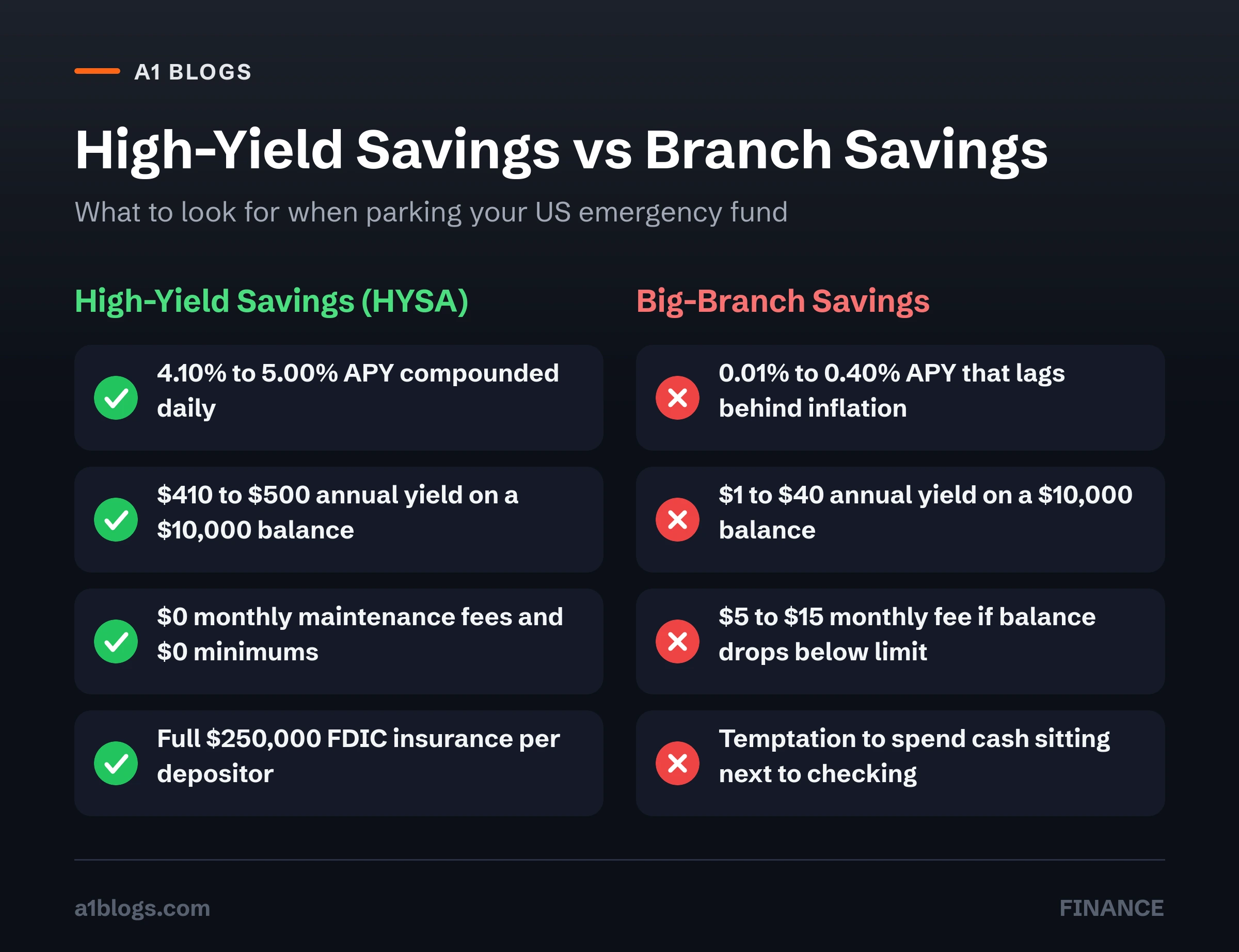
A high-yield savings account (often shortened to HYSA) is a federally insured bank account that pays an interest rate 10 to 12 times higher than a traditional branch savings account. Online banks and digital divisions of established national banks can afford to pay higher yields because they do not maintain thousands of expensive physical street branches or teller networks.
| Feature | Traditional Bank Savings | High-Yield Savings Account (HYSA) |
|---|---|---|
| Typical APY Range | 0.01% to 0.40% APY | 4.10% to 5.00% APY |
| Annual Interest on $10,000 | $1 to $40 per year | $410 to $500 per year |
| Federal Protection | Up to $250,000 via FDIC insurance | Up to $250,000 via FDIC insurance |
| Monthly Maintenance Fees | $5 to $15 unless minimum kept | $0 at top online banks |
| ACH Transfer Speed to Checking | Instant if at the same bank | 1 to 2 business days (or same-day RTP) |
How a high-yield deposit account works in the US
When you deposit cash into a high-yield savings account, the bank holds your balance in liquid reserves and lends capital at prevailing short-term interest rates benchmarked to the Federal Reserve federal funds rate. Because online institutions run lean overhead, they pass the majority of that interest spread directly back to depositors.
Interest in a high-yield deposit account typically compounds daily and credits to your balance once a month. Daily compounding means the bank divides the stated annual interest rate by 365 and applies that fraction to your end-of-day balance every single night. On the last day of the statement cycle, all accrued daily pennies are deposited into your principal, so next month you earn interest on both your original cash and last month’s payout.
APY vs simple interest rate explained
Banks advertise two slightly different percentages on their rate sheets: the nominal interest rate and the APY (Annual Percentage Yield). The nominal interest rate only reflects the base rate before compounding. APY includes the effect of daily or monthly compounding over a full 365-day year.
Whenever you compare one high-yield online account against another, always compare the APY column. Federal Truth in Savings regulations require every US bank and credit union to calculate APY using the exact same mathematical formula, making it an apples-to-apples number.
A worked example: $10,000 emergency fund over 3 years
Suppose you move a $10,000 emergency fund out of a big-box bank paying 0.01% APY and place it into a high-yield savings account paying 4.60% APY, without adding another dime:
- At the 0.01% branch bank: Your $10,000 earns $1.00 in Year 1, $1.00 in Year 2, and $1.00 in Year 3. After three full years, your balance is $10,003.00.
- At the 4.60% HYSA: Your $10,000 grows to $10,460.00 after Year 1, $10,941.16 after Year 2, and $11,444.45 after Year 3.
- Net difference: You pocket $1,441.45 in extra cash simply by spending 10 minutes opening an online account.
If you also contribute $300 a month toward your reserve, that three-year balance reaches $23,042, with more than $2,240 coming purely from compound interest.
How much to keep in a US emergency fund
Financial planners generally recommend keeping three to six months of essential living expenses inside your emergency fund. Notice the word essential. You do not need to save six months of restaurant dining, concert tickets, or vacation budgets. You only need to cover the bills required to keep a roof overhead, utilities running, food on the table, and insurance active if you lose your income or face an unexpected medical bill.
Calculating your monthly core survival number
Open your last two bank and credit card statements and add up these six baseline categories:
- Housing: Rent or mortgage principal, property tax, and homeowners insurance.
- Utilities: Electric, natural gas, water, trash, and home internet (you can trim usage with our DIY home energy audit checklist).
- Groceries and household supplies: Supermarket food, pharmacy prescriptions, and baby or pet necessities.
- Transportation: Car payment, auto insurance, gas, or public transit passes.
- Minimum debt payments: Student loans, personal loans, and credit card minimums.
- Health insurance premiums: What you would pay out of pocket or via COBRA if between jobs.
When 3 months is enough vs when you need 6 to 9 months
Your target multiplier depends on how predictable your household paycheck is:
- 3 months of expenses: Dual-income households where both partners have stable W-2 salaries in different industries, no dependents, and low fixed housing costs.
- 6 months of expenses: Single-income families, homeowners responsible for roof or HVAC repairs, or workers in cyclical industries like tech, media, or construction.
- 9 to 12 months of expenses: Full-time freelancers, commission sales reps, and small business owners whose monthly revenue swings widely (see our 1099 tax deductions guide for managing variable contractor cash flow).
7 rules for choosing the best high-yield deposit account
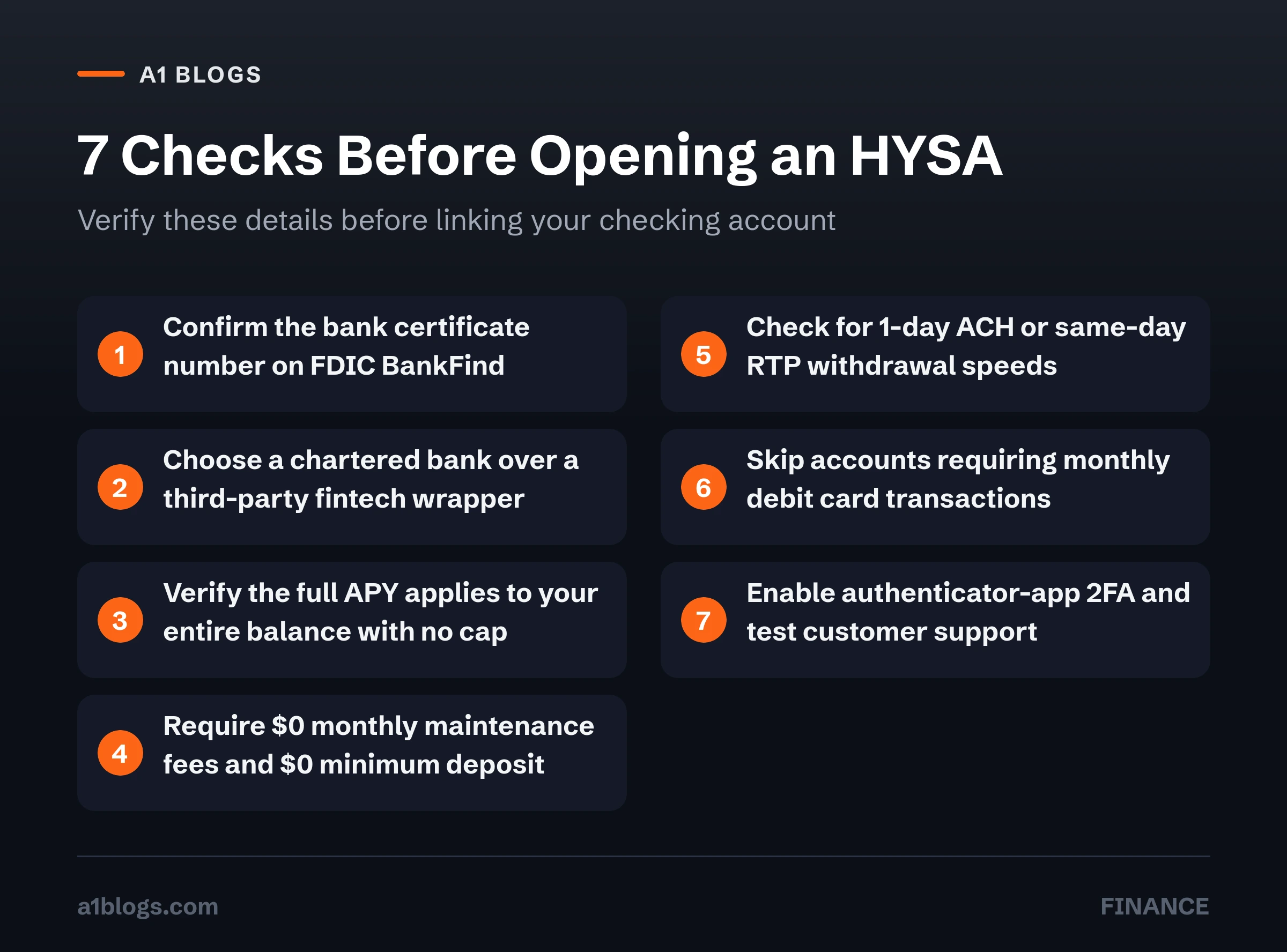
Not every advertised rate deserves your deposit. Use these seven checks before linking your primary checking account to a new high-yield online account.
1. Verify direct FDIC or NCUA insurance
Never rely solely on a sleek website banner. Confirm that the institution holds an active certificate on the official FDIC BankFind Suite or, for credit unions, the National Credit Union Administration (NCUA) registry. Standard FDIC insurance covers up to $250,000 per depositor, per insured bank, for each account ownership category. If you open a joint high-yield savings account with your spouse, your combined coverage at that single bank doubles to $500,000.
2. Understand fintech sweep networks vs chartered banks
Many popular financial apps are not banks themselves; they are technology companies that partner with one or more underlying chartered banks. While partner banks provide FDIC insurance once funds arrive in their custody, a fintech middleman adds an extra ledger layer. Whenever possible, open your high-yield online account directly with an FDIC-certificated bank so you hold a direct legal claim on your deposit.
3. Watch out for balance tiers and promotional teaser rates
Some banks advertise a headline 5.15% APY in bold letters, but bury in the fine print that the rate only applies to balances under $5,000, or drops to 1.50% after 90 days. Look for a high-yield deposit account that pays its full stated APY across your entire balance, from the first dollar up to $250,000, with no cap or expiration date.
4. Demand zero monthly fees and no minimum balance
A genuine high-yield online account should never charge a $10 monthly maintenance fee or penalize you if an emergency forces you to drain your balance down to $50. Stick to institutions with a $0 minimum opening deposit and $0 monthly service charges.
5. Check ACH transfer speed and daily withdrawal limits
When your transmission fails or a pipe bursts on a Friday afternoon, you need your cash quickly. Test how fast the bank moves money via Automated Clearing House (ACH) transfers to your primary checking account. Top online banks process standard transfers in one business day or participate in the FedNow and Real-Time Payments (RTP) networks for same-day delivery, with daily withdrawal limits of at least $10,000 to $50,000.
5. Avoid hoop-jumping requirements
Skip accounts that force you to make 15 debit card purchases a month or maintain a $5,000 direct deposit just to unlock the advertised APY. Your emergency fund should earn top interest passively while sitting untouched.
7. Review customer service hours and fraud controls
Before transferring five figures, call the bank’s support line and test its mobile app. Make sure the account supports hardware security keys or authenticator-app two-factor authentication (not just SMS text codes) and offers phone support seven days a week. You should also protect your broader financial profile by learning how to freeze your credit at all three US bureaus.
Step-by-step: how to build and automate your emergency fund
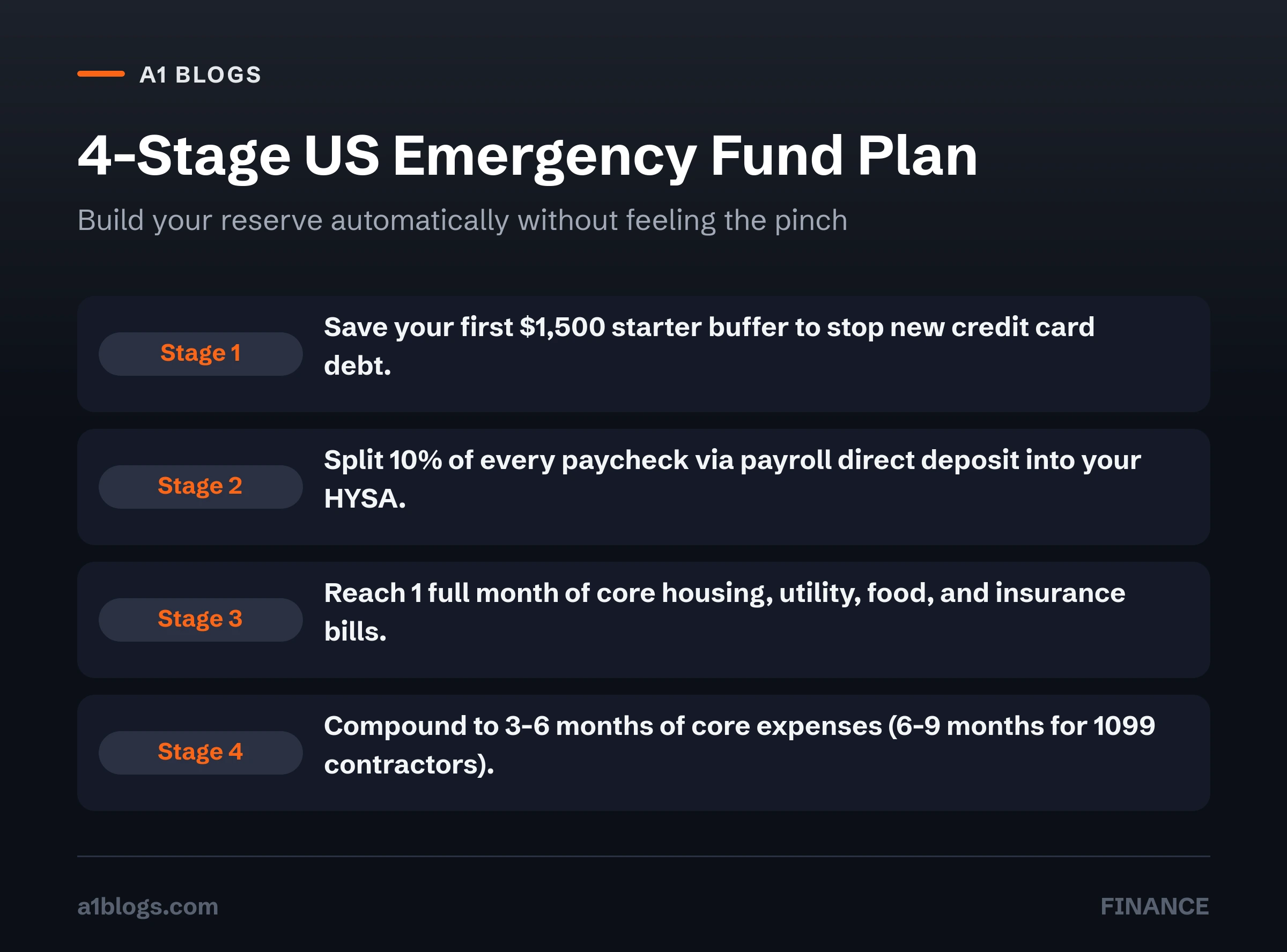
Waiting until the end of the month to save whatever is left over in checking almost never works. Instead, build your emergency fund in four sequential stages:
- Stage 1: The $1,500 starter buffer. Open your high-yield deposit account today with whatever you can spare, even $100, and push to $1,500 first. That initial cushion stops a flat tire or urgent dental crown from going onto a 22% APR credit card.
- Stage 2: Direct-deposit paycheck splitting. Ask your employer’s payroll portal (such as ADP, Gusto, or Workday) to route a fixed dollar amount or 10% of every paycheck straight into your high-yield online account routing and account number before the rest hits checking.
- Stage 3: One-month core expense milestone. Keep automating until your balance equals one full month of your survival budget. At this point, you are ahead of more than half of US households.
- Stage 4: Full 3-to-6-month runway. Let automated transfers and monthly APY compounding carry you to your full target. Whenever you receive a tax refund, year-end bonus, or cash rebate, route 50% of the windfall straight into the account. Readers who manage cross-border family budgets or religious wealth obligations can also review our zakat calculation guide and income tax slabs 2026-27 for annual cash calculation rules.
High-yield savings account vs CDs, money market accounts and T-bills
Once your emergency fund crosses $10,000, you might wonder whether other low-risk options beat a high-yield savings account:
- Money Market Accounts (MMAs): Offered by banks with the same FDIC insurance as a high-yield online account, plus a debit card or paper checkbook. Useful if you want to pay an emergency plumber directly from the savings balance without waiting a day for an ACH transfer.
- No-Penalty Certificates of Deposit (CDs): Lock in a fixed APY for 7 to 14 months while allowing you to withdraw your full principal and interest without early withdrawal fees after the first week.
- US Treasury Bills (4-week to 13-week T-Bills): Backed by the US government via TreasuryDirect or a brokerage account. T-bill interest is exempt from state and local income taxes, which can give residents in high-tax states like California or New York a slightly higher after-tax return, though you should always keep at least one to two months of instant cash inside a liquid high-yield deposit account.
How high-yield savings account interest is taxed in the US
Interest earned inside a high-yield online account is treated as ordinary taxable income by the Internal Revenue Service (IRS) in the calendar year it is credited to your account, even if you never withdraw the cash. The Consumer Financial Protection Bureau and IRS rules require any bank that pays you $10 or more in interest during the year to issue Form 1099-INT by January 31 of the following year.
Do not let taxes scare you away from earning a higher APY. You only pay your marginal federal and state tax rate on the extra profit. If you earn $600 in interest inside your high-yield deposit account and sit in the 22% federal tax bracket, you owe $132 in federal tax and still come out $468 ahead compared to earning zero at a branch bank.
Frequently asked questions
Can I lose money in a high-yield savings account?
No, provided your deposit is held at an institution covered by FDIC insurance (or NCUA insurance for credit unions) and your total balance at that bank stays within the $250,000 per-depositor, per-ownership-category limit. Your principal cannot drop in value even if the stock market crashes.
Why do high-yield deposit account APY rates change?
A high-yield online account pays a variable interest rate, not a fixed contract rate. When the Federal Reserve raises or lowers the federal funds target rate to manage inflation, online banks adjust their APY up or down within a few weeks.
Does opening a high-yield savings account hurt my credit score?
No. Almost all banks run a soft credit pull or verify your identity through ChexSystems when you apply for a deposit account. Because you are not applying to borrow money, opening a high-yield deposit account has zero impact on your FICO credit score.
How many withdrawals can I make from a high-yield savings account per month?
The Federal Reserve permanently lifted the old Regulation D federal mandate that capped savings withdrawals at six per month. However, some individual banks still enforce their own six-transfer monthly limit or charge a small excess transaction fee, so check your bank’s fee schedule before using the account like a daily checking hub.
Should I keep my high-yield deposit account at a different bank from my checking account?
Keeping your emergency fund at a separate online bank is one of the smartest behavioral tricks you can use. Because the balance does not sit right next to your checking balance when you log in to pay everyday bills, you are far less tempted to dip into your reserve for impulse purchases, while your money remains just one business day away via ACH transfer.
Is a 5% APY high-yield savings account safe?
Yes, as long as you verify the bank’s certificate number on the official FDIC registry and confirm there are no hidden balance caps or promotional bait-and-switch clauses. Online banks pay 4% to 5% APY because they save hundreds of millions of dollars on physical real estate, not because they take unsafe gambles with insured deposits.