Saving your down payment is only half the cash hurdle of buying a house in the United States. Every year, thousands of buyers celebrate having a 3% or 5% down payment sitting in the bank, only to get blindsided three days before signing when the title company asks for another $9,000 to $19,000 in wire-transfer funds. Those extra charges are first-time homebuyer closing costs, and they typically add 2% to 5% of the total loan amount on top of your down payment.
Thank you for reading this post, don't forget to subscribe!This guide breaks down all eight categories of first-time homebuyer closing costs, shows you how to read Page 2 of the standardized federal Loan Estimate form, compares upfront fees on an FHA vs conventional loan, and walks through four legal ways to cut your cash-to-close by $4,000 or more.
Table of Contents
First-time homebuyer closing costs at a glance
In a US residential real estate purchase, closing costs are the combined lender fees, third-party inspections, title insurance policies, government recording taxes, and prepaid property tax and insurance reserves required to originate your mortgage and transfer legal title into your name.
| Home Purchase Price | Typical 2% Low-End Closing Costs | Typical 3.5% Average Closing Costs | Typical 5% High-Tax State Closing Costs |
|---|---|---|---|
| $250,000 Starter Home | $5,000 | $8,750 | $12,500 |
| $380,000 Median US Home | $7,600 | $13,300 | $19,000 |
| $500,000 Metro Home | $10,000 | $17,500 | $25,000 |
Notice the spread between states. Buyers in states with high county transfer taxes and mandatory attorney closings (such as New York, Pennsylvania, Delaware, and Maryland) regularly land near 4% to 5%, while buyers in low-transfer-tax states (such as Missouri, Indiana, or Texas) often settle closer to 2% to 3%. Before wiring a dime to any escrow agent, always verify the deed chain and tax parcel history, just as we outline in our guides to verify property ownership online and property tax in Islamabad.
How to read your 3-page CFPB Loan Estimate
By federal law under the TILA-RESPA Integrated Disclosure (TRID) rule enforced by the Consumer Financial Protection Bureau (CFPB), every mortgage lender must send you a standardized three-page Loan Estimate within three business days of receiving your mortgage application.
Flip straight to Page 2 (“Closing Cost Details”) of your Loan Estimate. The left column lists Loan Costs (Boxes A, B, and C), which cover the lender and third-party settlement services. The right column lists Other Costs (Boxes E, F, G, and H), which cover government recording fees and your own prepaid home insurance and property tax escrow reserves. Comparing Page 2 across three different lenders is the single easiest way to spot padded junk fees.
8 hidden first-time homebuyer closing costs to budget for
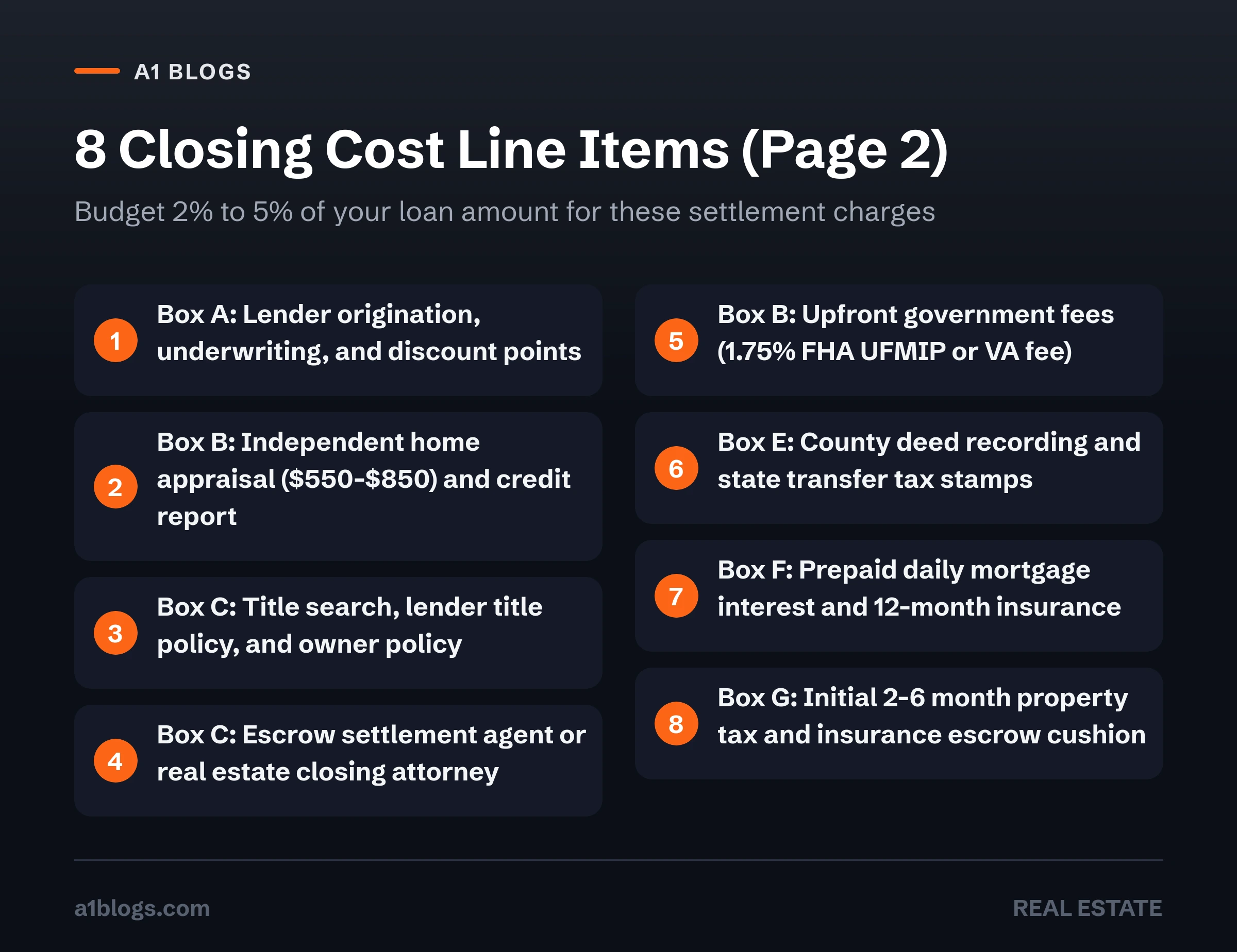
Do not rely on a rough online mortgage calculator that only shows principal and interest. Budget for these eight specific line items on your Loan Estimate.
1. Lender origination, underwriting and processing fees (Box A)
Mortgage lenders typically charge 0.5% to 1.0% of the loan amount (roughly $1,800 to $3,800 on a $380,000 mortgage) to verify your W-2s or tax returns, underwrite your file, and fund the loan. Some lenders split this into “application fee,” “processing fee,” and “underwriting fee,” while others bundle it into one flat origination line. Box A also includes optional discount points, where 1 point equals 1% of the loan amount paid upfront to permanently lower your mortgage interest rate by roughly 0.25%.
2. Independent home appraisal and credit report fees (Box B)
Before wiring $350,000+ to the seller, the lender hires a state-licensed independent appraiser to inspect the house and confirm its market value matches your contract price. A standard single-family home appraisal costs $550 to $850, and you usually pay for it by card during the first week of escrow. Lenders also pass through a $50 to $120 tri-merge credit report fee (if you placed a security freeze on your credit files, read our guide on how to freeze your credit so you remember to lift it for 48 hours before applying).
3. Title search, lender’s title insurance and owner’s title policy (Box C)
A title company or real estate closing attorney searches county land records to make sure no previous owner left behind unpaid contractor mechanic’s liens, IRS tax liens, or boundary disputes. You will see two separate title insurance premiums:
- Lender’s title insurance (mandatory): Protects the mortgage company for the loan amount. Usually costs $600 to $1,400.
- Owner’s title insurance (optional inBox H, but vital): Protects your equity and legal ownership for as long as you or your heirs own the home. It is a one-time payment at closing (typically $800 to $2,000), and in many US counties you can negotiate for the seller to pay for the owner’s policy in the purchase contract.
4. Escrow settlement or closing attorney fee (Box C)
The neutral third party that holds your earnest money deposit, coordinates the payoff of the seller’s old mortgage, collects signatures on closing day, and records the new deed charges a settlement or closing fee of $500 to $1,500.
5. Upfront FHA, VA or USDA government mortgage fees (Box B)
Your loan type changes your upfront closing math dramatically when comparing an FHA vs conventional loan:
- FHA loans: Backed by the U.S. Department of Housing and Urban Development (HUD), FHA loans allow a 3.5% down payment with a 580+ credit score, but they charge an Upfront Mortgage Insurance Premium (UFMIP) of 1.75% of the base loan amount ($6,417 on a $366,700 loan). Most buyers roll this 1.75% fee into the loan balance rather than paying it in cash at the table, though doing so increases your monthly payment.
- VA loans: Eligible veterans and active-duty service members put 0% down and pay zero monthly mortgage insurance, but most first-time VA buyers without a service-connected disability exemption owe a one-time VA Funding Fee of 2.15% (with 0% down).
- Conventional loans: Require 0% upfront mortgage insurance fee at closing if you pay monthly Private Mortgage Insurance (PMI).
6. County recording fees and state real estate transfer taxes (Box E)
Your county clerk or recorder of deeds charges $80 to $250 to officially record the new deed and mortgage in public land records. In addition, roughly 35 states and several major cities levy a real estate transfer tax or mortgage stamp tax ranging from 0.1% up to 2.0%+ of the sale price. Always ask your agent how local custom splits transfer taxes between buyer and seller in your county.
7. Prepaid daily interest and 12 months of homeowners insurance (Box F)
Unlike rent, which you pay on the 1st of the month for the month ahead, mortgage interest is paid in arrears. At closing, you prepay per-diem mortgage interest for the exact number of days remaining between your closing date and the end of that calendar month. Lenders also require you to pay your entire first year of homeowners insurance ($1,400 to $3,200+) upfront before they release loan funds.
8. Initial property tax and insurance escrow cushion (Box G)
If your lender collects property taxes and homeowners insurance inside your monthly mortgage payment, they establish an escrow impounds account at closing. Federal RESPA rules allow the lender to collect 2 to 6 months of property taxes plus 2 to 3 months of homeowners insurance upfront so the escrow bucket has enough cash on hand when the county tax collector sends the next semi-annual bill.
Worked example: cash-to-close on a $380,000 US home
Here is how the exact numbers add up for a buyer purchasing a $380,000 single-family home with a 5% conventional down payment ($19,000) and a $361,000 loan amount:
- Box A (Lender Origination & Underwriting): $1,495
- Box B (Appraisal, Credit Report, Flood Cert, Tax Service): $785
- Box C (Title Search, Lender Title Policy & Escrow Settlement Fee): $2,350
- Box E (County Deed Recording & Local Transfer Stamps): $920
- Box F (15 Days Prepaid Interest at 6.25% + 12-Month Home Insurance): $2,825
- Box G (3 Months Property Tax Cushion + 2 Months Insurance Reserve): $1,940
- Box H (Optional Owner’s Title Insurance + Home Inspection paid earlier): $1,185
- Total First-Time Homebuyer Closing Costs: $11,500 (3.02% of purchase price)
- Total Cash Needed at Closing (Down Payment + Closing Costs): $30,500 (minus whatever earnest money deposit you already wired when the contract was signed).
Keep your down payment and closing cost cash parked inside an FDIC-insured high-yield savings account while house hunting so your $30,500 earns 4.50%+ APY right up until wire week.
FHA vs conventional loan: which has lower closing costs?
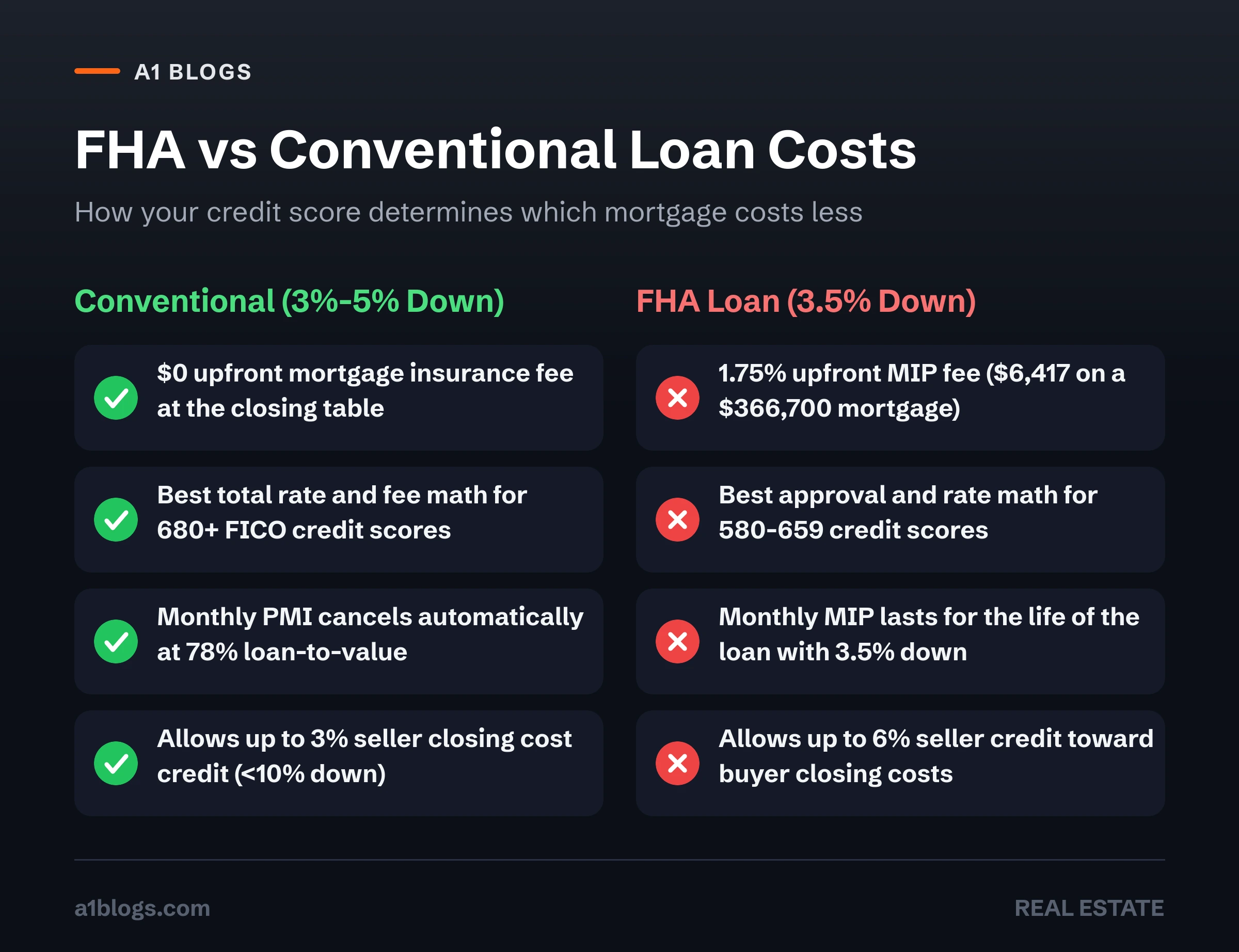
When comparing an FHA vs conventional loan, look at both the Day 1 cash table and the 5-year total cost:
- Choose a Conventional 3% Down Loan (HomeReady or Home Possible) if your FICO score is 680 or higher. You avoid FHA’s 1.75% upfront mortgage insurance fee ($6,300+ saved on a $365k loan), and your monthly Private Mortgage Insurance automatically cancels once your loan balance reaches 78% of the original home value.
- Choose an FHA 3.5% Down Loan if your credit score sits between 580 and 659 or your debt-to-income ratio is higher. FHA interest rates and monthly insurance rates are far more forgiving for sub-660 credit scores than conventional pricing adjustments, even after factoring in the 1.75% upfront MIP rolled into the loan.
4 proven ways to reduce your first-time homebuyer closing costs
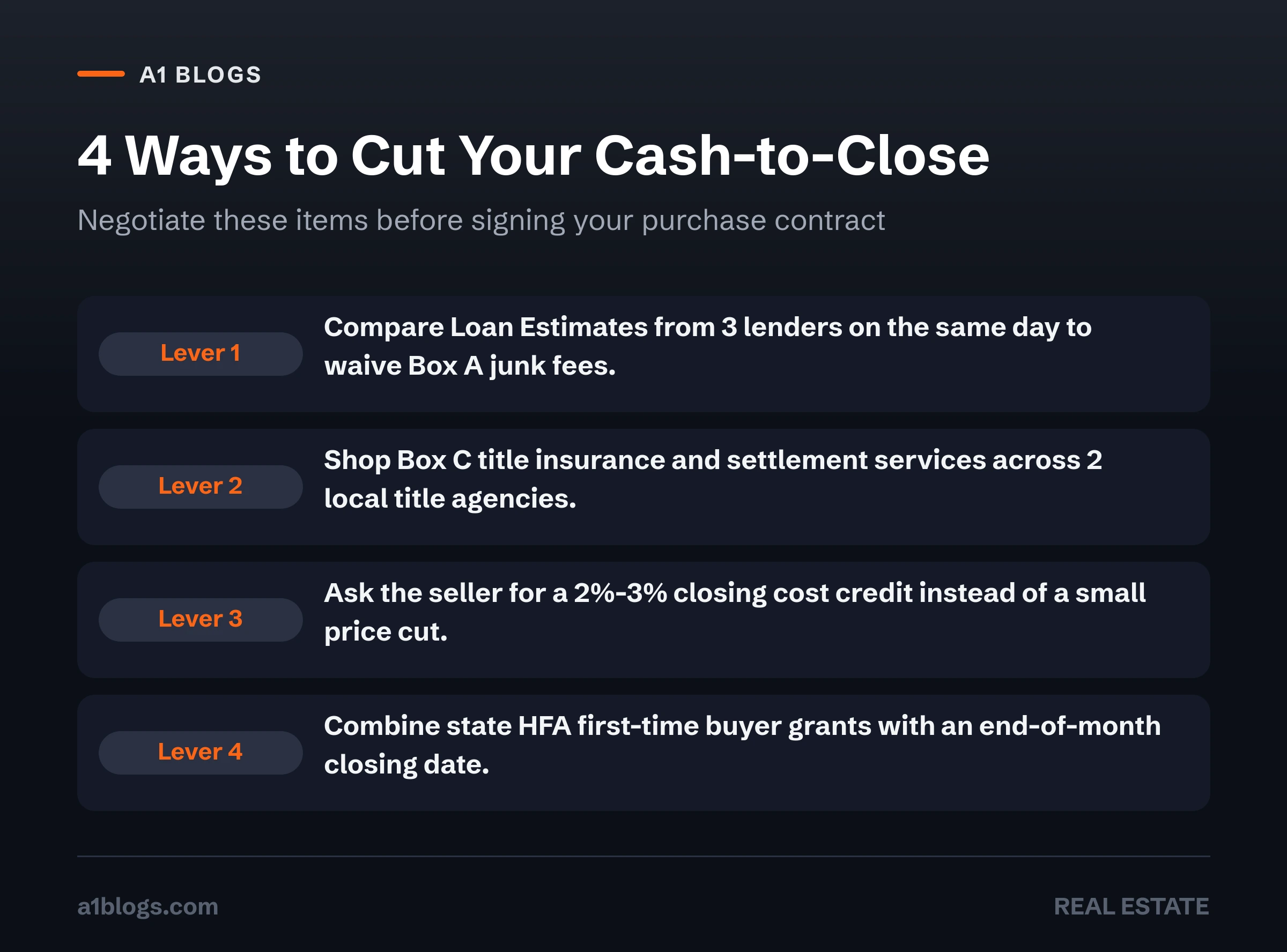
You do not have to pay every dollar on Page 2 out of your own savings. Use these four levers to shrink your cash-to-close:
- Shop the “Services You Can Shop For” in Box C: Title insurance and settlement fees vary by up to $1,200 between title companies in the same zip code. Call two independent title agencies and ask for their reissue rate or first-time buyer fee sheet.
- Negotiate a Seller Concession (Seller Credit) Instead of a Price Drop: Asking a seller to knock $10,000 off a $380,000 house only reduces your 5% down payment by $500 and trims your monthly payment by ~$62. Asking that same seller to keep the price at $380,000 and give you a $10,000 seller closing cost credit cuts the cash you have to wire on closing day by a full $10,000. Conventional loans allow up to 3% in seller concessions ($11,400 on a $380k home) with less than 10% down, and FHA loans allow up to 6%.
- Compare Lender Credits vs Par Rate: You can take a slightly higher mortgage interest rate (for example, 6.50% instead of 6.25%) in exchange for a $3,500 lender credit that offsets Box A, B, and C fees. This works well if you plan to refinance within two to three years.
- Stack State Housing Finance Agency (HFA) Grants: Almost every US state runs a first-time buyer program offering $5,000 to $15,000 in down payment and closing cost assistance grants or 0%-interest forgivable second loans.
Wire fraud warning: protect your closing funds on signing week
Real estate wire fraud is one of the fastest-growing cybercrimes in the United States. Hackers compromise the email inbox of a real estate agent or title processor, watch for your closing date, and send you a fake PDF with “updated wire instructions” 24 hours before closing.
Follow one unbreakable rule: Never trust wire routing numbers sent by email. Call your title company or closing attorney using a phone number you independently looked up on their official website (never the number inside the email signature) and verbally verify the bank name, routing number, and account number before initiating your wire. Once you move in, run our DIY home energy audit checklist to cut your first year of utility bills by 25%.
Frequently asked questions
Can I roll first-time homebuyer closing costs into my mortgage loan?
On a purchase mortgage, you generally cannot borrow more than the home’s appraised value to cover ordinary Box A, B, C, or G closing costs directly (the main exception is rolling the 1.75% FHA upfront MIP or VA funding fee into the loan). However, you can achieve the exact same result by negotiating a seller closing cost credit or accepting a lender credit in exchange for a slightly higher interest rate.
Does my earnest money deposit count toward closing costs?
Yes. The 1% to 2% earnest money deposit you wire to escrow within three days of signing the purchase agreement is held in trust and credited directly against your total cash-to-close on your final Closing Disclosure.
How Does closing on the 28th of the month reduce my upfront cash?
Closing near the end of the calendar month (for example, on the 27th or 28th instead of the 3rd) cuts your Box F prepaid daily interest from 28 days down to just 3 or 4 days, reducing the cash you need at the closing table by $1,200 to $2,000, though your first regular monthly mortgage payment will arrive sooner.
What is the 3-day Closing Disclosure rule?
Federal TRID rules require your lender to deliver your final Closing Disclosure (CD) at least three business days before you sign loan documents. Place your final Closing Disclosure side by side with your original Loan Estimate: Box A lender fees are legally barred from increasing by even $1 unless a valid changed circumstance occurred (such as switching loan programs or changing your rate lock).
Who pays the real estate agent commissions in 2026?
Following the nationwide NAR settlement rules, buyer agent compensation is negotiated separately in a written buyer representation agreement before you tour homes. However, buyers can still include a term in their purchase offer requesting that the seller pay the buyer’s agent commission out of the sale proceeds so the buyer does not have to bring extra cash to closing.
Are mortgage closing costs tax-deductible on my federal tax return?
Most title, appraisal, and origination fees are not deductible in the year you buy (instead, certain title and transfer fees are added to your home’s cost basis to reduce future capital gains). The two closing items you *can* deduct if you itemize on Schedule A are prepaid mortgage interest (Box F) and bona fide discount points paid to lower your interest rate, plus property taxes paid from escrow.