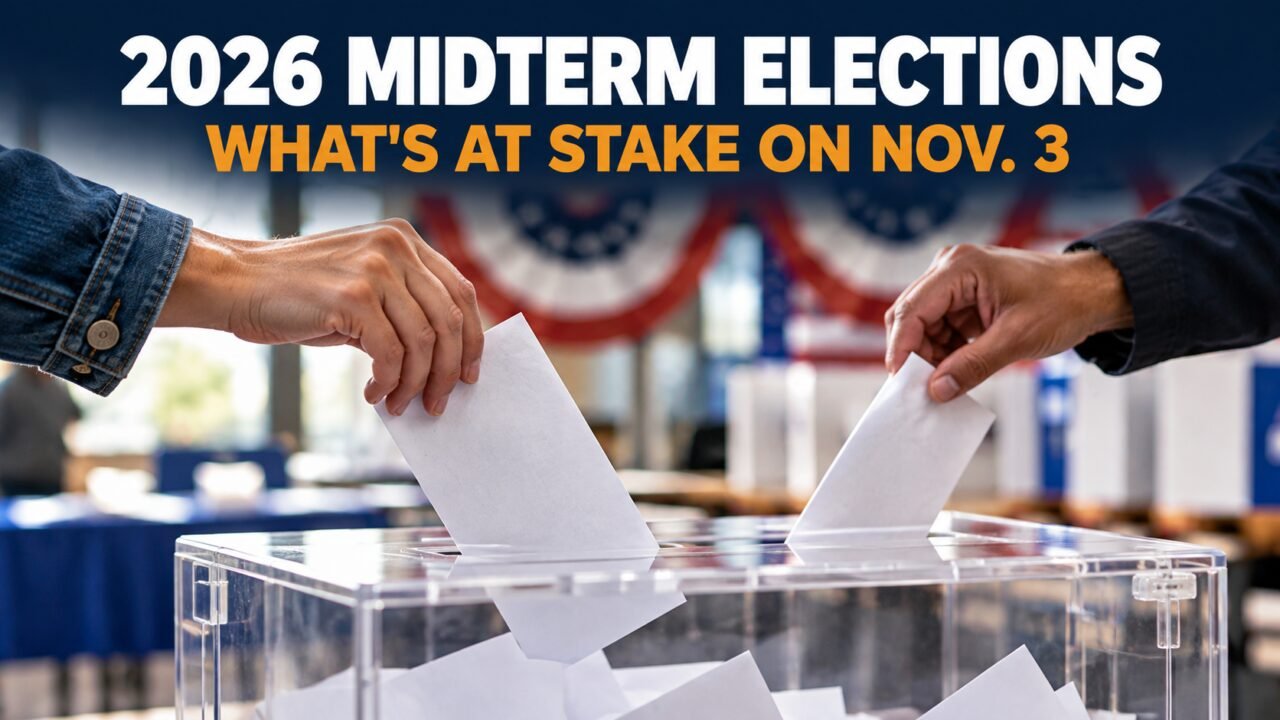
The 2026 midterm elections are on Tuesday, Nov. 3, a little more than five weeks away. Every seat in the House of Representatives is on the ballot, along with 35 Senate seats, 36 governorships and thousands of state and local races. Republicans control both chambers of Congress going in, but their House majority is so narrow that a handful of districts could change who runs it.
Midterms often get less attention than presidential elections, and turnout is usually lower. That makes each vote count for more. This guide explains what is on the ballot, how the fight for Congress looks, why new district maps matter so much this year, and what you need to do to vote.
Table of Contents
When are the 2026 midterm elections?
Election Day is Tuesday, Nov. 3, 2026. Many states let people vote before that date, either in person during an early voting period or by mail, and some have already started sending out ballots.
The results decide who sits in the 120th Congress. Newly elected members of the House and Senate take office on Jan. 3, 2027, according to Ballotpedia, which tracks every race on the ballot. Governors take office on dates set by each state, most of them in January.
The name comes from timing. These elections fall in the middle of a president’s four-year term, so they are often treated as a verdict on how the president and the party in power are doing.
What is on the ballot this year
The biggest prize is Congress. All 435 House seats are up, as they are every two years. In the Senate, 35 seats are being contested. The Bipartisan Policy Center notes that 33 of those are regular elections and two are special elections: one in Ohio for the seat JD Vance left when he became vice president, and one in Florida for the seat Marco Rubio left to become secretary of state.
Thirty-six states are also electing governors. Most states hold legislative elections at the same time, and many ballots include state constitutional amendments, local tax measures, judges, sheriffs, school boards and city councils. For many people, those local races affect daily life more directly than anything decided in Washington.
It is worth looking up a sample ballot for your address before you vote. Most county election offices post them online a few weeks before Election Day.
Fact 1: The House majority is razor thin
Republicans won a narrow House majority in 2024, and deaths, resignations and special elections have kept it close ever since. As of this fall, NBC News reports that Democrats need a net gain of just three seats to take control of the House.
That is a very small number in a chamber of 435. It means a few close races in suburban districts could decide which party chooses the speaker, controls every committee and sets the agenda for the next two years.
It also means both parties are spending heavily in a relatively small number of competitive districts. Ballotpedia counts about 42 House battlegrounds nationwide. If you live in one of them, expect a lot of television ads, mailers and text messages between now and November.
Fact 2: The Senate map looks different
Republicans hold 53 of the 100 Senate seats. Democrats would need a net gain of four seats to take control, because Vice President JD Vance casts the tie-breaking vote in a 50-50 Senate.
The map matters as much as the math. Ballotpedia lists nine Senate seats as battlegrounds. Democrats are defending two seats in states that Donald Trump won in 2024: Georgia, where Sen. Jon Ossoff is running for re-election, and Michigan, where the seat is open. Republicans are defending one seat in a state Kamala Harris won: Maine, held by Sen. Susan Collins.
Several open seats have drawn attention. In North Carolina, former Gov. Roy Cooper is running as a Democrat for a seat left open by a retiring Republican. In Iowa, Republican Sen. Joni Ernst is not running again, and Rep. Ashley Hinson is the Republican candidate. The two special elections add more uncertainty: in Ohio, appointed Republican Sen. Jon Husted faces former Democratic Sen. Sherrod Brown, and in Florida, appointed Republican Sen. Ashley Moody is on the ballot to finish Rubio’s term.
Fact 3: New district maps in several states
House districts are normally redrawn once a decade, after the census. This year has been different. Britannica describes how President Trump urged Texas lawmakers in 2025 to redraw the state’s map to help Republicans win up to five more seats. Other states responded, most notably California, where voters approved a plan to redraw districts in a way likely to help Democrats.
The result is a patchwork of new maps. Ballotpedia reports that California, Missouri, North Carolina and Texas voluntarily redrew their congressional districts in the middle of the decade, while Ohio is using a new map because of state law and Utah because of a court case. Virginia lawmakers also passed a new map, but the state Supreme Court ruled it unconstitutional. A U.S. Supreme Court decision this year in Louisiana v. Callais, which struck down part of the Voting Rights Act, led some Southern states to redraw their maps as well.
Supporters of the new maps in each state argue they are responding to what the other party did elsewhere. Critics in both parties say mid-decade redistricting lets politicians choose their voters instead of the other way around. Either way, the maps will shape the House result as much as any campaign.
Fact 4: History usually favors the party out of power
The president’s party has lost House seats in most midterm elections since World War II. In 2010, two years into Barack Obama’s presidency, Republicans gained 63 House seats. In 2018, during Trump’s first term, Democrats gained 41 seats and took control of the House.
There are exceptions. In 1998 and 2002, the president’s party gained House seats, and in 2022 Democrats lost the House by a much smaller margin than many forecasters expected. History is a guide, not a rule.
Analysts offer several explanations for the pattern. Voters who are unhappy with the direction of the country are often more motivated to turn out than voters who are satisfied. The president’s party also tends to hold more marginal seats after a good presidential year, which leaves more of them exposed two years later.
Fact 5: Governors and state races matter more than they look
Thirty-six governors’ races are on the ballot, and several are open seats. In Ohio, for example, Democrat Amy Acton and Republican Vivek Ramaswamy are running to replace term-limited Gov. Mike DeWine.
Governors sign or veto state laws on everything from abortion and guns to taxes and schools. In many states, they also play a role in drawing district maps and running elections. State legislatures, meanwhile, write the rules for voting, set education budgets and, in many states, control redistricting.
If you want to understand why district maps changed so much this year, look at who controls the statehouse where you live.
Fact 6: Most midterm campaigns are about the economy
Every election has its own themes, but the economy almost always sits near the top of voters’ concerns. This year, surveys have repeatedly found the cost of living, including groceries, housing, energy and health care, among the issues voters say matter most.
Other issues vary by state and district: immigration, abortion, crime, foreign policy, tariffs and trade, and the conduct of the Trump administration. Candidates in competitive races tend to focus on local issues and the economy, while candidates in safe seats often run on national themes.
If you are trying to decide how to vote, candidate websites, local newspapers and nonpartisan voter guides from groups such as the League of Women Voters can help you compare where candidates stand.
Fact 7: Results may take days, not hours
On election night, networks will project winners in many races quickly. Close contests can take much longer. States count ballots at different speeds, and states with large numbers of mail ballots, such as California, often take a week or more to finish counting.
A slow count does not mean something is wrong. Election officials verify signatures, process mail ballots that arrive by the deadline and review provisional ballots. Some states allow mail ballots postmarked by Election Day to arrive a few days later.
If control of the House or Senate depends on a handful of close races, the country may not know which party has won for several days. Recounts in very tight races can take longer.
Why turnout in the midterms matters so much
Fewer Americans vote in the midterms than in presidential years. In 2020, about two-thirds of eligible voters cast a ballot. In the 2022 midterms, turnout was closer to 46 percent. Even the 2018 midterms, which had the highest midterm turnout in about a century, only reached roughly half of eligible voters.
Lower turnout changes who decides the result. Older voters, homeowners and people with strong party loyalty vote reliably in midterm elections. Younger voters, renters and people who move often are much less likely to take part. That gap is one reason both parties spend so much of their campaign budgets simply reminding supporters to vote.
It also means small groups of voters can swing close races. In a district where 200,000 people vote in a presidential year, perhaps 150,000 vote in the midterms. A few thousand extra votes in one direction can decide who wins.
How to spot election misinformation
False information spreads fast in the weeks before any election, and the 2026 midterm elections are no exception. The most common tricks are simple: messages claiming that Election Day has moved, that you can vote by text or phone, that polling places have closed, or that a certain group of people will be turned away.
The safest rule is to check anything about how, when or where to vote with your state or county election office directly. Their websites and phone numbers are listed on vote.gov. Election officials do not announce changes through anonymous text messages or social media posts.
Be skeptical of dramatic videos and audio clips, especially ones that surface in the final days before a vote. AI tools can now produce convincing fake recordings of candidates. If a clip seems designed to make you angry or to stop you from voting, look for reporting from established news organizations before you share it.
How to vote in the 2026 midterm elections
The rules depend on where you live, so check with your state or local election office. The federal site vote.gov links to every state’s official registration and voting information.
A quick checklist:
- Confirm that you are registered at your current address. Deadlines vary, and some states allow same-day registration.
- Find out whether your state offers early in-person voting and when it starts.
- If you want to vote by mail, request your ballot as soon as possible and return it well before the deadline.
- Check whether your state requires photo ID at the polls, and what kinds are accepted.
- Look up your polling place, which may have changed since the last election.
- Review a sample ballot so you are not surprised by local races and ballot measures.
If you run into problems at the polls, ask a poll worker for help. If you are told you are not on the voter list, you have the right to cast a provisional ballot in federal elections.
Your rights and help at the polls
Federal law gives voters several protections that are easy to forget until you need them. Polling places for federal elections must be accessible to voters with disabilities, and most have at least one accessible voting machine. Under the Voting Rights Act, a voter who needs help because of a disability or difficulty reading can bring a person of their choice to assist them, as long as that person is not their employer or a union representative.
In many counties, ballots and voting materials are available in languages other than English, and some polling places have bilingual poll workers. Your county election office can tell you what is offered where you live.
There is no federal law requiring employers to give workers time off to vote, but many states do require it, sometimes with pay. If you work long hours on Election Day, check your state’s rules, or plan to vote early or by mail so the midterm elections do not become a choice between your job and your ballot.
If you are in line when the polls close, stay in line. In every state, voters who are waiting at closing time are allowed to vote, and leaving early is the most common way people lose their chance to take part in the midterms.
Key dates before the midterm elections
The exact calendar depends on your state, but these are the dates most voters need to know:
- Early October: registration deadlines begin to close in many states, often about 30 days before Election Day.
- October: early in-person voting opens in most states, and mail ballots go out.
- Late October: the last day to request a mail ballot in many states.
- Tuesday, Nov. 3: Election Day. Polls close at different times depending on the state.
- November and December: states count and certify results. Close races may go to recounts.
- Jan. 3, 2027: the new Congress is sworn in.
If you will be away on Election Day, look up your state’s rules for absentee or early voting now rather than in the last week, when deadlines may have passed.
What changes if control of Congress flips
If Democrats win the House, they would choose the speaker and chair every committee. That would give them the power to hold hearings, issue subpoenas and investigate the administration, and it would make it much harder for President Trump to pass major legislation without Democratic support.
If Democrats win the Senate, they would control which of the president’s nominees, including federal judges and Cabinet officials, get a vote. That is often the most lasting effect of Senate control, because federal judges serve for life.
If Republicans keep both chambers, the president would have two more years with a friendly Congress, although a narrow House majority would still make it hard to pass bills when Republicans disagree among themselves. Split control, with each party winning one chamber, would likely mean more gridlock and more negotiation.
2026 midterm elections: common questions
When is Election Day 2026?
Tuesday, Nov. 3, 2026.
How many seats are up in the 2026 midterm elections?
All 435 House seats, 35 Senate seats including two special elections, and 36 governorships, plus many state and local offices.
How many seats do Democrats need to win the House?
According to NBC News, Democrats need a net gain of three seats to win a House majority.
How many seats do Democrats need to win the Senate?
A net gain of four seats. Republicans hold 53 seats, and the vice president breaks 50-50 ties.
When do new members of Congress take office?
On Jan. 3, 2027.
Where can I check my voter registration?
The official site vote.gov links to every state’s registration and voting information.
Whatever your views, check your registration this week and make a plan for when and how you will vote. For more political coverage, see our politics section and latest stories.