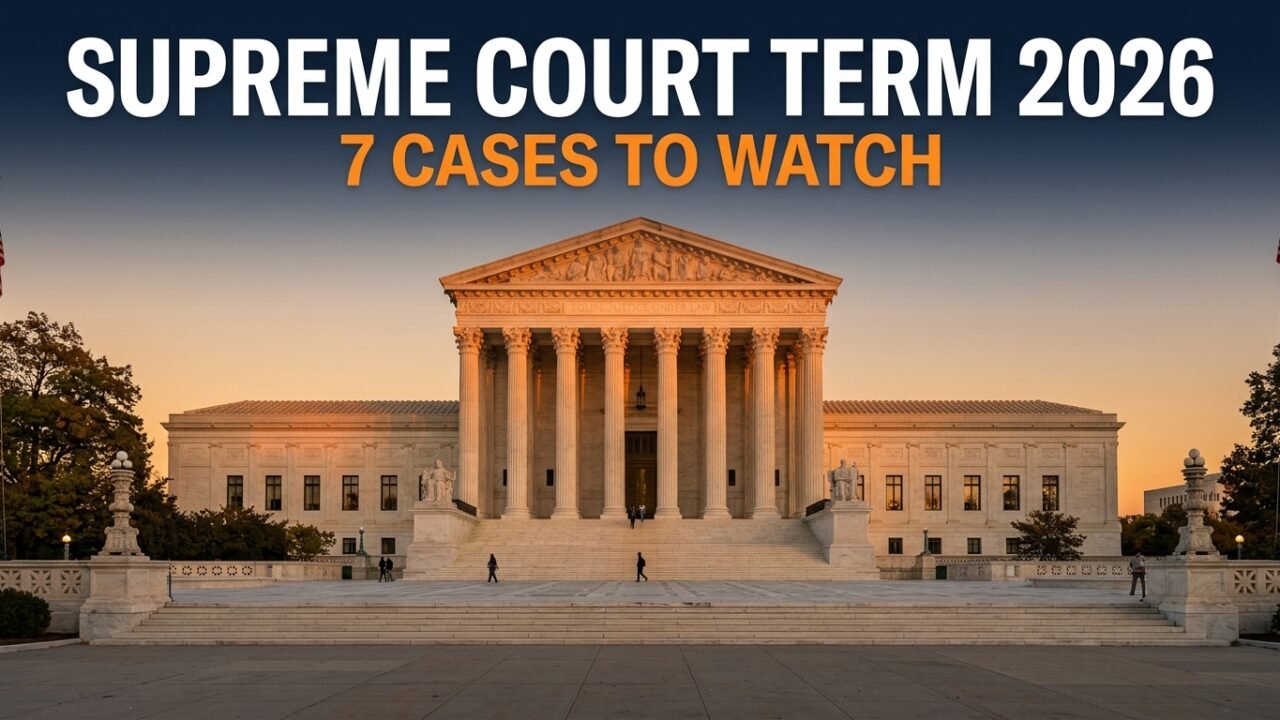
The Supreme Court term that begins on Monday, Oct. 5, will open with a lawsuit that asks whether oil and gas companies can be made to pay for damage linked to climate change. Over the following nine months, the justices will also hear cases on immigration detention, gun restrictions, religious schools, retirement savings and the rules for proving citizenship when registering to vote. Most decisions will arrive in a rush next June.
The Supreme Court rarely makes headlines in October, when arguments are just beginning, but the cases it agrees to hear shape American law for decades. This guide explains how the new term works, the cases already on the calendar, and what to watch as the year unfolds.
Table of Contents
When does the Supreme Court term start?
By law and tradition, the Supreme Court begins each new term on the first Monday in October. This year, that is Oct. 5, 2026. The term officially runs until the day before the first Monday of the following October, but the justices usually issue their final opinions by the end of June or the first days of July.
The previous term ended on June 30, 2026, when the court announced its last three decisions. On the same day, it agreed to hear several new cases for the term ahead, a common pattern at the end of June.
The court hears oral arguments in two-week sittings from October through April, with breaks in between for the justices to write opinions and review new petitions.
The October argument session
According to SCOTUSblog, which tracks the court closely, the justices will hear seven cases over five days in October. The first case on Oct. 5 is Suncor Energy v. County Commissioners of Boulder County, a climate dispute from Colorado.
Other October cases include a challenge involving the long-term detention of noncitizens, a privacy dispute about how media companies share information about what people watch online, and a case about how an employer’s retirement plan invested workers’ savings. Criminal cases and a dispute involving the military in Guam are also on the calendar.
As of mid-July, the court had agreed to hear 20 cases for the term, and it adds more through the fall and winter. By the end of the term, it typically decides around 60 argued cases.
Case to watch 1: Climate change and oil companies
In Suncor Energy v. County Commissioners of Boulder County, a Colorado county is seeking millions of dollars from oil and gas companies, arguing that they knew their products would contribute to climate change and misled the public about the risks. The county says it faces costs from wildfires, floods and heat that it links to a changing climate.
The companies argue that climate change is a global issue that should be handled by federal law and Congress, not by state courts in lawsuits brought by individual cities and counties. The key question for the justices is whether federal law blocks these kinds of state-law claims.
The outcome could affect dozens of similar lawsuits filed by cities, counties and states across the country. For context on the international side of the climate debate, see our guide to the COP31 climate summit.
Case to watch 2: Immigration detention and bond hearings
In Genalo v. Black, the court will consider whether a noncitizen who has been held in immigration detention for a long time has a constitutional right to a bond hearing, where a judge decides whether they can be released while their case continues. If there is such a right, the justices may also decide what the government must prove to keep someone locked up.
Supporters of bond hearings argue that holding people for months or years without a chance to ask for release violates basic due process. The government argues that Congress has set the rules for immigration detention and that courts should not add new requirements. The decision could affect thousands of people in immigration custody.
Case to watch 3: Gun restrictions and the Second Amendment
The court has agreed to hear two consolidated cases about laws that restrict the possession of certain semi-automatic rifles, often called assault weapons. The question is whether those laws violate the Second Amendment, which protects the right to keep and bear arms, as applied to the states through the 14th Amendment.
Several states have such bans. Gun rights groups argue that these rifles are commonly owned by law-abiding Americans and are therefore protected. Supporters of the laws argue that states can restrict especially dangerous weapons to protect public safety. The ruling could shape gun laws nationwide.
Case to watch 4: Religious preschools and state funding
In a case accepted in April, Catholic preschools in the Archdiocese of Denver argue that Colorado discriminated against them on the basis of religion when it denied them funding under the state’s universal preschool program.
The case follows a series of recent decisions in which the court has ruled that states cannot exclude religious schools from public benefit programs simply because they are religious. Colorado argues that it requires all participating preschools to follow the same nondiscrimination rules. The case will test how far those earlier rulings extend.
Case to watch 5: Proving citizenship to register to vote
Arizona requires people registering to vote with its state form to provide satisfactory evidence of U.S. citizenship, and it wants to be able to audit its voter rolls within 90 days of a federal election. The Republican Party in Arizona asked the Supreme Court to rule on those rules after lower courts limited them.
Supporters say the requirements protect the integrity of elections by ensuring only citizens vote. Opponents say eligible citizens, especially people without easy access to birth certificates or passports, could be blocked from registering, and that federal law limits what states can require. With the 2026 midterm elections just weeks away, election rules are especially in the spotlight.
Case to watch 6: Your retirement savings
Anderson v. Intel Corporation Investment Policy Committee, the first case the court agreed to hear for this term, concerns how employers’ retirement plans invest workers’ money. The dispute centers on claims that the plan’s managers acted imprudently by putting savings into alternative investments, such as hedge funds and private equity, and on how much a worker must show to bring that kind of lawsuit.
It may sound technical, but tens of millions of Americans rely on workplace retirement plans. The ruling could affect how easily workers can challenge investment decisions made on their behalf.
Case to watch 7: Privacy and what you watch online
Salazar v. Paramount Global involves a federal law that protects the privacy of people’s video-watching records. The question is how far that law reaches when a media company shares data about what a subscriber viewed with other businesses, such as social media platforms used for advertising.
The decision could affect how websites and apps handle tracking technology and what users can do if their viewing information is shared without clear consent.
How the Supreme Court picks its cases
The court receives thousands of petitions each year asking it to review lower court decisions, and it agrees to hear only a small fraction. It takes the votes of four of the nine justices to grant a case, a practice known as the rule of four.
The justices are most likely to take a case when lower courts disagree about the same legal question, when a federal law has been struck down, or when an issue has major national importance. They discuss petitions at private conferences, and their decisions to grant or deny a case usually come without explanation.
What happens at oral arguments
Each case usually gets about an hour of oral argument, with lawyers for each side presenting their case and answering the justices’ questions. In practice, much of the time is taken up by questions, which often reveal what issues the justices find most important.
Since 2020, the court has provided live audio of oral arguments, so anyone can listen as they happen. Transcripts and recordings are posted on the Supreme Court’s website the same day. Cameras are still not allowed in the courtroom.
After arguments, the justices meet privately to vote. One justice in the majority is assigned to write the opinion, and others may write concurring or dissenting opinions. Drafts circulate for weeks or months before a final decision is announced.
The emergency docket
Alongside its regular cases, the court handles emergency applications, often called the emergency or shadow docket. These are requests to pause lower court rulings or allow government policies to take effect while legal challenges continue.
In recent years, the emergency docket has become far more significant, with the court making major decisions on immigration, federal spending and executive power through short orders, sometimes with little explanation. Critics argue this leaves important issues decided without full briefing and argument. Supporters say the court must be able to act quickly when urgent disputes arise. Expect the emergency docket to make news throughout the term.
The court’s makeup
The Supreme Court has nine justices, who serve for life unless they retire or are removed. In recent terms, six justices appointed by Republican presidents have formed a conservative majority, and three appointed by Democratic presidents have formed a liberal minority. Chief Justice John Roberts leads the court.
The ideological split does not decide every case. Many rulings are unanimous or cross the usual lines, particularly in technical cases involving business, criminal procedure and federal statutes. But in the most divisive cases, votes often break along familiar lines.
Why this term matters to you
The Supreme Court’s decisions reach into daily life in ways that are easy to overlook. This term alone could affect whether local governments can seek damages from energy companies, how long immigrants can be held without a hearing, which guns states can restrict, how religious schools are funded, what documents you need to register to vote, how your retirement savings are managed and how your online viewing data is protected.
Most of the answers will come in May and June, when the court releases its biggest decisions. Until then, the questions justices ask at oral arguments are the best early clue to where they may land.
How a case reaches the Supreme Court
Almost every case the justices hear has already been through at least two other courts. A typical federal case starts in a district court, where a judge or jury decides the facts. The losing side can appeal to one of the 13 federal courts of appeals. Cases from state courts start in state trial courts and move up to the state’s highest court.
Only after that can a party ask the Supreme Court to review the decision, by filing a petition for a writ of certiorari. If four justices agree, the case is granted and scheduled for briefing and oral arguments. That process can take years, which is why many cases on this term’s calendar began long before 2026.
In a small number of situations, such as disputes between states, the Supreme Court acts as the first and only court. These original jurisdiction cases are rare, often involving boundaries or water rights.
Who argues before the justices
The lawyers who appear at oral arguments are usually specialists. Many have argued dozens of times before the court, and some have served as clerks to the justices earlier in their careers.
The federal government is represented by the solicitor general’s office, part of the Justice Department. The solicitor general is sometimes called the “tenth justice” because of the office’s influence and frequent appearances. States send their own solicitors general to defend state laws. Outside groups often file friend-of-the-court briefs, called amicus briefs, to add arguments and information.
For a lawyer, arguing before the Supreme Court is a career milestone. For a client, it is often the last chance after years of litigation.
How to read a Supreme Court opinion
Supreme Court opinions can run to dozens or even hundreds of pages, but there is a shortcut. Most begin with a syllabus, a summary prepared by the court’s reporter of decisions, which explains the holding and the vote in plain terms. It is not part of the official opinion, but it is the fastest way to understand the result.
Next comes the majority opinion, which sets the legal rule. Concurring opinions agree with the result but give different or additional reasons. Dissenting opinions disagree with the result. Dissents do not change the outcome, but they often signal where the law might go in the future.
The final lines tell you what happens next. “Affirmed” means the lower court’s decision stands. “Reversed” means it is overturned. “Vacated and remanded” means the case is sent back to the lower court to be decided again under the Supreme Court’s new guidance.
The court’s calendar for the year
The Supreme Court’s year follows a predictable rhythm. Just before the term opens, the justices hold what is known as the long conference, where they work through the large number of petitions that piled up over the summer. The first new cases granted at that conference are usually argued in the winter.
Argument sittings run roughly every month from October through April, typically two weeks of arguments followed by a break of a few weeks. The justices hold regular private conferences to vote on argued cases and consider new petitions. Opinions trickle out through the winter and spring, then arrive in large numbers in May and June, when the court works to finish its caseload before the summer recess.
That is why the most closely watched decisions of any term tend to come in its final weeks.
How to follow the Supreme Court term
If you want to follow the court, the official Supreme Court website posts argument calendars, live audio, transcripts and opinions. SCOTUSblog provides previews and analysis of every case, and the National Constitution Center publishes accessible explainers.
Opinions are usually released at 10 a.m. Eastern time on days the court announces in advance. In June, those days come thick and fast.
Supreme Court term: common questions
When does the Supreme Court term start in 2026?
On Monday, Oct. 5, 2026, the first Monday in October.
What is the first case of the term?
Suncor Energy v. County Commissioners of Boulder County, a lawsuit by a Colorado county against oil and gas companies over climate change.
How many cases does the Supreme Court hear each year?
Usually around 60 argued cases. As of mid-July, it had agreed to hear 20 cases for this term.
When will decisions come out?
Some decisions come out during the winter and spring, but the biggest usually arrive in June.
Can I listen to Supreme Court arguments?
Yes. The court provides live audio of oral arguments, and recordings are posted online.
Mark Oct. 5 on your calendar and listen to the first argument if you can. For more political coverage, see our politics section.