
The College Football Playoff format is in its third year with 12 teams, and it still raises questions every November. Who gets a bye? Why does a two-loss team make it while a conference champion gets the 11th seed? Where are the first-round games played, and when is the title game?
This guide explains the College Football Playoff format for the 2026-27 season in plain terms. It covers how teams qualify, how seeding works, the full schedule from Selection Day to the national championship in Las Vegas, and what changed from the old four-team system. Dates come from the CFP’s announced schedule.
Table of Contents
The College Football Playoff format in brief
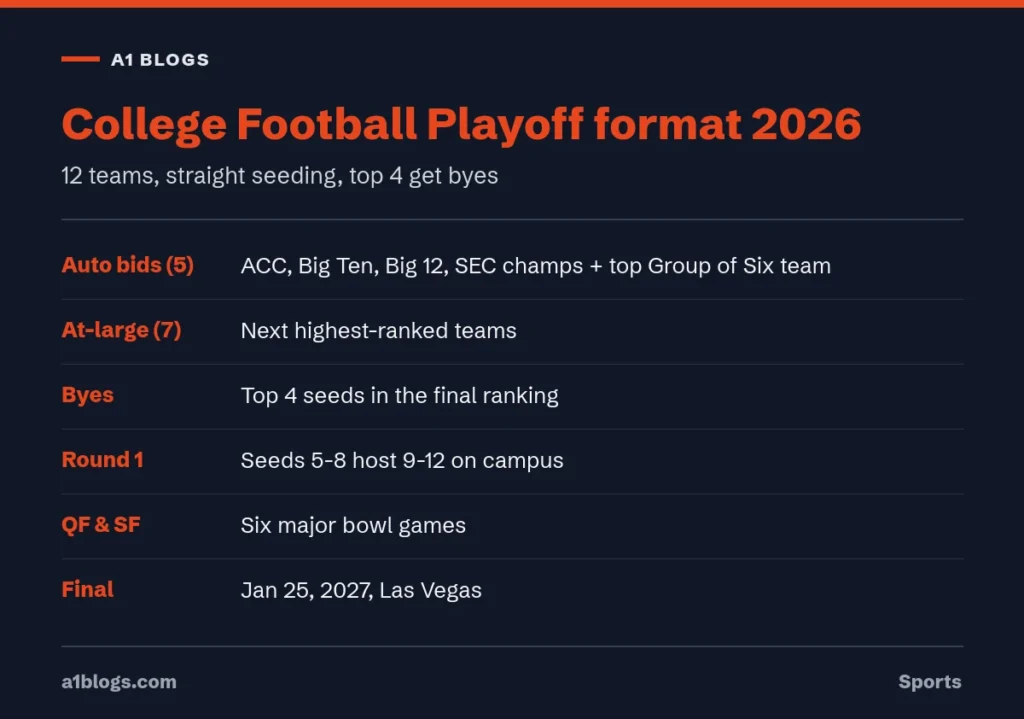
If you only need the basics, here they are.
- Teams: 12 make the College Football Playoff.
- Automatic bids: 5. The champions of the ACC, Big Ten, Big 12 and SEC, plus the highest-ranked team from the conferences outside the Power Four.
- At-large bids: 7, chosen by the selection committee.
- Byes: the top 4 seeds skip the first round.
- First round: seeds 5 through 8 host seeds 9 through 12 on their home campuses.
- Quarterfinals and semifinals: played in six major bowl games.
- Title game: Monday, January 25, 2027, at Allegiant Stadium in Las Vegas.
The College Football Playoff stays at 12 teams for 2026 after the conferences could not agree on a plan to expand it. The structure is the same one used last season, with straight seeding for the byes.
How teams qualify for the College Football Playoff
Every season ends with a 13-member selection committee ranking the top 25 teams. That final ranking decides who gets into the College Football Playoff and where each team is seeded.
The five automatic bids
Four automatic bids go to the champions of the Power Four conferences: the ACC, the Big Ten, the Big 12 and the SEC. If you win one of those conference championship games, you are in the College Football Playoff, even if the committee ranks you outside its top 12.
The fifth automatic bid goes to the highest-ranked team from the other FBS conferences, often called the Group of Five or, with the rebuilt Pac-12, the Group of Six. This guarantees that at least one team from outside the biggest conferences gets a shot at the title every year.
The seven at-large bids
The other seven spots go to the highest-ranked teams that did not earn an automatic bid. This is where the debate happens. A team with one or two losses in a strong conference often gets an at-large bid over a team with a better record in a weaker one, because the committee looks at schedule strength and quality wins, not just the win-loss record.
Notre Dame and independents
Notre Dame plays football as an independent, so it can’t win a conference title and can’t earn an automatic bid. Under the current agreement, Notre Dame is in the College Football Playoff if it finishes in the committee’s top 12. Other independent teams have to earn an at-large bid on their ranking.
How seeding works in the CFP bracket
Once the 12 teams are set, the committee places them in the CFP bracket from 1 to 12.
Straight seeding
When the 12-team College Football Playoff began in 2024, the four byes were reserved for the four highest-ranked conference champions. That rule produced some odd results, with highly ranked teams that missed their conference title game being seeded below lower-ranked champions.
Starting with the 2025 season, the College Football Playoff format moved to straight seeding. The top four seeds and their byes now go to the four highest-ranked teams in the committee’s final ranking, whether or not they won a conference title. The other teams are seeded in order of their ranking too.
What happens to a low-ranked champion
If a Power Four champion or the top Group of Six team finishes outside the top 12, it still gets into the College Football Playoff. It takes one of the lower seeds, and the lowest-ranked at-large team that would have made it is left out. This is why some fans call a strong team’s miss a result of the champion rule.
First-round matchups
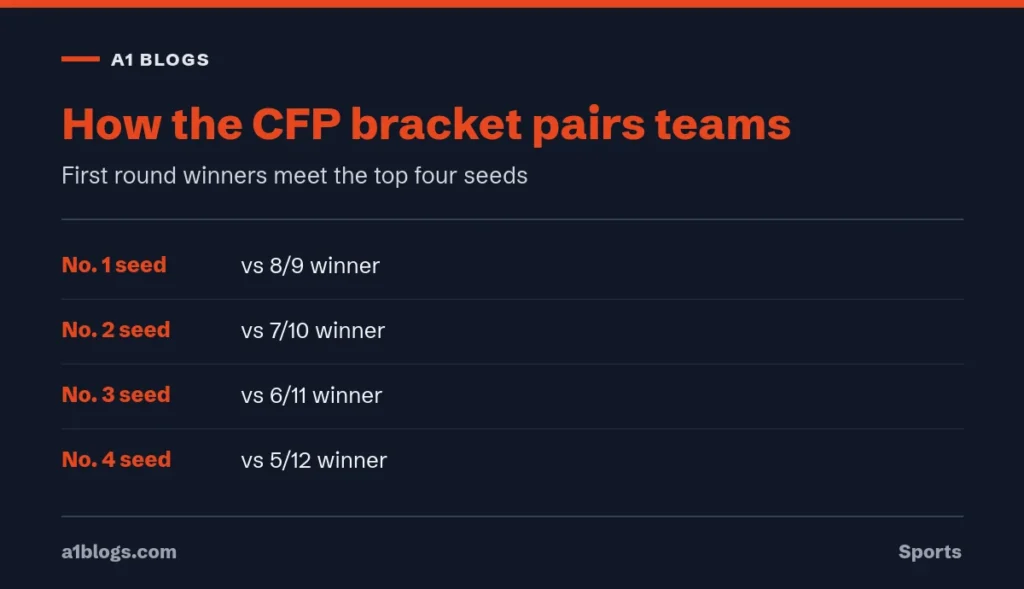
The CFP bracket uses fixed pairings in the first round:
- No. 5 seed hosts No. 12
- No. 6 seed hosts No. 11
- No. 7 seed hosts No. 10
- No. 8 seed hosts No. 9
The winners then face the top four seeds in the quarterfinals. The No. 1 seed plays the 8-9 winner, the No. 2 seed plays the 7-10 winner, the No. 3 seed plays the 6-11 winner, and the No. 4 seed plays the 5-12 winner.
The 2026-27 College Football Playoff schedule
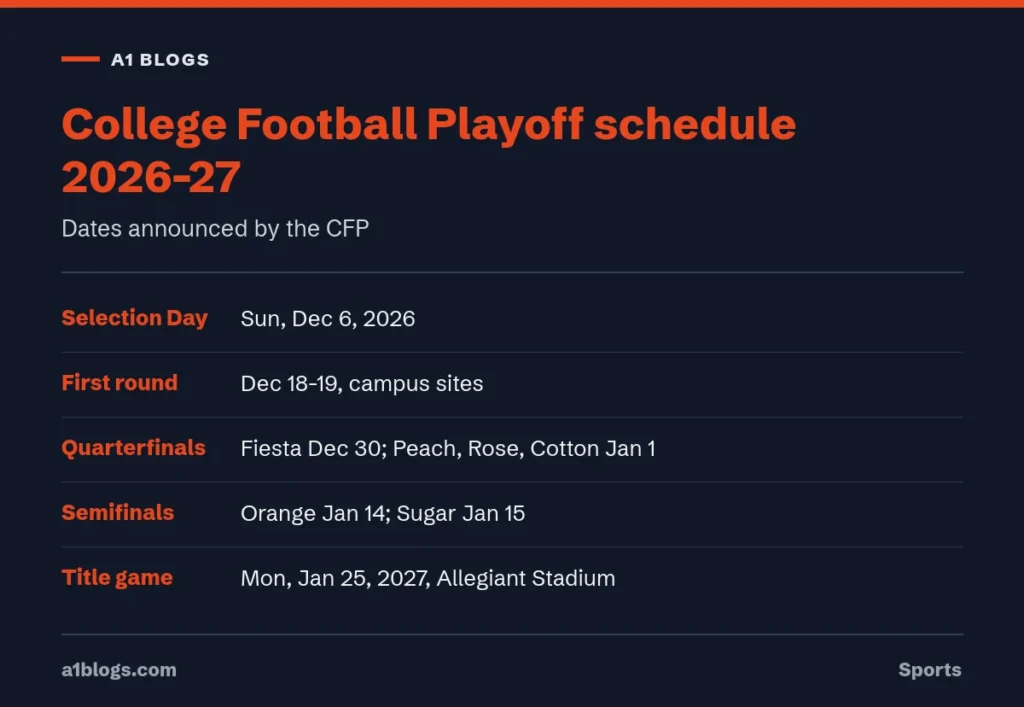
Here is the full schedule for this season, based on dates announced by the CFP. Kickoff times are Eastern.
Selection Day: Sunday, December 6, 2026
The committee releases its final ranking and the full CFP bracket on the Sunday after the conference championship games. Teams find out their seed and opponent that day.
First round: December 18 and 19
The four first-round games are played on the campuses of seeds 5 through 8. One game is on Friday night, December 18, and three are on Saturday, December 19. Home games give these schools a rare December playoff game in their own stadium, and they have produced some of the loudest atmospheres of the season.
Quarterfinals: December 30 and January 1
The quarterfinals are played at four of the traditional New Year’s Six bowls:
- Fiesta Bowl in Glendale, Arizona, on Wednesday, December 30
- Peach Bowl in Atlanta on Friday, January 1
- Rose Bowl in Pasadena, California, on January 1
- Cotton Bowl in Arlington, Texas, on January 1
The committee assigns the top seeds to bowls, and in recent years it has given priority to the higher seeds when it chooses which bowl site each team plays at.
Semifinals: January 14 and 15
The Orange Bowl in Miami Gardens, Florida, hosts one semifinal on Thursday, January 14. The Sugar Bowl in New Orleans hosts the other on Friday, January 15. The six bowls rotate the quarterfinal and semifinal games from year to year.
National championship: January 25, 2027
The title game is on Monday, January 25, 2027, at Allegiant Stadium in Las Vegas, home of the Raiders. Kickoff is scheduled for 7:30 p.m. ET on ABC and ESPN. It is the first time the College Football Playoff title game will be held in Las Vegas.
Why conference championship weekend matters so much
The first Saturday of December is the last big day before Selection Day. Each major conference holds a title game between its top two teams, and those results shape the final ranking more than any other weekend.
A win can lift a team several spots. It adds a strong opponent to the schedule and, for the Power Four leagues, guarantees a place in the field. A loss is harder to read. A team that was in the top four before the game might stay in the field as an at-large pick, but it can lose its bye and drop into the first round. A team that was on the edge of the field might fall out completely.
This is also where the debate about rest begins. Teams that do not reach their conference title game get an extra week off, and some fans argue that this is an advantage. Others point out that playing in the title game is a chance to add a quality win, which the committee values.
If you follow a team in the race, check its conference’s tiebreaker rules early in November. Two teams with the same conference record are separated by head-to-head results and other tiebreakers, and that decides who plays for the title.
Overtime rules in college football playoff games
College overtime is different from the NFL system. There is no clock. Each team gets one possession starting at the opponent’s 25-yard line, and the team with more points after both possessions wins.
- In the first overtime, teams can kick an extra point or go for two after a touchdown.
- In the second overtime, teams must go for two after a touchdown.
- From the third overtime on, teams no longer run full possessions. They alternate two-point plays from the 3-yard line until one team scores and the other does not.
The rules are the same in the regular season and in the playoff, so a playoff game can’t end in a tie. If you want to compare them with the pro game, our guide to NFL overtime rules explains how the league changed its system in 2025.
Where to watch College Football Playoff games
The 2026-27 College Football Playoff is split between ESPN networks and TNT Sports. The announced TV plan has one first-round game on ESPN, one on ABC and ESPN, and two on TNT, truTV and HBO Max. The quarterfinals are also split between the two companies, and the national championship is on ABC and ESPN.
ABC is a broadcast network, so its games are free with a TV antenna. ESPN and TNT need a cable or streaming subscription. If you have cut the cord, our guide on how to watch NFL games without cable covers the streaming services that carry ESPN and other sports channels. Most of the same options work for college football.
How the selection committee ranks teams
The committee meets several times in November and releases a weekly top 25 ranking on Tuesday nights, leading up to the final ranking on Selection Day. The rankings in early November often change a lot, so it is best to treat them as a snapshot rather than a prediction.
The committee does not use a formula. Its members watch games, study data and vote in rounds. According to the CFP’s protocol, they consider:
- Conference championships won
- Strength of schedule
- Head-to-head results
- Results against common opponents
- Other factors, such as injuries that affected a team’s results
Members have to leave the room when their own school or a school they have ties to is being discussed. The committee chair explains each week’s ranking in a short TV interview, which is often the best guide to how the committee is thinking.
How the 12-team College Football Playoff changed the sport
From the 2014 season through the 2023 season, the College Football Playoff had only four teams. The committee picked the top four, and everyone else played in bowl games. Conference champions from smaller leagues had almost no chance to get in, and every year at least one strong team felt left out.
The 12-team College Football Playoff format, which started in the 2024 season, changed that. More teams now have a realistic path to the title, and late-season games between teams ranked in the teens can have playoff stakes. Home playoff games in December brought new excitement to campus stadiums.
The change also brought some new arguments. Teams with byes have had long breaks between their conference title game and the quarterfinal, and some fans think rest hurt those teams more than it helped. Others argue that a 12-team field makes the regular season less important, because one or two losses no longer end a team’s title hopes.
Recent champions
Ohio State won the first 12-team College Football Playoff after the 2024 season, beating Notre Dame 34-23 in Atlanta. Last season, Indiana finished an unbeaten year by beating Miami 27-21 in the title game to win its first national championship. Indiana’s run as a team that rarely made bowl games a few years earlier showed how much the bigger field has opened up the sport.
How to follow the race in November
The weekly rankings get a lot of attention, but a few simple habits make the race easier to follow.
First, look at the schedule ahead, not just the record so far. A one-loss team with two ranked opponents left has more chances to move up, and more chances to fall, than a one-loss team with an easy finish.
Second, pay attention to head-to-head results. When two teams have similar records and resumes, the committee often puts the team that won their game ahead.
Third, watch the race for the fifth automatic bid. It is usually decided by a few teams from different conferences, and their results against Power Four opponents carry a lot of weight.
Finally, remember that the ranking only matters once. Teams can be ranked 15th in early November and still finish in the top eight if they keep winning. The last ranking on Selection Day is the only one that sets the field.
Tips for fans traveling to a playoff game
First-round games are announced on Selection Day and played less than two weeks later, so fans of the host schools have very little time to plan. Season ticket holders usually get the first chance to buy, and the rest go on sale soon after. Book hotels as soon as you know your team is likely to host, and expect cold weather at some northern campuses in late December.
For the quarterfinals and semifinals, schools sell tickets through their athletic departments, and the bowls sell some directly. The title game in Las Vegas is a destination event. Hotels in the city fill quickly for big events, so if your team is in contention, it is worth looking at refundable bookings early.
How bowl games fit into the College Football Playoff
The College Football Playoff did not replace bowl season. It uses six of the biggest bowls, the Rose, Sugar, Orange, Cotton, Fiesta and Peach, as its quarterfinal and semifinal sites. The bowls keep their names, history and local traditions, and the games still feel like bowl games for fans who travel to them.
Teams that miss the playoff can still play in dozens of other bowl games from mid-December through early January. Many players and coaches see those games as a reward for a good season and an early start on next year.
Frequently asked questions
How many teams are in the College Football Playoff?
Twelve. The College Football Playoff format includes five automatic bids for conference champions and seven at-large bids.
Do conference champions get a bye?
Not automatically. Since 2025, the top four seeds and their byes go to the four highest-ranked teams, whether or not they won their conference.
Where are first-round CFP games played?
On the home campuses of the teams seeded 5 through 8. Those teams host seeds 9 through 12 on December 18 and 19.
When and where is the 2027 national championship?
Monday, January 25, 2027, at Allegiant Stadium in Las Vegas.
Can a team from outside the Power Four make the CFP bracket?
Yes. The highest-ranked team from the conferences outside the Power Four gets an automatic bid. Other teams from those leagues can also earn at-large bids if they finish high enough in the rankings.
Will the College Football Playoff expand to 16 teams?
Not for 2026. The CFP stayed at 12 teams after the conferences could not agree on an expanded format. Future changes are still possible.
How is Notre Dame treated in the College Football Playoff format?
Notre Dame can’t win a conference title, but it is in the College Football Playoff if it finishes in the committee’s top 12.
The official College Football Playoff website posts the weekly rankings and the full CFP bracket on Selection Day. The full TV plan for each round is listed in FBSchedules’ 2026-27 CFP schedule.