
Every December, one college football player walks onto a New York stage and lifts the most famous individual trophy in American sports. Many fans know the names of past winners. Far fewer know how Heisman Trophy voting actually works: who gets a ballot, how the points are counted, and why some players with huge seasons finish a distant second.
This guide explains the Heisman voting process from the ballots to the ceremony. It uses last year’s results as a worked example, explains the regional system that is meant to keep the vote fair, and looks at the records, controversies and trends that shape the race. The numbers come from the Heisman Trust and published voting results.
Table of Contents
Heisman Trophy voting at a glance
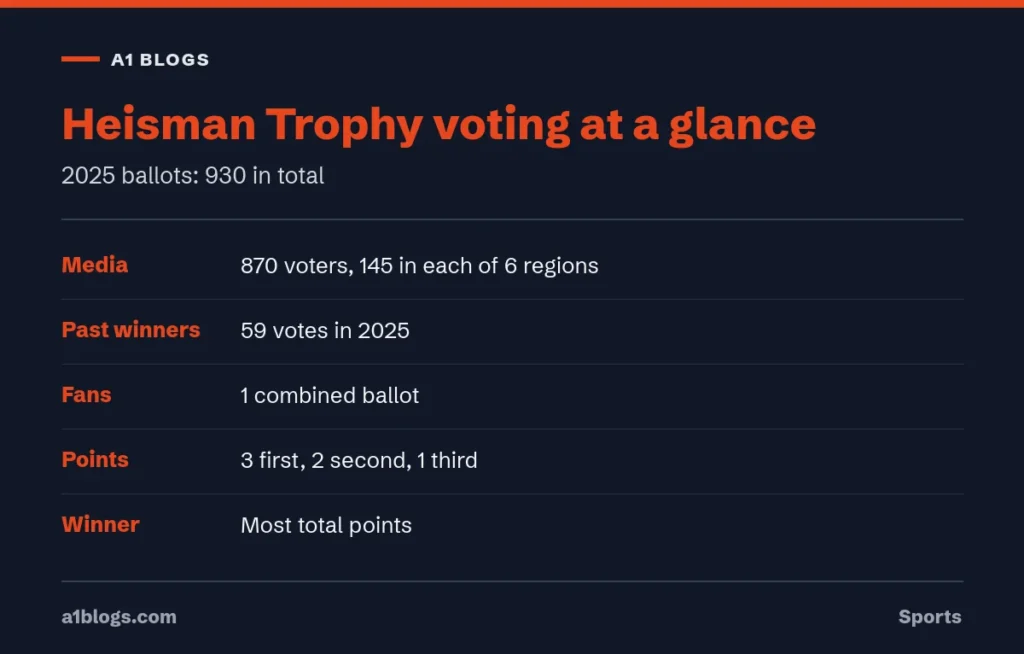
Here is the short version:
- Who votes: about 930 voters. In 2025 there were 870 media members, 59 former Heisman Trophy winners and one combined fan vote.
- What they vote for: each voter names three different players, ranked first, second and third.
- How points work: 3 points for a first-place vote, 2 for second and 1 for third.
- Who wins: the player with the most total points.
- When: ballots go out after the regular season and are due a few days later. The winner is announced at a ceremony in New York, usually on the second Saturday of December.
The winner does not need a majority of first-place votes. Total points decide it, which is why the 3-2-1 system matters so much.
Who gets a Heisman ballot
The Heisman Trust gives out three kinds of ballots.
Media voters
Most Heisman Trophy voting is done by sportswriters and broadcasters who cover college football. There are 870 media voters, split evenly across six regions of the country:
- Far West
- Mid-Atlantic
- Midwest
- Northeast
- South
- Southwest
Each region has 145 media voters. Regional representatives choose voters in their area, and the Heisman Trust reviews the list. Splitting votes evenly by region is meant to stop any one part of the country from controlling the result.
Former winners
Every living Heisman Trophy winner gets a vote. In 2025, 59 former winners took part. Their votes count the same as media ballots, and they are spread across the six regions too.
The fan vote
The public also gets a say. Fans vote online, and the combined result of the fan vote counts as one single ballot. It has very little effect on the outcome, but it lets fans take part in the process.
How Heisman voting points work
The point system is simple. Each ballot has three lines, and each line is worth a different number of points:
- First place: 3 points
- Second place: 2 points
- Third place: 1 point
Voters must list three different players. They do not have to explain their choices, and individual ballots are kept private unless voters choose to share them.
The points from every ballot are added up, and the player with the highest total wins. An accounting firm tallies the votes, and the results are kept secret until the winner is announced at the ceremony.
Why points matter more than first-place votes
Because second and third places add points, a player who appears on almost every ballot can beat a player who has more first-place votes but is left off many ballots. In practice, the winner usually leads in both. But the 3-2-1 system rewards players who are seen as strong candidates in every region, not just loved in one.
The maximum possible score
With 930 ballots, the most points any player could get is 2,790, if every voter put him first. Comparing a winner’s total with that maximum is a good way to measure how dominant a season was.
A worked example: the 2025 Heisman vote
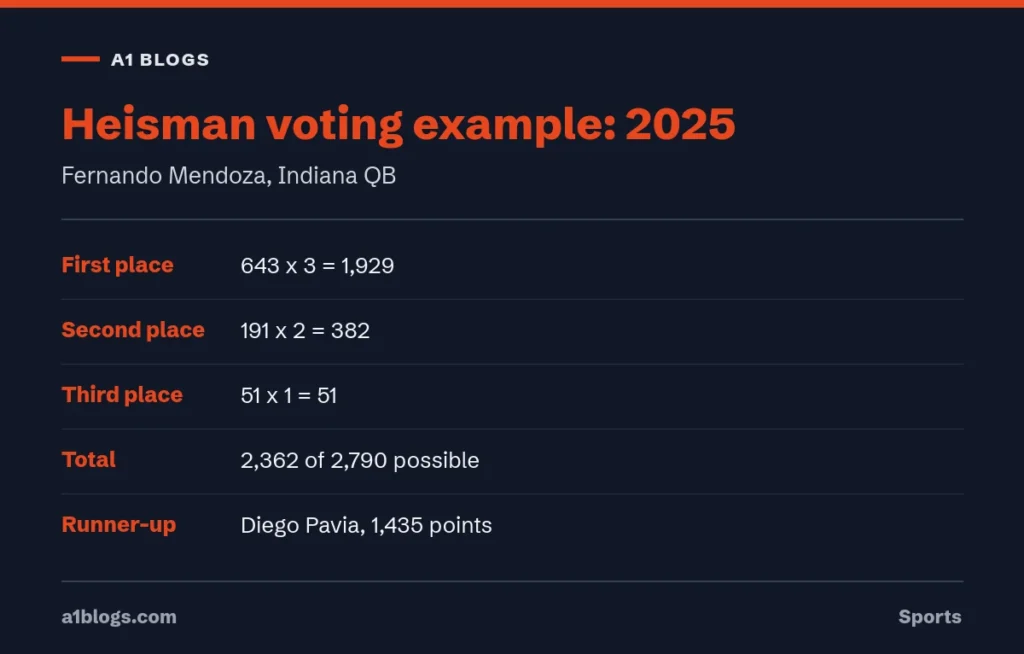
Indiana quarterback Fernando Mendoza won the 2025 Heisman Trophy. Here is how his vote broke down, according to the published results:
- Total points: 2,362
- First-place votes: 643
- Second-place votes: 191
- Third-place votes: 51
You can check the math. 643 times 3 is 1,929. 191 times 2 is 382. Add 51 for the third-place votes and you get 2,362.
Vanderbilt quarterback Diego Pavia finished second with 1,435 points, including 189 first-place votes. Mendoza’s total was about 84.7% of the 2,790 possible points. He was the first Big Ten player to win since Troy Smith of Ohio State in 2006, and Indiana’s first winner ever. A few weeks later, Indiana beat Miami in the national championship game to finish an unbeaten season.
The Heisman Trophy voting timeline
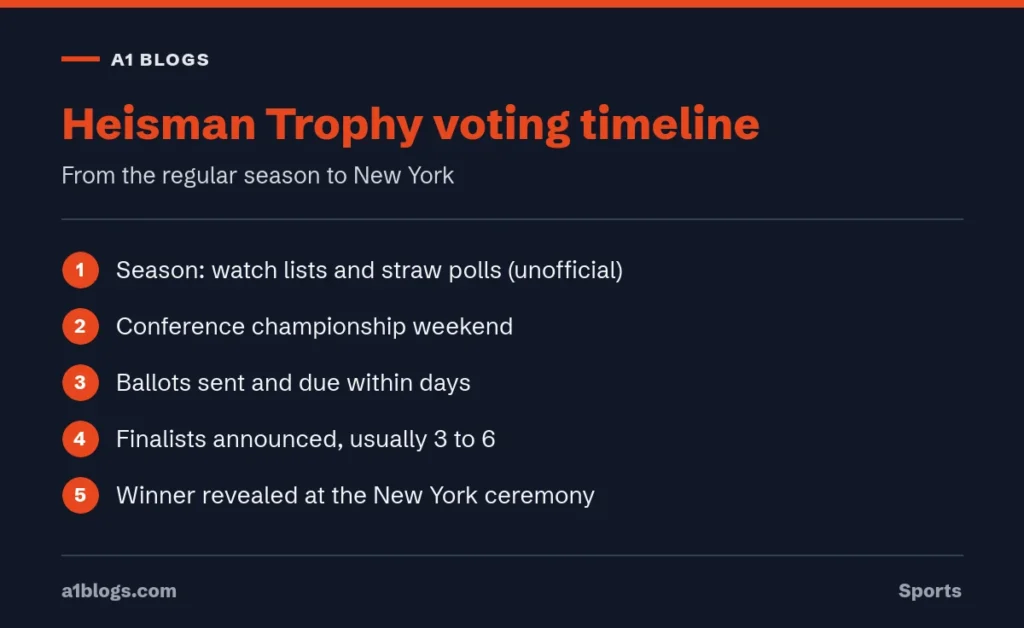
The Heisman Trophy race runs all season, but the official process happens in the first two weeks of December.
During the season
There is no official ranking during the season. Media outlets publish Heisman watch lists and straw polls, and they shape the conversation, but none of them count. Voters are free to change their minds right up to the deadline.
After conference championship weekend
Ballots go out electronically after the conference championship games, which this year are on the first weekend of December. Voters usually have only a few days to submit them. That short window means late-season games, especially conference title games, can matter a great deal.
Finalists
A few days before the ceremony, the Heisman Trust announces the finalists, usually three to six players. Finalists are invited to New York for the ceremony. The number of finalists depends on how close the voting is, so a runaway race may have only three or four.
The ceremony
The winner is announced live on TV at a ceremony in New York City. Until the envelope is opened, even the finalists do not know who won. The winner gives a speech, and the full voting results are released afterward.
What voters look for
The Heisman Trust’s mission statement says the award goes to the outstanding college football player whose performance best shows the pursuit of excellence with integrity. That leaves a lot of room for judgment, and voters weigh the same things fans argue about every week.
Statistics
Big numbers matter. Passing yards, touchdowns, rushing totals and efficiency stats all show up in Heisman voting debates. Voters look at advanced stats too, but traditional numbers still get the most attention.
Team success
It is rare for a player on a losing team to win. Voters tend to favor players whose teams are in the national title race, and a big performance in a game with playoff stakes can move votes.
Big moments
Heisman moments are signature plays or games that voters remember. A game-winning drive on national TV or a huge performance against a top-ranked opponent can define a candidate’s season.
Position
Quarterbacks dominate the modern Heisman Trophy. Mendoza was the 21st quarterback to win since 2000. Running backs and receivers win occasionally, and defensive players almost never do. Charles Woodson of Michigan, a cornerback who also returned punts and caught passes, won in 1997. Colorado’s Travis Hunter, who played both receiver and cornerback, won in 2024.
How to read a Heisman results table
When the Heisman Trust releases the full Heisman Trophy voting results, they come as a table that can look confusing at first. Each row is a player. The columns show first-place, second-place and third-place votes, then the total points.
The results are also broken down by region. This is the most interesting part for many fans, because it shows where each player’s support came from. A player who leads in all six regions is a clear national choice. A player who wins one region but trails badly elsewhere probably had strong local support and less attention nationally.
Two more numbers are worth checking. The first is how many ballots left a player off entirely. If a top finalist is missing from many ballots, voters were split about him. The second is the gap between first and second place in points. A large gap means a landslide. A small one means Heisman voting was close enough that a single game might have changed the result.
Following the 2026 Heisman Trophy race
The 2026 race is still wide open in October. Here is how to follow it like a voter would.
Start with the teams in the playoff picture. Voters rarely pick a player whose team has several losses, so the strongest candidates usually play for teams that are in the top 15 of the rankings.
Watch November closely. Rivalry week and conference championship games come right before ballots go out, and a big performance in those games stays fresh in voters’ minds. A slow finish can sink a candidate who led all season.
Remember the deadline. Ballots are due before the College Football Playoff first round on December 18 and 19, so the race is decided by the regular season and conference title games. Anything that happens in the playoff comes too late for this year’s Heisman Trophy.
Finally, take early lists with a grain of salt. The favorite in October often fades. Injuries, tough schedules and new stars change the race every year.
How Heisman voting compares with other awards
The Heisman Trophy is the best known award in college football, but it is not the only one. The Maxwell Award, the Walter Camp Award and several position awards also name a top player each season. Each uses its own group of voters, which can include coaches and sports information directors as well as media members.
Because the voting groups differ, the awards sometimes go to different players. When they all agree, it is usually a sign of a truly dominant season. When they split, it shows how much judgment is involved in picking one player from more than a hundred teams.
Myths about the Heisman
A common myth is that only seniors can win. Johnny Manziel of Texas A&M won as a redshirt freshman in 2012, and Jameis Winston of Florida State did the same in 2013. Many recent winners have been juniors.
Another myth is that the award goes to the best NFL prospect. Heisman voting rewards a single college season. Some winners have become NFL stars, while others never had long pro careers, and many top NFL draft picks never finished near the top of the vote.
A third myth is that the fan vote can swing the result. With one ballot out of about 930, the fan vote is a way for the public to take part, not a deciding factor.
Records and history
The first winner
The first award went to Jay Berwanger of the University of Chicago in 1935. At first it was called the DAC Trophy, after the Downtown Athletic Club in New York that created it. It was renamed after John Heisman, the club’s athletic director and a famous coach, after his death in 1936. Berwanger also became the first player ever picked in the NFL draft, as our guide on how the NFL draft works explains.
The only two-time winner
Ohio State running back Archie Griffin is the only player to win the Heisman Trophy twice, in 1974 and 1975. Several players have finished in the top three twice, but none has matched Griffin.
Landslides
LSU quarterback Joe Burrow won in 2019 with one of the most lopsided votes in history, after a season in which LSU went unbeaten and won the national title. Comparing winners by their share of possible points is the fairest way to measure these landslides, because the number of voters has changed over time.
The Reggie Bush case
USC running back Reggie Bush won in 2005, then gave up the trophy in 2010 after NCAA sanctions against USC related to benefits he received. In 2024, after the NCAA’s rules on athletes earning money changed, the Heisman Trust reinstated him as the 2005 winner.
Common criticisms of Heisman Trophy voting
No voting system is perfect, and the Heisman has its critics.
The most common complaint is that the award has become a quarterback award. Many argue that offensive linemen and defensive players have almost no chance, however good they are.
Another is timing. Ballots are due before the College Football Playoff begins, so a player’s playoff performance does not count. Some fans would rather see the vote held after the national championship, as other major awards are. You can read how the playoff is structured in our guide to the College Football Playoff format.
A third criticism is that voters are influenced by preseason hype and national TV exposure. Players on teams with more national TV games get more attention, and that can show up in the voting.
Supporters of the system point out that the regional structure spreads votes across the country, that former winners add a players’ perspective and that the 3-2-1 system rewards broad support rather than strong support from one region.
Frequently asked questions
How many people vote for the Heisman Trophy?
About 930. In 2025 there were 870 media voters, 59 former winners and one combined fan vote.
How are Heisman voting points calculated?
Each voter ranks three players. A first-place vote is worth 3 points, second place 2 points and third place 1 point. The player with the most total points wins.
Can fans vote for the Heisman Trophy?
Yes, but all fan votes together count as one ballot out of about 930.
When is the Heisman Trophy ceremony?
It is held in New York City in December, usually on the second Saturday of the month, a week after conference championship weekend.
Do playoff games count in Heisman Trophy voting?
No. Ballots are due before the College Football Playoff starts, so only regular-season and conference championship games count.
Has anyone won the Heisman Trophy twice?
Only Archie Griffin of Ohio State, in 1974 and 1975.
Who won the Heisman Trophy last year?
Indiana quarterback Fernando Mendoza won the 2025 award with 2,362 points.
Can a defensive player win the Heisman?
It is possible but very rare. Charles Woodson in 1997 is the best-known example, and Travis Hunter in 2024 won while playing both offense and defense. Pure defensive players and offensive linemen have historically struggled to get enough votes.
Are Heisman ballots made public?
Not by the Heisman Trust. Individual ballots stay private, but many media voters choose to publish their own ballots and explain their choices after the ceremony.
Can a voter pick the same player twice?
No. Each ballot must list three different players. A ballot that repeats a player would not follow the rules.
What happens if two players tie in points?
Ties at the top are extremely unlikely with about 930 ballots. The Heisman has never needed to split the award between two players.
Do freshmen win the Heisman?
They can. Johnny Manziel in 2012 and Jameis Winston in 2013 both won as redshirt freshmen, showing that age and class do not limit who voters can choose.
The Heisman Trust explains its process in Heisman Balloting: How it Works, and the full 2025 results are in Sports Illustrated’s voting breakdown.