
A golf handicap lets a 25-handicap weekend player have a fair match against a friend who shoots in the 70s. It is one of the best ideas in sports, and also one of the least understood. Many golfers know their number but can’t explain where it comes from, why it changed after a bad round, or why it gives them more strokes on one course than another.
This guide explains how a golf handicap works under the World Handicap System, which the United States adopted in 2020. You will learn how your Handicap Index is calculated, how it becomes a Course Handicap for the tees you play, what net double bogey means and how to get an official handicap of your own. The numbers and formulas come from the USGA’s published rules.
Table of Contents
What a golf handicap measures
A golf handicap measures your potential, not your average. Under the World Handicap System, your Handicap Index shows what you can shoot on a good day, based on your better recent rounds. It is not the number of strokes you usually shoot over par.
That difference surprises a lot of new golfers. If your Handicap Index is 15, you will usually score higher than par plus 15. Most golfers only play to their handicap a few times out of every ten rounds. That is how the system is designed, because a golf handicap should reflect what you are capable of when your game is working.
The point of a golf handicap is fairness. In a net competition, each player subtracts handicap strokes from their score. A higher-handicap player gets more strokes, so two players of very different skill can both have a real chance to win.
The World Handicap System in brief
Before 2020, golf had six different handicap systems around the world, including the USGA system in the United States and separate systems in Europe, Australia and South Africa. A golfer who moved countries could find their handicap changed overnight.
The World Handicap System replaced all six with one set of rules, run by the USGA and The R&A. In the United States it took effect on January 1, 2020. It uses the course and slope ratings that American golfers already knew, and it added a few new ideas, including daily updates and a maximum hole score called net double bogey.
The main parts of the World Handicap System are:
- Handicap Index: your portable number, which travels with you to any rated course in the world.
- Course Handicap: the number of strokes you get on a specific course from a specific set of tees.
- Playing Handicap: your Course Handicap adjusted for the format of the competition.
- Score Differential: the value calculated from each round you post.
How your Handicap Index is calculated
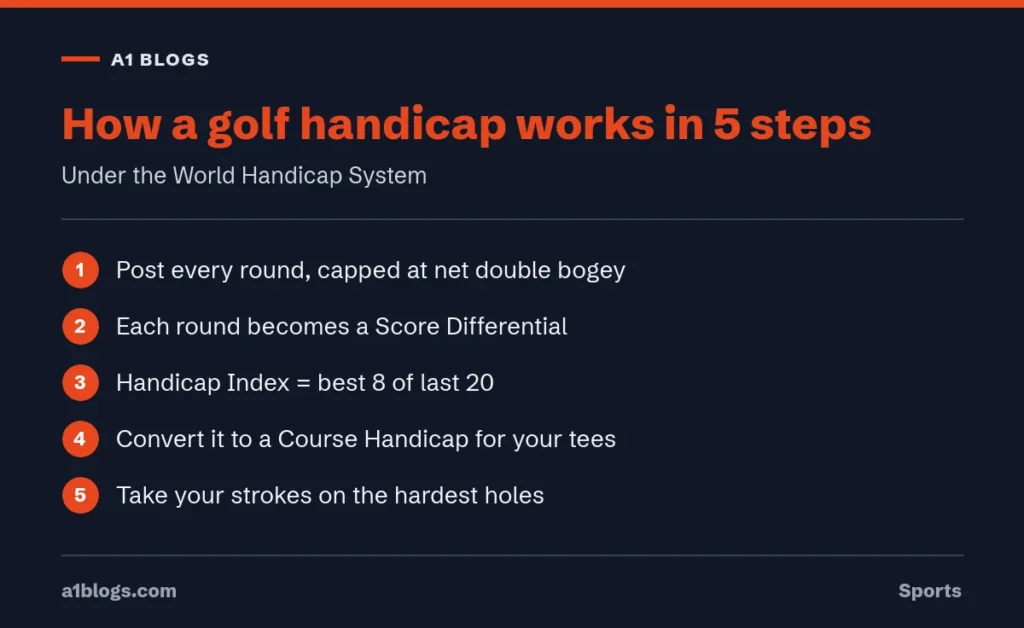
Your Handicap Index is the average of the best 8 Score Differentials from your most recent 20 rounds. Each time you post a new score, the oldest one drops off and the calculation runs again. Your index updates daily, overnight after you post.
What a Score Differential is
A Score Differential tells the system how well you played compared with how hard the course was. Here is the formula:
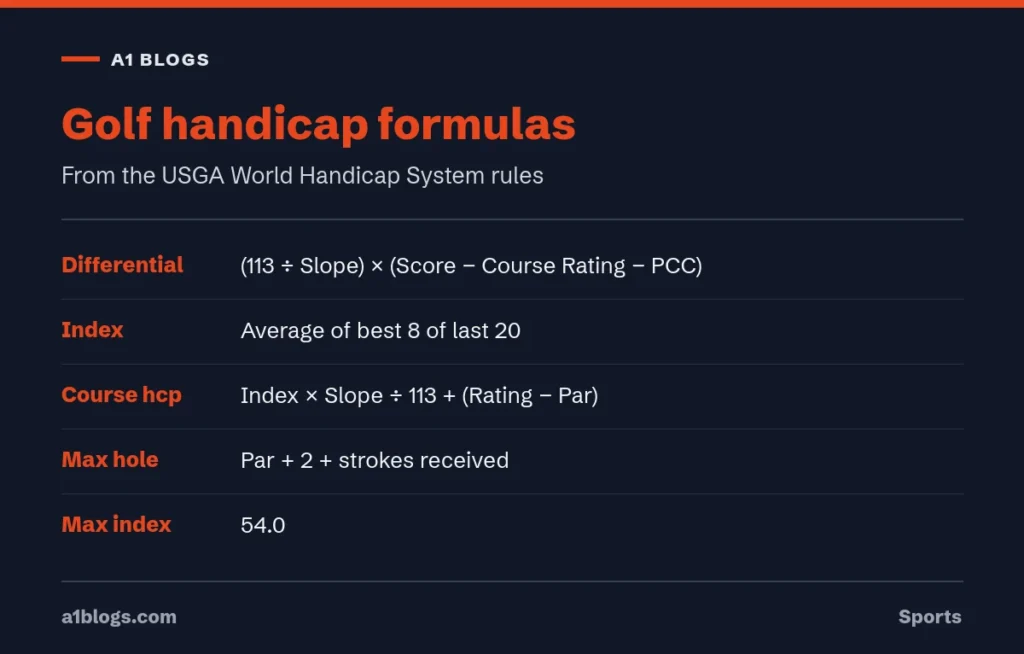
Score Differential = (113 ÷ Slope Rating) × (Adjusted Gross Score − Course Rating − PCC adjustment)
That looks like a lot, so let’s take it piece by piece.
- Adjusted Gross Score is your score after any hole scores above the maximum are reduced. Most of the time it is just your total score.
- Course Rating is what a scratch golfer, a player with a Handicap Index of 0, is expected to shoot from those tees in normal conditions.
- Slope Rating measures how much harder the course is for a bogey golfer than for a scratch golfer. It runs from 55 to 155, and a course of average difficulty has a Slope Rating of 113.
- PCC stands for playing conditions calculation. The system can adjust scores from a day when conditions were unusually hard or easy, such as heavy wind or a course set up for a tournament.
A worked example
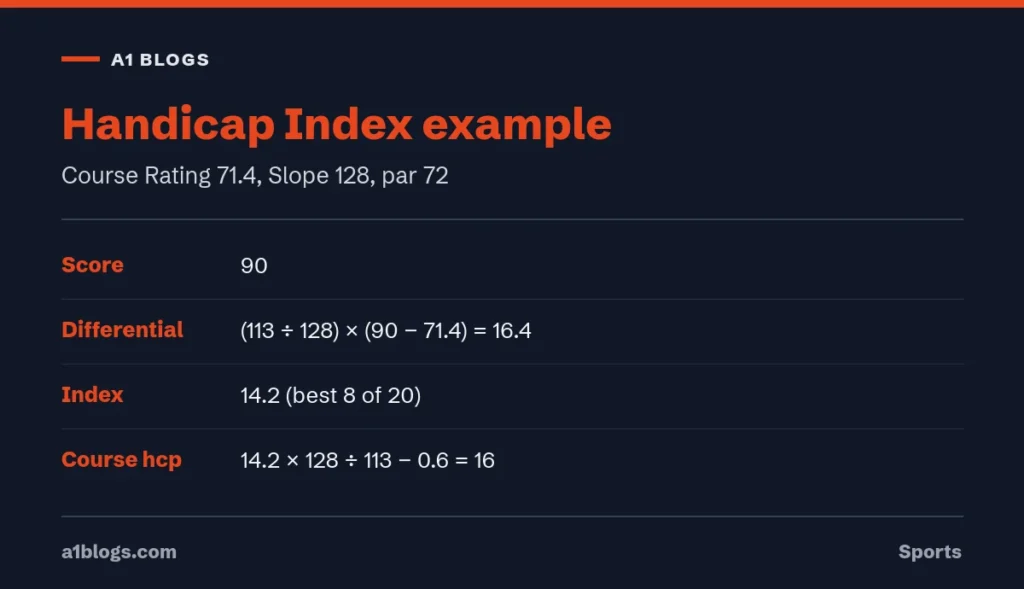
Say you shoot 90 on a course with a Course Rating of 71.4 and a Slope Rating of 128, and the PCC adjustment is 0.
- 90 minus 71.4 is 18.6.
- 113 divided by 128 is about 0.883.
- 0.883 times 18.6 is about 16.4.
Your Score Differential for that round is 16.4. After 20 rounds, the system takes your eight lowest differentials, adds them up and divides by eight. If those eight average 14.2, your Handicap Index is 14.2.
If you have fewer than 20 rounds
New golfers do not need to wait for 20 rounds. You can get your first Handicap Index after posting 54 holes, which can be three 18-hole rounds or a mix of 9-hole and 18-hole rounds. With fewer than 20 rounds, the system uses fewer differentials, and adds a small adjustment when you only have a few scores:
- 3 differentials: the lowest one, minus 2.0
- 4 differentials: the lowest one, minus 1.0
- 5 differentials: the lowest one
- 6 differentials: the average of the lowest 2, minus 1.0
- 7 or 8 differentials: the average of the lowest 2
- 9 to 11 differentials: the average of the lowest 3
- 12 to 14 differentials: the average of the lowest 4
- 15 or 16 differentials: the average of the lowest 5
- 17 or 18 differentials: the average of the lowest 6
- 19 differentials: the average of the lowest 7
- 20 differentials: the average of the lowest 8
The adjustments for 3, 4 and 6 differentials help stop new golfers from starting with a handicap that is too high.
The maximum Handicap Index
The highest Handicap Index allowed under the World Handicap System is 54.0, for both men and women. Golfers who are better than scratch have a plus index, such as +2.0. A plus handicap means strokes are added to your score in net competitions, not taken away.
From Handicap Index to Course Handicap
Your Handicap Index is a portable number. To use it on a course, you convert it into a Course Handicap, which is the number of strokes you get from the tees you are playing that day.
Course Handicap = Handicap Index × (Slope Rating ÷ 113) + (Course Rating − Par)
Using the same course as before, with a par of 72:
- 14.2 times 128 divided by 113 is about 16.1.
- Course Rating minus par is 71.4 minus 72, or minus 0.6.
- 16.1 minus 0.6 is 15.5, which rounds to 16.
So a golfer with a 14.2 Handicap Index gets 16 strokes on that course. On an easier course with a lower slope, the same player might get 13. You do not have to do this math yourself. Courses post Course Handicap tables near the first tee, and the GHIN app calculates it for you.
Where your handicap strokes go
Each hole on the scorecard has a stroke index, also called the handicap row, from 1 to 18. The hole marked 1 is usually the hardest, and the hole marked 18 the easiest. With a Course Handicap of 16, you get one stroke on each of the holes ranked 1 through 16. With a Course Handicap of 20, you get one stroke on every hole plus a second stroke on holes 1 and 2.
Playing Handicap
In some competitions your Course Handicap is reduced by a set percentage, called the handicap allowance. In individual stroke play, the recommended allowance is 95% of your Course Handicap. Other formats, like four-ball and match play, use different allowances. The tournament committee decides which ones to use, so check the rules sheet before you tee off.
Net double bogey: the maximum score on a hole
To stop one disaster hole from skewing your golf handicap, the World Handicap System caps the score you can post on any hole. The cap is called net double bogey.
Net double bogey = par + 2 + any handicap strokes you get on that hole
If you get one stroke on a par 4, your maximum score for handicap purposes is 7. If you get no strokes on that hole, your maximum is 6. If you take a 9 on that hole, you write 9 on your card for the match, but you post a 7 when you enter the score for your Handicap Index.
Net double bogey replaced Equitable Stroke Control, the old system in the US that used a single maximum for every hole based on your Course Handicap. Most golfers find net double bogey fairer because it accounts for which holes you get strokes on.
Rules that keep a golf handicap honest
The World Handicap System has a few built-in safeguards that stop a Handicap Index from moving too fast in either direction.
Soft cap and hard cap
The system remembers your lowest Handicap Index from the last 365 days, called your Low Handicap Index. If your index rises more than 3.0 strokes above that number, the increase above 3.0 is cut in half. That is the soft cap. The hard cap stops your index from rising more than 5.0 strokes above your low point, no matter how badly you play.
These caps protect players who have a long slump from getting too many strokes, and they make it harder to build an inflated handicap on purpose.
Exceptional score reduction
If you post a round with a Score Differential at least 7.0 strokes better than your current Handicap Index, the system treats it as exceptional. A differential 7.0 to 9.9 strokes better reduces all of your recent differentials by 1.0. A differential 10.0 or more strokes better reduces them by 2.0. This means your golf handicap reacts quickly when you suddenly get much better.
How to calculate golf handicap by hand
You do not need to do the math, because the GHIN app does it for you. Still, working through it once with a simple spreadsheet is the best way to understand how to calculate golf handicap numbers and why yours moves the way it does.
- List your last 20 rounds with the date, your adjusted score, and the Course Rating and Slope Rating of the tees you played.
- For each round, subtract the Course Rating from your score.
- Multiply that number by 113, then divide by the Slope Rating. Round to one decimal place. That is the Score Differential.
- Sort the 20 differentials from lowest to highest and take the lowest eight.
- Add those eight and divide by eight. Round to one decimal place.
The result should match your official index or be very close to it. Small differences usually come from playing conditions adjustments, caps or an exceptional score reduction, which the official system applies and a simple spreadsheet does not.
This exercise also shows which rounds really matter. Only eight of your 20 scores count at any moment, so a single bad round usually has no effect. When one of your best rounds becomes the oldest in the list, though, your number can jump when it drops off.
How to post scores
Your Handicap Index is only as good as the scores you post. The rules ask you to post every acceptable round, whether it was good or bad, on the day you play.
- Post rounds played under the Rules of Golf on a course with a valid rating, with at least one other person present.
- You can post 18-hole and 9-hole rounds.
- Post hole by hole when you can, so the system can apply net double bogey for you.
- Post on the day of play, so the playing conditions calculation can include your score.
Since 2024, a 9-hole score is turned into an 18-hole Score Differential by combining it with an expected score for the other nine holes, based on your Handicap Index. That means a quick 9 after work counts the moment you post it.
In the United States, most golfers post through the GHIN app or website, or at a kiosk in the clubhouse.
How to get an official golf handicap in the US
You cannot get an official Handicap Index on your own. In the United States, you need to join a golf club that is authorized to issue handicaps through one of the USGA’s Allied Golf Associations, usually your state or regional golf association.
That sounds harder than it is. A golf club in this sense does not have to own a course. Many state associations run clubs for golfers who do not belong to a private club, and you can sign up online. Many public courses and golf leagues also have handicap clubs. Membership fees vary by state and club.
Once you join, you get a GHIN number. Post at least 54 holes, and your first Handicap Index appears the next day.
Common golf handicap mistakes
The first mistake is only posting good rounds. It is tempting to skip a bad day, but it gives you a lower Handicap Index than your real ability, and you will struggle in net events.
The second is the opposite: holding back on good rounds. Under the World Handicap System, an inflated golf handicap is easier to spot than it used to be, and clubs can review and adjust a player’s Handicap Index.
The third is playing the wrong tees. Your Course Handicap changes with the tees you play, so if you move up or back, make sure you use the right Course Rating and Slope Rating when you post. The GHIN app handles this if you pick the correct tees.
The fourth is forgetting to post on the day you play. Late scores still count, but they miss the playing conditions calculation for that day.
Frequently asked questions
What is a good golf handicap?
It depends on your goals. A Handicap Index under 10 is usually considered a strong amateur player, and a scratch golfer has an index of 0. Many weekend golfers have a golf handicap between 15 and 25, and they enjoy the game just as much.
How many rounds do I need for a Handicap Index?
You need at least 54 holes, which can be three 18-hole rounds or a mix of 9- and 18-hole rounds. After 20 rounds, your index uses the full best-8-of-20 calculation.
Why did my golf handicap go up after a good round?
Your Handicap Index uses your most recent 20 rounds. When you post a new score, the oldest one drops off. If that old round was one of your best eight, your index can rise even after a good day.
Is a Handicap Index the same as a Course Handicap?
No. Your Handicap Index is your portable number. Your Course Handicap is the number of strokes you get on a specific course and set of tees, calculated from your index and the course’s ratings.
How often does my Handicap Index update?
Daily. Under the World Handicap System, your index updates overnight after you post a score.
Can I use my golf handicap overseas?
Yes. One of the main goals of the World Handicap System is that your Handicap Index works on any rated course around the world.
For the full rules, see the USGA’s handicapping pages and the one-page World Handicap System quick reference. For more rules and scoring explainers, browse our sports guides.