Every spring, 32 NFL teams spend three days picking the players who will shape their next decade. The NFL draft has become one of the biggest events on the sports calendar, with crowds of hundreds of thousands in the host city and millions watching on TV. But if you have ever wondered why the worst team picks first, why a team can trade a pick it won’t use for two years, or what a compensatory pick is, the rules are not obvious.
This guide explains how the NFL draft works from start to finish: the NFL draft order, the seven rounds, time limits, trades, compensatory picks, player eligibility and what happens to players after they are picked. The rules come from the NFL’s official draft rules page.
Table of Contents
How the NFL draft works in brief
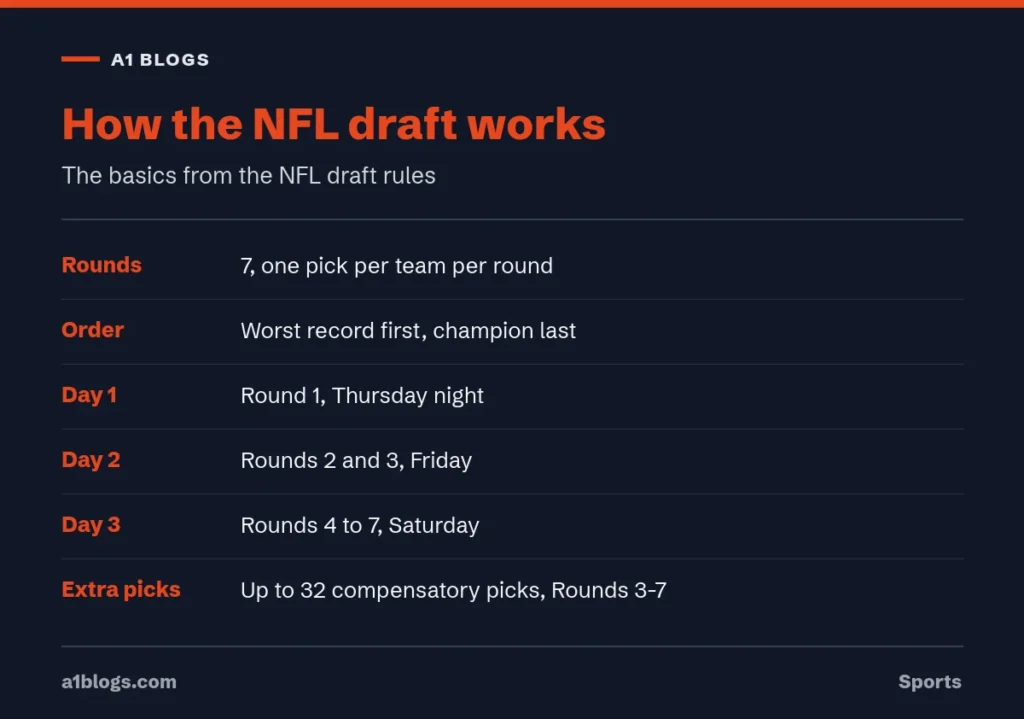
Here is the short version before we go into each part.
- Seven rounds. Each of the 32 teams gets one pick per round, plus any extra picks it has earned or traded for.
- Reverse order. Teams that had the worst records pick first, and the Super Bowl champion picks last in each round.
- Three days. The first round is on Thursday night, rounds 2 and 3 are on Friday, and rounds 4 through 7 are on Saturday.
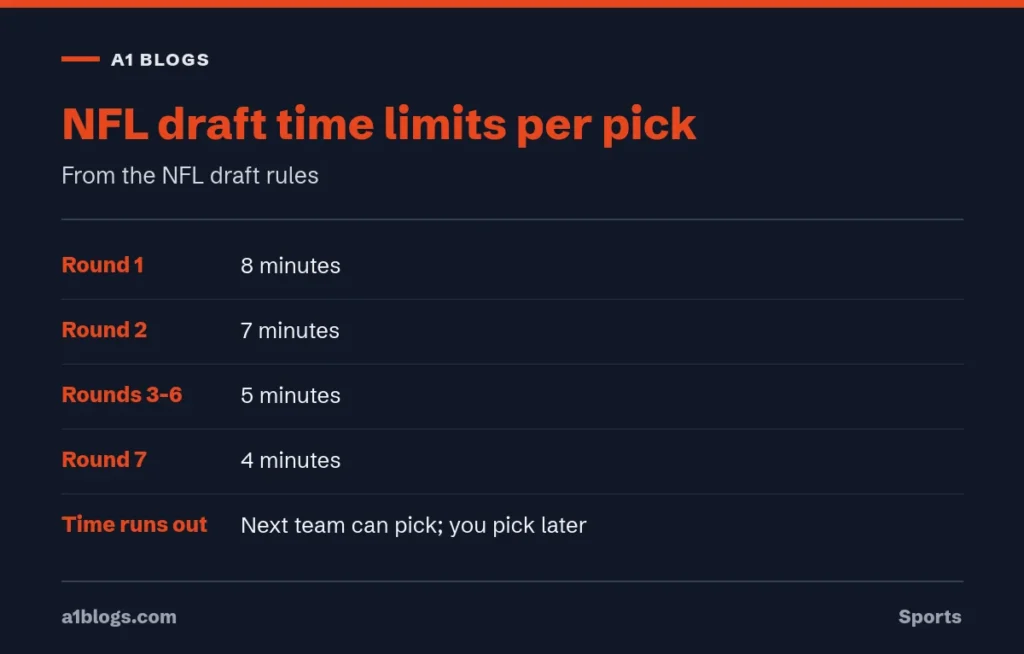
- Time limits. Teams get 8 minutes per pick in Round 1, 7 minutes in Round 2, 5 minutes in Rounds 3 through 6 and 4 minutes in Round 7.
- Trades allowed. Teams can trade picks and players before and during the draft.
- Extra picks. Up to 32 compensatory picks are added at the end of Rounds 3 through 7.
The NFL draft usually has about 257 picks in total. The exact number changes each year depending on compensatory picks and any picks the league takes away as penalties.
How the NFL draft order is set
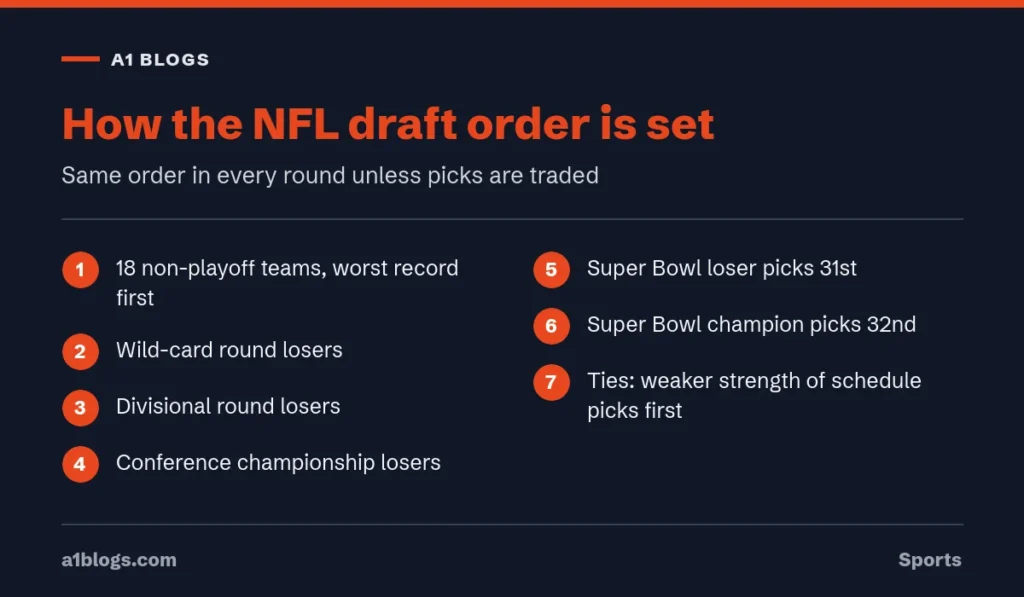
The NFL draft order rewards the teams that struggled most. The idea is to help weaker teams improve faster and keep the league competitive.
Teams that miss the playoffs
The 18 teams that do not make the playoffs pick first, ranked by regular-season record. The team with the worst record picks first overall. These spots are set as soon as the regular season ends in early January.
Playoff teams
The 14 playoff teams pick next. Under NFL draft rules, they are ordered by how far they went in the playoffs:
- Teams that lost in the wild-card round
- Teams that lost in the divisional round
- The two teams that lost in the conference championship games
- The Super Bowl loser, at No. 31
- The Super Bowl champion, at No. 32
Within each group, the team with the worse regular-season record picks first. This is why a wild-card team with 11 wins can pick before a division winner with 13 wins that lost in the same round.
Tiebreakers in the NFL draft order
When two teams have the same record, the NFL draft order uses strength of schedule. The team whose opponents had the lower combined winning percentage gets the higher pick. The logic is that a team that went 4-13 against weaker opponents is probably the worse team.
If teams are still tied, the league uses division or conference tiebreakers, then head-to-head results and a series of other steps. The last resort is a coin toss.
The order is the same in every round
The NFL draft order set after the season applies to all seven rounds. If you pick fifth in Round 1, you pick fifth in every round, unless picks have been traded. That is different from some fantasy drafts, which reverse the order every round.
The three days of the NFL draft
The draft takes place in late April. It moves to a different host city each year, and the 2026 NFL draft was held in Pittsburgh.
Day 1: the first round
The first round is on Thursday night and gets the biggest TV audience. Each team has 8 minutes to make its pick. The commissioner announces each first-round selection from the stage, and many of the top prospects attend in person, walking across the stage to shake hands and hold up their new team’s jersey.
Day 2: rounds 2 and 3
Friday evening covers the second and third rounds. Teams have 7 minutes per pick in Round 2 and 5 minutes in Round 3. This is where many future starters are found, and teams that traded out of the first round often add extra picks here.
Day 3: rounds 4 through 7
Saturday covers the final four rounds, with 5 minutes per pick through Round 6 and 4 minutes in Round 7. Picks come quickly, and teams often look for special teams players, backups and prospects who need development time. The last pick of the NFL draft is nicknamed Mr. Irrelevant, and the player gets a week of celebrations in Newport Beach, California.
What happens if a team runs out of time
If a team’s time runs out, it does not lose its pick. The next team can make its selection, and the team that ran out of time can still pick later. The risk is that the next team takes the player it wanted.
How trades work in the NFL draft
Trades are a big part of how the NFL draft works. Teams can trade picks and players with other teams at any time before and during the draft. Both teams report the trade to the league, which approves it before it is announced.
Trading up and trading down
A team that wants a specific player can trade up by giving another team a higher pick plus extra picks. A team that thinks several players are similar can trade down, picking a bit later but collecting more picks. Many teams use trade value charts, which give each pick a point value, to judge whether a deal is fair.
Trading future picks
Teams can also trade picks in future drafts. A team that wants a quarterback this year might give up its first-round pick next year to move up now. That is risky, because if the team has a bad season, the future pick it gave away could end up near the top of the NFL draft order.
Trading players for picks
Picks are also used as currency for player trades. A team might trade a veteran for a draft pick to save money or rebuild, or give up picks to add a star player. Those deals happen throughout the year, not only during the draft.
Compensatory picks
Compensatory picks are extra picks that the league awards to teams that lost more good free agents than they signed in the previous year. Under NFL draft rules, up to 32 compensatory picks are added at the end of Rounds 3 through 7.
The league uses a formula that looks at each free agent’s new salary, playing time and postseason honors. A team can receive up to four compensatory picks in one year. Since 2017, teams have been allowed to trade compensatory picks, which made them more valuable.
There is also a separate set of compensatory picks tied to diversity hiring. If a team’s minority or female staff member is hired as a head coach or top football executive by another team, the team that lost that person receives a third-round pick in each of the next two drafts, as long as the person had worked there for at least two full seasons.
Who can enter the NFL draft
Players must have been out of high school for at least three years to enter the draft. Most players are drafted after their third, fourth or fifth season in college.
Players who still have college eligibility left can declare early. Underclassmen must apply to the league by a January deadline, shortly after the college football national championship game. Those who declare give up their remaining college eligibility.
Players do not have to come from college. Prospects from international programs, smaller schools and other leagues can also be drafted if they meet the eligibility rules.
How teams scout before the NFL draft
Teams spend all year evaluating prospects. The process includes several major events.
College games and all-star games
Scouts watch college games all season, both in person and on film. After the season, all-star games such as the Senior Bowl give teams a week to watch top seniors practice and meet them in person.
The NFL Scouting Combine
The combine, long held in Indianapolis, is a week of testing in late February and early March. Prospects run the 40-yard dash, do the bench press and jumping drills, and go through position drills. Teams also hold interviews and run detailed medical exams, which can matter more than any drill.
Pro days and team visits
In March and April, colleges hold pro days where their players work out for NFL scouts. Teams also invite prospects to their facilities for visits and interviews. By draft day, most teams have a board that ranks hundreds of players.
What happens after a player is picked
When a team drafts a player, it holds that player’s rights. The player can negotiate only with that team.
Rookie contracts
Since 2011, rookie contracts have followed a set wage scale based on where a player is picked. Higher picks earn more. Every drafted player signs a four-year contract, and first-round picks come with a fifth-year option that the team can use to keep the player for one more season.
Because the money is set by the scale, most rookie deals are signed quickly. That was not always the case. Before the scale, long holdouts by top picks were common.
Undrafted free agents
As soon as the draft ends, teams race to sign the best players who were not picked. These undrafted free agents can sign with any team. Many go on to long NFL careers, and some have become stars, which is a good reminder that the draft is not the only way into the league.
A short history of the NFL draft
The first NFL draft was held in 1936 in Philadelphia. The Eagles took Jay Berwanger, the University of Chicago halfback who had just won the first Heisman Trophy, with the first pick. Berwanger never played in the league. He went into business instead, which shows how different pro football was at the time.
The draft grew longer and then shorter over the decades. For many years it ran 12 rounds or more, and in some years far more than that. The league cut it to 7 rounds in 1994, the format it still uses today.
For most of its modern history, the draft was held in New York. Starting in 2015, the league began moving it to a different city each year, with outdoor stages, fan festivals and free events. Chicago, Philadelphia, Dallas, Nashville, Cleveland, Las Vegas, Kansas City, Detroit and Green Bay have all hosted since then, and Pittsburgh hosted in 2026. Crowds in recent host cities have reached hundreds of thousands of people over the three days.
How to follow the NFL draft as a fan
The draft season starts long before April. Mock drafts, which predict each team’s picks, begin appearing as soon as the college season ends. They are fun to read, but even the best ones get only a handful of first-round picks exactly right, because teams trade and change their plans until the last minute.
Big boards are more useful. A big board ranks prospects from best to worst regardless of team needs, so it shows you which players experts value most. Comparing a few boards from different analysts gives you a good sense of where a player might go.
During the draft, pay attention to trades, especially in the first round. They often tell you more about a team’s plans than the picks themselves.
After the draft, analysts hand out grades for each team. Take them with a large grain of salt. It usually takes three seasons or more to know whether a draft class was good.
Common myths about the draft
One myth is that a drafted player has to sign with the team that picked him. He does not, but his options are limited. A player who refuses to sign can sit out and re-enter the draft the following year. Bo Jackson famously did this after the Buccaneers made him the first pick in 1986, and he was drafted again by the Raiders in 1987.
Another myth is that teams always draft the best player available. In practice, teams balance talent against need, contract situations and how a player fits their scheme. The best player on many boards is not always the first one taken.
How the NFL draft order is shaping up for 2027
The NFL draft order for next spring will be set by this season’s results. Every loss for a struggling team moves it closer to a top pick, which is why late-season games between losing teams are sometimes called draft-position games. Under NFL draft rules, only the regular-season record and playoff results matter. There is no lottery like the NBA uses.
If you play fantasy football, the draft also shapes next season’s rookie values. Our guide to fantasy football scoring explains how different scoring formats change which rookies matter. Many of next year’s top picks are playing in this year’s college season, and the race for the College Football Playoff is a good chance to watch them.
Frequently asked questions
How many rounds are in the NFL draft?
Seven. Each team gets one pick per round, plus any compensatory picks or picks gained in trades.
Why does the worst team pick first?
The NFL draft order is designed to help the weakest teams improve. Giving them the first chance at the best prospects keeps the league more balanced.
How long does a team have to make a pick?
Under NFL draft rules, teams have 8 minutes in Round 1, 7 minutes in Round 2, 5 minutes in Rounds 3 through 6 and 4 minutes in Round 7.
Can teams trade draft picks?
Yes. Teams can trade current and future picks, and they can trade picks for players. Compensatory picks can also be traded.
Who is eligible for the NFL draft?
Players who have been out of high school for at least three years. Underclassmen must declare by a January deadline.
What is Mr. Irrelevant?
The nickname for the last player picked in the NFL draft. He is celebrated with a week of events in Newport Beach, California.
Is there a lottery for the first pick?
No. Unlike the NBA, the NFL draft order is based only on records and playoff results, with strength of schedule as the first tiebreaker.
For the full rulebook, see the NFL’s official draft rules. The league also publishes combine results and prospect profiles.