Pickleball is easy to start and surprisingly tricky to play well. You can learn enough to rally in ten minutes, but the first time you play a real game, someone will call a kitchen fault, say a score with three numbers in it, or tell you that you can’t volley the return. Those moments are where most new players get lost.
This guide covers the pickleball rules every beginner needs, in the order you will meet them on the court: the court and equipment, the serve, the two-bounce rule, the kitchen rule, pickleball scoring in singles and doubles, faults and line calls. It also covers the changes in USA Pickleball’s 2026 rulebook, so you know what is current.
Table of Contents
Pickleball rules at a glance
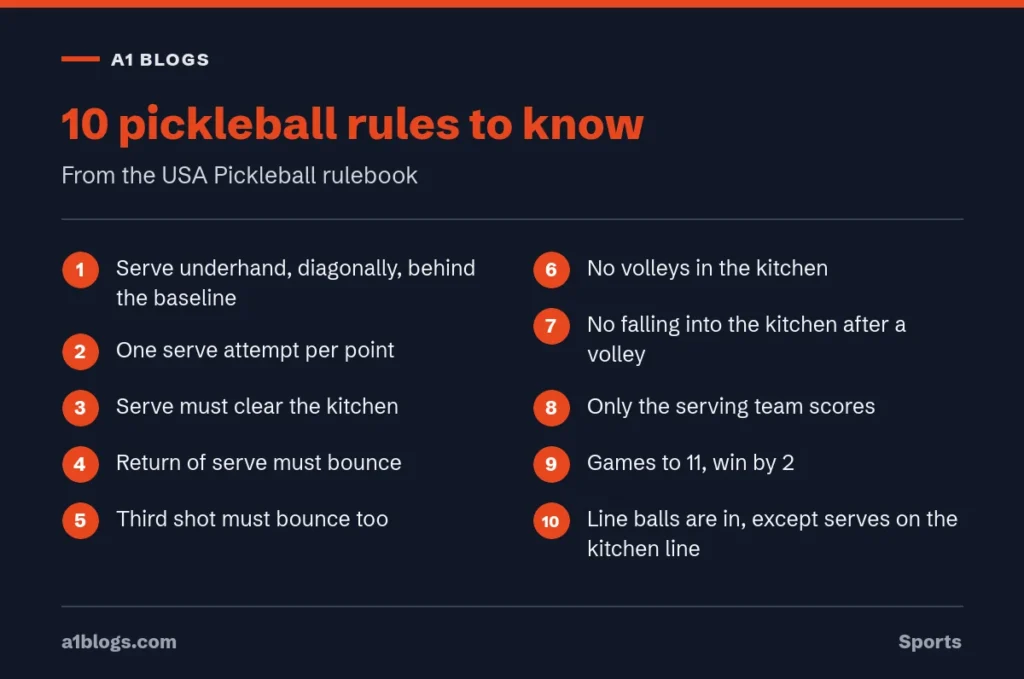
If you only remember ten things, make it these:
- Serve underhand, diagonally, from behind the baseline.
- You get one serve attempt per point.
- The serve must clear the kitchen and land in the correct service box.
- The return of serve must bounce before it is hit.
- The serving team’s next shot must also bounce. After that, volleys are allowed.
- You can’t volley while standing in the kitchen or on its line.
- Your momentum can’t carry you into the kitchen after a volley.
- In traditional pickleball scoring, only the serving team scores points.
- Games are usually played to 11, and you must win by 2.
- A ball that lands on any line is in, except a serve that lands on the kitchen line.
The rest of this guide explains each of these pickleball rules in more detail.
The court and equipment
A pickleball court is 20 feet wide and 44 feet long, the same size as a doubles badminton court. The same court is used for singles and doubles. The net is 36 inches high at the sidelines and 34 inches at the center.
The area within 7 feet of the net on each side is the non-volley zone, which everyone calls the kitchen. The kitchen line is part of the kitchen. Behind the kitchen, each side is split into a right and left service court by a center line.
Paddles are solid, with no strings. Under the pickleball rules, a paddle’s length and width added together can’t be more than 24 inches, and the paddle can’t be longer than 17 inches. Balls are hard plastic with holes. Outdoor balls are usually harder and have smaller holes than indoor balls, which helps them handle wind.
Pickleball rules for the serve
The serve starts every point, and the pickleball rules for serving are stricter than most beginners expect.
Where to stand
The server must have at least one foot behind the baseline when the paddle hits the ball, and neither foot can touch the baseline or the court inside it. The server must also stand between the imaginary extension of the center line and the sideline.
The volley serve
The traditional serve is the volley serve, where you hit the ball out of the air. Three things have to be true when you make contact:
- Your arm moves in an upward arc.
- The paddle head is below your wrist.
- You hit the ball below your waist.
The 2026 rulebook added the words clear and clearly to these three requirements. If the referee can’t clearly see that your serve met all three, it is a fault. In practice, that means a borderline sidearm serve is now more likely to be called.
The drop serve
The drop serve is an easier option for beginners. You drop the ball from your hand, let it bounce anywhere on the court, and then hit it. You can’t throw or bounce it down with force; it has to be a simple drop. Because the ball has bounced, the upward arc and below-the-waist requirements do not apply.
Where the serve has to land
The serve goes diagonally into the opponent’s service court. It has to clear the kitchen. A serve that lands in the kitchen or on the kitchen line is a fault, while a serve that lands on the sideline, center line or baseline of the correct service court is in.
You get only one serve attempt. There is no second serve in pickleball. Since 2021, there are also no service lets. A serve that clips the net and lands in the correct service court is in play.
The two-bounce rule
The two-bounce rule, sometimes called the double bounce rule, is one of the most important pickleball rules and one of the easiest to forget.
- The receiving team must let the serve bounce before returning it.
- The serving team must then let the return bounce before hitting it.
After those two bounces, either team can volley the ball, hitting it out of the air, or play it off the bounce.
The rule takes away the advantage of serving and rushing the net. It forces the serving team to stay back for one more shot, which is why the third shot is so important in pickleball strategy.
The kitchen rule
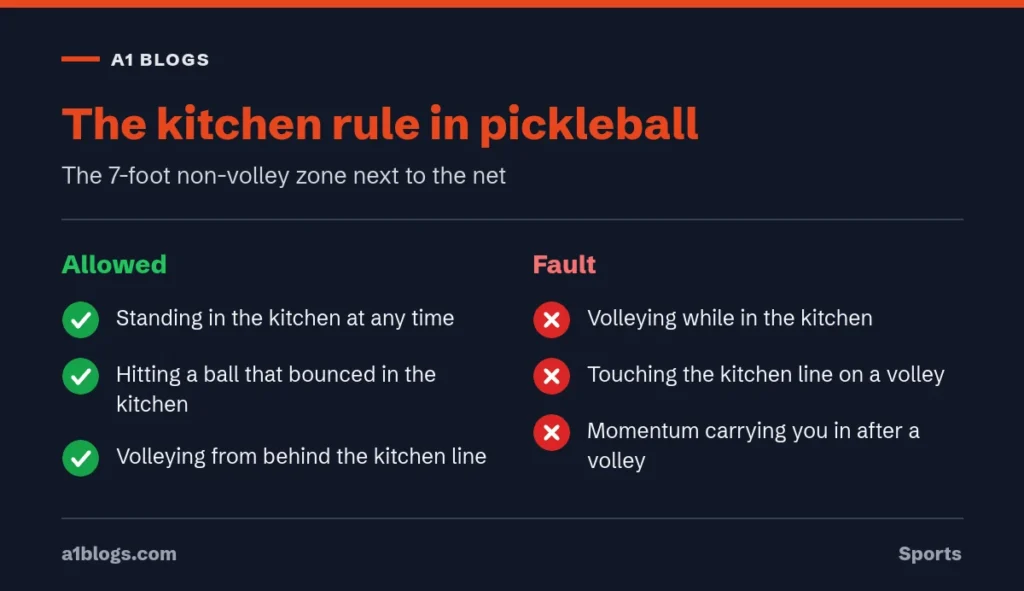
The kitchen rule is the pickleball rule that causes the most arguments. It is simple once you see what it actually says.
You can’t volley in the kitchen
You are not allowed to volley the ball while you are standing in the kitchen or touching the kitchen line. If any part of your body or anything you are wearing or carrying touches the kitchen during or after a volley, it is a fault.
Momentum counts
The kitchen rule also covers the moment after a volley. If you volley a ball while standing outside the kitchen, then your momentum carries you into the kitchen, it is a fault, even if the ball is already dead. Your paddle falling into the kitchen counts too.
You can stand in the kitchen
This surprises many beginners. You are allowed to be in the kitchen at any time. You can step in to hit a ball that has bounced, and you can stay there as long as you like. You just can’t volley while you are in it. Before you volley again, both feet have to be back outside the kitchen.
Pickleball scoring in doubles
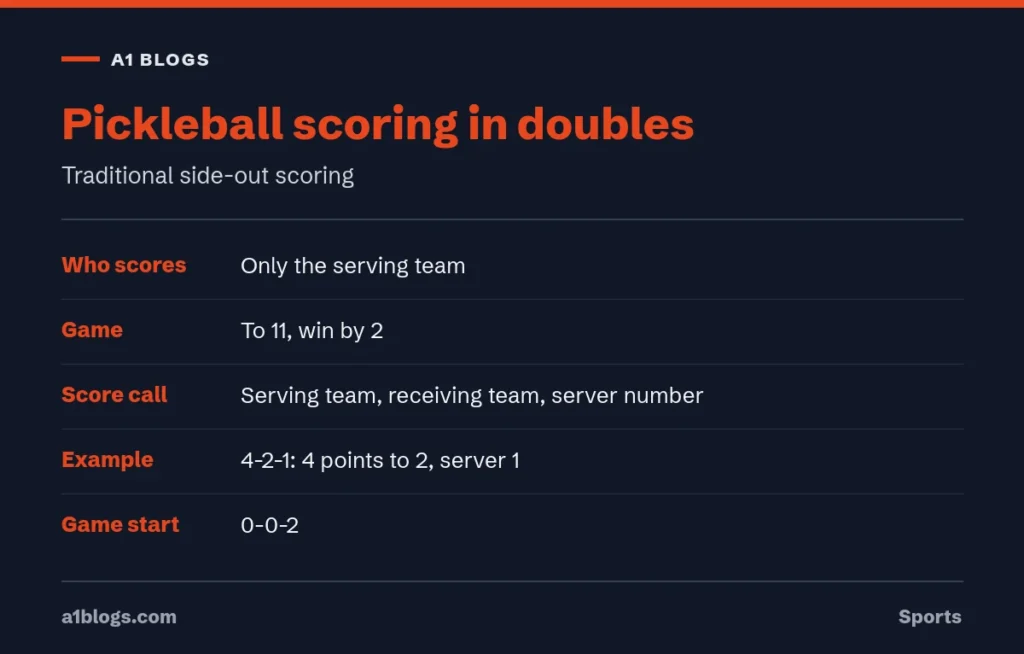
Traditional pickleball scoring uses side-out scoring, which means only the serving team can win points. If the receiving team wins the rally, it does not score. Instead, the serve passes to the next server or to the other team.
The three numbers
In doubles, the score is called with three numbers before every serve:
- The serving team’s score
- The receiving team’s score
- The server number, 1 or 2
A score of 4-2-1 means the serving team has 4 points, the receiving team has 2 and the first server on the serving team is serving.
Why games start at 0-0-2
In doubles, each player on a team gets to serve before the serve passes to the other team. At the very start of the game, though, only one player on the first serving team serves. To show that, the game starts at 0-0-2, as if the first server has already had a turn.
How the serve moves
The first server serves from the right side. Each time the serving team wins a point, the server switches sides with their partner and serves again from the other side. When the serving team loses a rally, the second partner serves from whichever side they are on. When the second server loses a rally, it is a side out, and the other team starts serving from the right.
Pickleball rules for doubles positions
Beginners often think partners have to stay on fixed sides of the court. They do not. The pickleball rules only care about two things before each serve: the correct player serves from the correct side, and the correct player on the other team receives.
Who is correct depends on the score. In doubles, the player who served first for a team serves from the right when that team’s score is even and from the left when it is odd. If you lose track, the score tells you where everyone should be, which is one more reason to call the full pickleball scoring numbers before every serve.
Once the ball is served, players can move anywhere on their side. Many experienced teams use a tactic called stacking. Both partners line up on the same side before the serve, then one moves across as soon as the ball is hit, so each player ends up on their stronger side. Stacking is legal, as long as the right player serves or receives.
If the wrong player serves or the server stands on the wrong side, it is a fault if it is caught before the next serve. In recreational games, most players simply correct the positions and replay the point.
Unwritten pickleball rules and etiquette
Some of the most important habits on a pickleball court are not in the rulebook. Following them makes you a welcome partner at any park.
- Call the score loudly and clearly. The server should say it before every serve, so nobody is surprised.
- Make fair line calls. If you did not clearly see the ball land out, it is in.
- Wait for your turn at busy courts. Many parks use a paddle rack, where players line up their paddles to show the order for the next game.
- Don’t walk behind a court during a point. Wait until the rally is over, then cross quickly.
- Tap paddles after the game. Players usually meet at the net and tap paddles as a handshake.
Open play groups often mix levels, so try to match the pace of the game. Hitting hard at a beginner who is standing at the kitchen line is legal under the pickleball rules, but it rarely makes you friends.
Pickleball scoring in singles
Singles pickleball scoring is simpler, because there is only one server per side. The score is called with two numbers, the server’s score first.
The server serves from the right side when their score is even and from the left side when their score is odd. When the server loses a rally, it is a side out and the opponent serves.
Rally scoring and the 2026 changes
Some events and leagues use rally scoring instead of side-out scoring. In rally scoring, a point is scored on every rally, no matter which team served. Games are usually played to a higher total, such as 15 or 21.
Until 2026, rally scoring games had one exception: game point had to be won by the serving team. The 2026 USA Pickleball rulebook removed that requirement, so under the new pickleball rules a point is a point at all times. If your team leads 14-10 in a game to 15 and the other team serves into the net, you win.
The 2026 rulebook also changed line calls. If you return the ball, your out call has to come before your opponent hits their next shot. You can’t keep playing and then call a ball out after you see how the rally goes. The rulebook also added a new section with rules for wheelchair players, standing players with physical limitations and hybrid doubles teams.
Faults and line calls
A fault ends the rally. Common faults under the pickleball rules include:
- Hitting the ball out of bounds or into the net
- Volleying before the two-bounce rule allows it
- Breaking the kitchen rule
- A serve that does not land in the correct service court
- The ball hitting a player or their clothing
- Touching the net with your body or paddle while the ball is in play
A ball that touches any part of a line is in, with the one exception of a serve that lands on the kitchen line. In recreational play, each team calls the lines on its own side, and if you are not sure, the ball is in.
Where pickleball came from
Pickleball was invented in 1965 on Bainbridge Island, near Seattle, by Joel Pritchard, Bill Bell and Barney McCallum. They put it together on a badminton court with ping-pong paddles and a perforated plastic ball to entertain their families. Washington made it the official state sport in 2022.
Today the sport is played in parks, gyms and clubs across the United States, and the Sports & Fitness Industry Association has named it the fastest-growing sport in America in several recent years. Many players come from tennis, and the scoring is a common point of confusion. If you know tennis, our guide to tennis scoring shows how different the two systems are.
Mistakes beginners make
The most common mistake is running to the net after serving. The two-bounce rule means the return will bounce in your court first, so stay near the baseline until the third shot is hit.
The second is volleying from inside the kitchen, or stepping into it right after a volley at the net. Breaking the kitchen rule this way is the most common fault at the net, so practice stopping just behind the kitchen line.
The third is getting pickleball scoring wrong. Say the three numbers before every serve in doubles. It feels awkward at first but saves arguments.
The fourth is hitting the ball hard all the time. Soft shots that land in the kitchen, called dinks, are a big part of the game, because they are hard to attack.
Frequently asked questions
What is the kitchen rule in pickleball?
The kitchen rule says you can’t volley the ball while standing in the 7-foot non-volley zone next to the net, or let your momentum carry you into it after a volley. You can enter the kitchen to hit a ball that has bounced.
How do you score in pickleball?
In traditional pickleball scoring, only the serving team scores. Games go to 11, and you must win by 2. In doubles, the score is called with three numbers: serving team, receiving team and server number.
Can you serve overhand in pickleball?
No. The volley serve must be hit with an upward arc, below your waist, with the paddle head below your wrist. The drop serve is another option.
Does the serve have to bounce in pickleball?
Yes. Under the two-bounce rule, the receiving team must let the serve bounce, and the serving team must let the return bounce.
Is a ball on the line in or out?
In, except for a serve that lands on the kitchen line, which is a fault.
What changed in the pickleball rules for 2026?
In rally scoring, game point no longer has to be won on serve. Out calls must be made before the opponent hits the ball, the volley serve requirements must be clearly met, and a new section covers adaptive play.
Can you hit the ball before it bounces in pickleball?
Yes, once the two-bounce rule has been met. After the return and the third shot have each bounced once, players can volley, as long as they are not standing in the kitchen.
How long does a game of pickleball take?
A recreational doubles game to 11 usually takes 10 to 20 minutes, depending on the level of play and how many side outs there are. Many open play sessions rotate players after each game.
For the full rulebook, see USA Pickleball. A summary of the 2026 changes is available from The Kitchen.