
Tennis scoring confuses almost everyone the first time. Points go 15, 30, 40 instead of 1, 2, 3. Zero is called love. A game at 40-40 can go on for ten more minutes, and a set at 6-6 suddenly switches to a different way of counting. Once you understand the logic, though, a tennis score tells you exactly where a match stands.
This guide explains tennis scoring from the smallest unit to the biggest: points, games, sets and matches. It covers deuce and advantage, how a tennis tiebreak works, the 10-point tiebreak used at the Grand Slams, no-ad scoring and how to read a tennis score on TV. It finishes with the mistakes beginners make when keeping score at the local courts.
Table of Contents
Tennis scoring in 4 levels
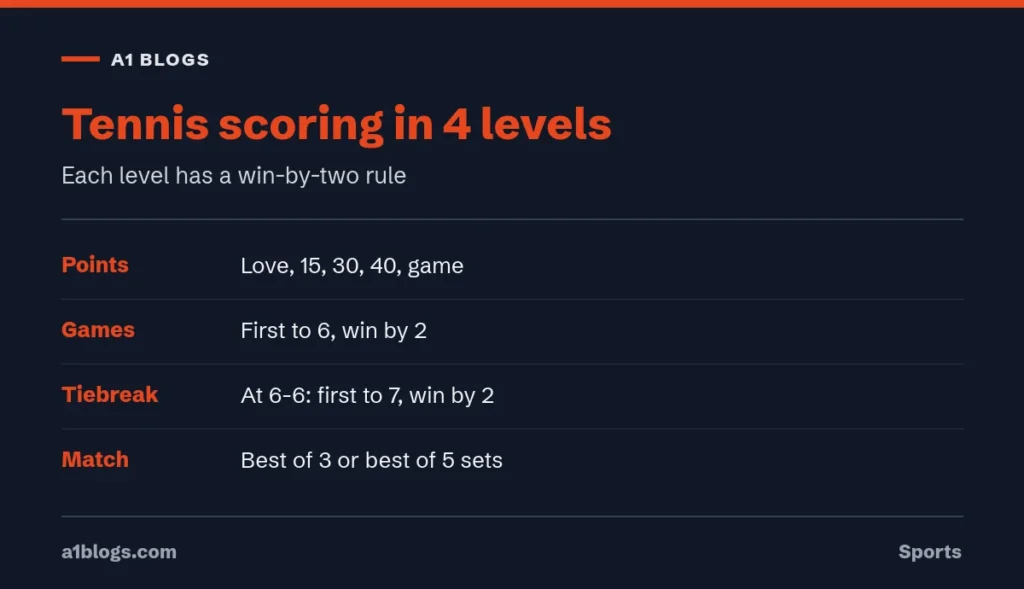
The easiest way to learn tennis scoring is to think of it as four levels, each built from the one below it.
- Points make up a game.
- Games make up a set.
- Sets make up a match.
- Tiebreaks settle a set when the games are tied at 6-6.
You need four points to win a game, six games to win a set and two or three sets to win a match. Each level has a win-by-two rule, which is why tennis matches can stretch on for so long.
How points work in a game
A game is played with the same player serving for every point. The first player to win four points wins the game, as long as they are at least two points ahead.
The point names
Tennis scoring uses special names for points:
- 0 points: love
- 1 point: 15
- 2 points: 30
- 3 points: 40
- 4 points: game
The server’s score is always called first. If the server has won two points and the receiver has won one, the tennis score is 30-15. If the receiver leads by the same margin, it is 15-30. When both players have the same score, the umpire says all, as in 15-all or 30-all.
Why 15, 30 and 40?
Nobody knows for sure. One popular theory says early scorekeepers used a clock face, moving the hand to 15, 30 and 45 minutes, and 45 was later shortened to 40. Another theory links love to the French word for egg, l’oeuf, because a zero looks like an egg. Historians have not confirmed either one, so treat them as stories rather than facts.
Deuce and advantage
When the score reaches 40-40, it is called deuce. From deuce, a player has to win two points in a row to win the game.
- If the server wins the next point, the score is advantage server, often called ad-in.
- If the receiver wins it, the score is advantage receiver, or ad-out.
- If the player with the advantage wins the next point, they win the game.
- If they lose it, the score goes back to deuce.
There is no limit to how many times a game can go back to deuce. Some games last 20 points or more.
How sets work
The first player to win six games wins the set, as long as they lead by at least two games. A set can end 6-0, 6-1, 6-2, 6-3 or 6-4.
If the score reaches 5-5, the set continues. A player who wins the next two games wins 7-5. If the players split those two games, the score is 6-6, and in most tennis scoring systems a tiebreak decides the set.
Serving and changing ends
Players take turns serving games. The server alternates between the right side of the court, called the deuce court, and the left side, called the ad court. The first point of every game is served from the deuce court.
Players change ends of the court after the first game of each set and then after every two games, so they swap after the first, third, fifth and seventh games, and so on. This balances out the effects of the sun and wind.
How a tennis tiebreak works
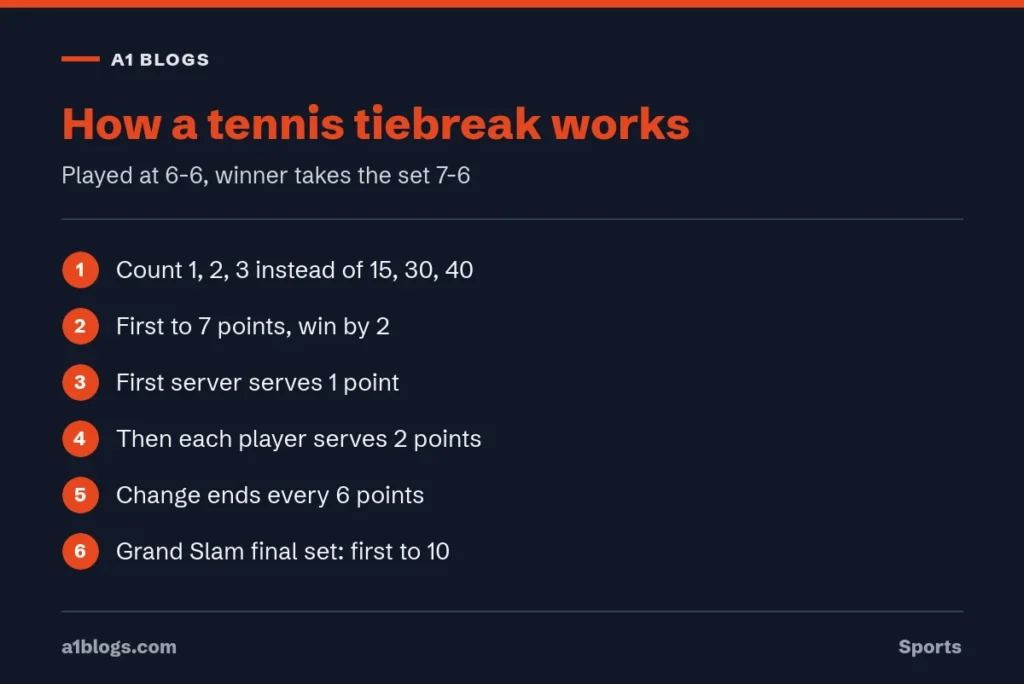
The tennis tiebreak was invented to stop sets from going on for hours. It is played as a single special game at 6-6, and the winner takes the set 7-6.
Tiebreak scoring
A standard tennis tiebreak uses ordinary numbers instead of 15, 30 and 40. The first player to reach 7 points wins, as long as they are at least two points ahead. If the score reaches 6-6 in the tiebreak, it continues until one player leads by two, which can mean scores like 10-8 or 12-10.
Who serves in a tiebreak
The serve rotates differently in a tennis tiebreak.
- The player whose turn it is to serve serves the first point, from the deuce court.
- After that, each player serves two points in a row, starting from the ad court.
- Players change ends after every six points, for example at 4-2 or 3-3.
- The player who served first in the tiebreak receives first in the next set.
The two-points-each pattern keeps the tiebreak fair, because neither player gets to serve more than one extra point.
How tiebreaks appear in a tennis score
On TV and in results, a set won in a tiebreak is shown as 7-6. The loser’s tiebreak points are often shown in brackets, so 7-6(5) means the winner took the tiebreak 7-5. A set score of 7-6(10) means the tiebreak finished 12-10.
How matches work
A match is won by taking the majority of sets.
- Best of three sets: the first player to win two sets wins. This is the format for most professional events and for women’s singles at the Grand Slams.
- Best of five sets: the first player to win three sets wins. Men’s singles at the four Grand Slam tournaments use this format.
Most club and high school matches are best of three sets, sometimes with a shorter format for the third set, which we cover below.
The 10-point tiebreak at the Grand Slams
For many years, each Grand Slam had its own rule for the final set. Some played on until a player led by two games, and the matches could last for hours. In 2010 at Wimbledon, John Isner beat Nicolas Mahut 70-68 in the fifth set, in a match that lasted 11 hours and 5 minutes over three days.
Since 2022, all four Grand Slams use the same tennis scoring rule for the final set. If the score reaches 6-6 in the deciding set, the players play a tiebreak to 10 points instead of 7, still with a two-point margin. A deciding set won this way is shown as 7-6, with the tiebreak score in brackets, such as 7-6(10-8).
The match tiebreak
In some formats, a full third set is replaced with a match tiebreak, also called a super tiebreak. It is played to 10 points with a two-point margin, using the same serving pattern as a normal tennis tiebreak. Professional doubles events use it in place of a third set, and many club leagues and junior events use it to keep matches short.
No-ad tennis scoring
No-ad scoring removes advantage points. When a game reaches deuce, the next point decides the game. The receiver, or the receiving team in doubles, chooses which side of the court to receive from.
No-ad tennis scoring makes games faster and more predictable in length. It is used in US college tennis and in professional doubles. Many recreational leagues use it too, so check the rules before your first match.
Shorter formats you will see in leagues
Not every match is played over full sets. Club leagues, junior events and social round robins often use shorter formats to fit more matches into an evening.
- Pro set: a single set to 8 games instead of 6, with a two-game margin. A tiebreak is usually played at 8-8.
- Short sets: sets to 4 games, with a tiebreak at 4-4. They are popular in junior events and some social formats.
- Timed matches: players count games until time runs out. The player ahead wins, and a tie is often settled by one deciding point.
- Match tiebreak instead of a third set: split sets are settled by a 10-point tiebreak, which can cut 40 minutes or more from a match.
If you join a league, the format is usually printed on the scorecard or the league website. Read it before your first match so you are not arguing about it at 5-5 in the second set.
How to keep score in a friendly match
In social tennis there is no umpire, so players keep score themselves. A few simple habits keep things smooth.
Start by deciding who serves first. Many players spin a racket and call up or down based on the logo on the handle. The winner can choose to serve, receive or pick a side.
The server calls the game score out loud before every point, server’s score first. Many players also call the set score at the start of each game, such as 3-2. If you lose track, go back to the last score both players agree on.
Each player makes the line calls on their own side of the net. If you are not sure whether a ball was out, the standard etiquette is to call it in. Your opponent will do the same for you.
Penalties in professional tennis
At the professional level, an umpire can change the score as a penalty. Under the code of conduct, a player who breaks the rules first gets a warning. A second offense costs a point, and further offenses can cost a game or lead to a default, which ends the match.
Time rules matter too. At the Grand Slams, a serve clock gives the server 25 seconds between points. Players who go over can receive a warning and then lose a first serve. Most fans never notice these rules until they decide a big moment, but they are part of the official scoring system.
How to read a tennis score on TV
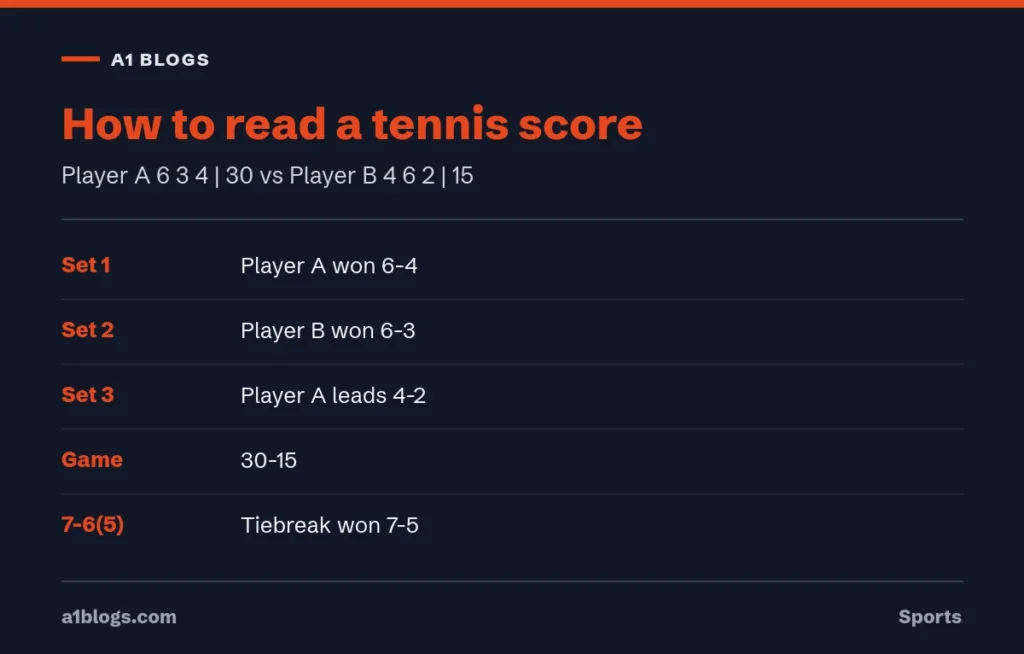
A tennis score on a TV graphic packs a lot of information into one line. Here is a typical example:
Player A 6 3 4 | 30 versus Player B 4 6 2 | 15
Reading it from left to right:
- Player A won the first set 6-4.
- Player B won the second set 6-3.
- Player A leads the third set 4-2.
- In the current game, the score is 30-15.
A small dot or ball icon next to a name shows who is serving. During a tiebreak the game score switches to normal numbers, such as 4-3.
Key moments in a tennis score
Commentators use a few terms you will hear in every match.
- Break point: the receiver is one point from winning a game on the other player’s serve.
- Break of serve: the receiver wins the game. Breaking serve is the main way players win sets.
- Hold: the server wins their own service game.
- Set point and match point: one player is a point away from winning the set or match.
Understanding these terms helps you follow the momentum of a match, because a single break of serve is often enough to win a set.
A short history of tennis scoring
The modern game took shape in England in the 1870s, and the points system of 15, 30 and 40 came from older forms of the game played in France. The tiebreak is much newer. American tennis promoter James Van Alen pushed for a quicker way to end sets, and the US Open became the first Grand Slam to use a tiebreak in 1970.
Other events followed over the next decades, but final sets were treated differently for a long time. The Isner and Mahut match at Wimbledon in 2010 became a symbol of why change was needed. Wimbledon brought in a final-set tiebreak at 12-12 in 2019, and in 2022 all four Grand Slams agreed on the 10-point tiebreak at 6-6.
Tennis scoring mistakes beginners make
If you play socially, these mistakes come up often.
The first is calling the score in the wrong order. The server’s score always comes first, and in friendly matches the server should call the score before each point. That habit prevents most arguments.
The second is serving from the wrong side. If the total number of points in the game is even, such as at 0-0, 15-15 or 30-0, serve from the deuce court. If it is odd, serve from the ad court.
The third is forgetting the serving order in a tennis tiebreak. Remember one serve for the first player, then two each.
The fourth is forgetting to change ends after odd games. It seems minor, but on a windy or sunny day it can make a real difference.
The last is not agreeing on the format before you start. Decide whether you are playing advantage or no-ad, and whether a third set will be a full set or a match tiebreak.
Frequently asked questions
What does love mean in tennis scoring?
Love means zero. A score of 15-love means the server has won one point and the receiver none.
How many points do you need to win a tennis tiebreak?
Seven points, with a lead of at least two. In the final set at Grand Slams and in match tiebreaks, you need 10 points with a two-point lead.
Why does tennis use 15, 30 and 40?
The origin is unclear. A popular theory involves a clock face used to keep score, with 45 later shortened to 40, but historians have not confirmed it.
What happens at 6-6 in a set?
In most formats, the players play a tennis tiebreak. The winner takes the set 7-6.
What is deuce?
Deuce is a score of 40-40. From deuce, a player must win two points in a row to win the game, unless the match uses no-ad tennis scoring.
How is a tennis score different in doubles?
The tennis scoring system is the same in doubles. Teams take turns serving games, and the players on each team alternate serving their team’s service games. Professional doubles usually uses no-ad scoring and a match tiebreak instead of a third set.
What is a bagel in tennis?
A bagel is a set won 6-0, because the zero looks like a bagel. A set won 6-1 is sometimes called a breadstick.
Can a set end 7-5?
Yes. If the score reaches 5-5, a player who wins the next two games takes the set 7-5. A tiebreak is only played if the set reaches 6-6.
Do you have to win by two in every part of tennis?
Almost. Games, sets, tiebreaks and match tiebreaks all need a two-point or two-game margin. The exceptions are no-ad games and some timed formats, where a single deciding point is used.
Tiebreaks are one way sports settle a tie quickly. Hockey uses a different idea, which our guide to NHL overtime rules explains. For more sports explainers, see our golf handicap guide. The full official rules are published by the International Tennis Federation, and the USTA has resources for finding leagues and courts in the US.