
Fantasy football scoring looks simple until you join a second league and find that the same player scored 14 points in one and 21 in the other. The difference is almost always the scoring format. Standard, half-PPR and full PPR scoring reward the same plays in different ways, and that changes which players you should draft, start and trade for.
This guide explains how fantasy points are calculated for each position, walks through real examples in all three formats, and shows how common custom settings change player values. Exact numbers vary between platforms and leagues, so treat the values below as the most common defaults and check your own league settings.
Table of Contents
How fantasy football scoring works
Every fantasy football scoring system does the same basic job. It turns a player’s real NFL stats into fantasy points. Yards, touchdowns and catches add points. Interceptions and lost fumbles take points away. Your team’s score for the week is the total of the fantasy points from the players in your starting lineup. Points from players on your bench do not count.
The three main formats differ in one setting: how many points a player earns for each catch.
- Standard: no points for catches. Players score only from yards and touchdowns.
- Half-PPR: half a point for each catch.
- PPR scoring: one full point per reception.
That one setting sounds small, but a receiver who catches 100 passes in a season earns 100 extra points in a PPR league. That can move a player up several rounds in your draft.
Fantasy football scoring for offensive players
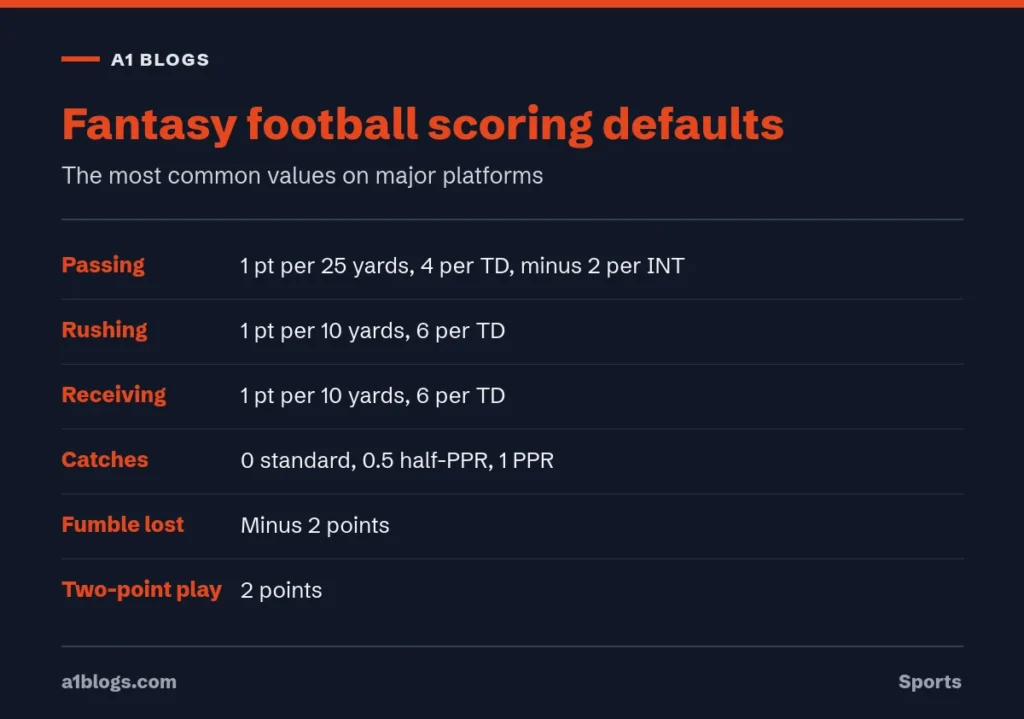
Most leagues use the same values for offense, with the catch bonus as the main difference. These are the most common defaults on the big platforms.
Passing
- 1 point for every 25 passing yards (0.04 points per yard)
- 4 points per passing touchdown
- Minus 2 points per interception thrown
- 2 points for a two-point conversion pass
Some leagues give 6 points for a passing touchdown instead of 4. That small change makes quarterbacks much more valuable, which we cover later.
Rushing and receiving
- 1 point for every 10 rushing or receiving yards (0.1 points per yard)
- 6 points per rushing or receiving touchdown
- 2 points for a two-point conversion run or catch
- Minus 2 points for each fumble lost
- Plus 0.5 or 1 point per catch in half-PPR or PPR scoring
A lost fumble costs points, but a fumble your team recovers usually does not. Return yards on kickoffs and punts usually go to the team defense rather than to the individual player, although some leagues count them.
Kicker and defense scoring
Kickers and team defenses use their own scoring rules, and they vary more between platforms than offense does.
Kickers
- 1 point per extra point made
- 3 points for a field goal of 0 to 39 yards
- 4 points for a field goal of 40 to 49 yards
- 5 points for a field goal of 50 yards or more
Some platforms take away a point for a missed extra point or a missed short field goal. A few leagues give 1 point for every 10 yards of a made field goal, so a 47-yard kick earns 4.7 points.
Team defense and special teams
Team defense (often listed as D/ST or DEF) earns points for plays that help it stop the other team:
- 1 point per sack
- 2 points per interception
- 2 points per fumble recovery
- 2 points per safety
- 2 points per blocked kick
- 6 points per defensive or return touchdown
Most leagues also give points based on how many points the defense allowed. A common scale gives 10 points for a shutout and fewer points as the opponent scores more, down to a negative score if the defense gives up 35 or more. Check your league settings, because this scale differs more than any other part of fantasy football scoring.
Standard vs half-PPR vs PPR scoring
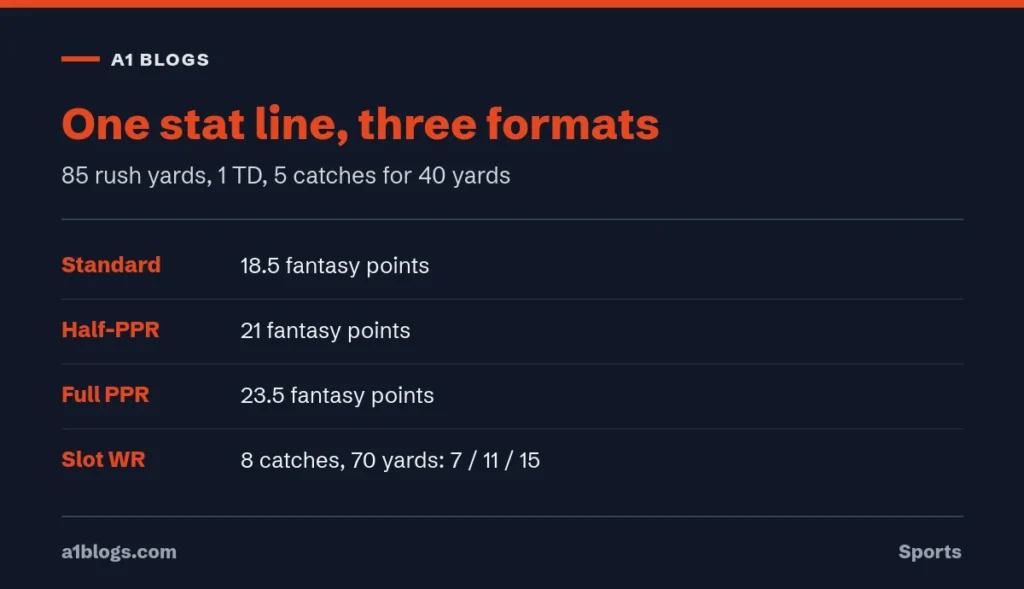
The best way to see the difference is with one stat line scored three ways.
Say a running back runs for 85 yards and a touchdown and catches 5 passes for 40 yards. His yards are worth 12.5 points (125 total yards divided by 10), and the touchdown adds 6.
- Standard: 12.5 + 6 = 18.5 points
- Half-PPR: 18.5 + 2.5 = 21 points
- PPR scoring: 18.5 + 5 = 23.5 points
Now take a slot receiver who catches 8 passes for 70 yards and no touchdowns.
- Standard: 7 points
- Half-PPR: 11 points
- PPR scoring: 15 points
In standard leagues the running back scored more than twice as many points as the receiver. In PPR scoring the gap shrinks from 11.5 points to 8.5. Over a full season, those differences decide who is a starter and who sits on your bench.
A quarterback example
A quarterback throws for 275 yards, 2 touchdowns and 1 interception, and also runs for 20 yards.
- Passing yards: 275 divided by 25 = 11 points
- Passing touchdowns: 2 times 4 = 8 points
- Interception: minus 2 points
- Rushing yards: 20 divided by 10 = 2 points
That is 19 points in every format, because catches do not affect quarterbacks. In a league with 6-point passing touchdowns, the same game is worth 23 points.
Which format should your league use?
There is no correct fantasy football scoring format. Each one rewards a different type of player, and each league picks the one its members enjoy.
Standard scoring
Standard leagues reward touchdowns and big plays. Running backs who get carries near the goal line are worth more, and weekly scores swing more because a single touchdown is a big share of a player’s total. Some players like that randomness. Others find it frustrating.
Half-PPR scoring
Half-PPR is a middle ground. It gives reliable pass catchers a boost without making a five-catch, 30-yard game look better than a strong rushing day. Many fantasy players see it as the most balanced option, and it is the default on some popular platforms.
Full PPR scoring
PPR scoring rewards volume. Wide receivers and running backs who catch a lot of short passes become steady weekly starters, and scores are higher and a bit more predictable. Most high-stakes and expert leagues use full PPR scoring or a variation of it.
How PPR scoring changes your draft
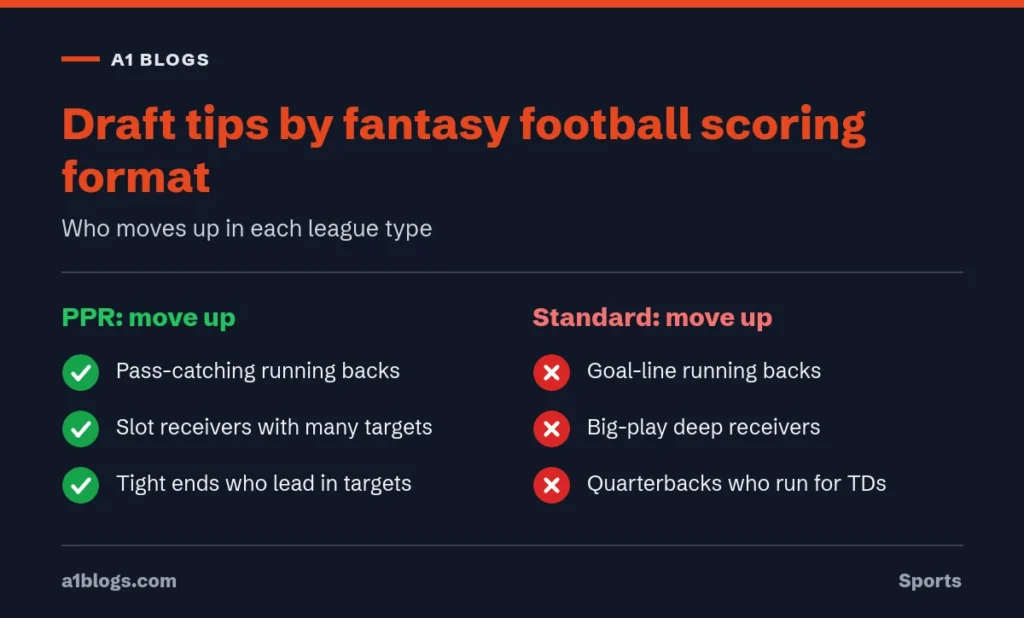
Once you know your league’s fantasy football scoring, you can adjust your draft rankings. Most platforms let you view rankings for your exact format, and that is the first thing to check.
In PPR scoring, move these players up:
- Running backs who catch a lot of passes, even if they share carries
- Slot receivers who see many short targets
- Tight ends who are a main target in their offense
In standard scoring, move these players up:
- Running backs who get goal-line carries
- Big-play receivers who score long touchdowns
- Quarterbacks who run for touchdowns
Targets matter more than catches when you predict PPR fantasy points, because a player can’t catch passes that are not thrown to him. Look at a player’s target share, which is the percentage of his team’s passes thrown his way.
Common custom fantasy football scoring settings
Many leagues tweak the defaults. Before you draft, read your league’s settings page for these changes.
Six-point passing touchdowns
Giving quarterbacks 6 points per touchdown pass, the same as runners and receivers, makes passing touchdowns worth 50% more. Quarterbacks become the highest-scoring players by a wide margin, and drafting one early makes more sense.
Superflex and two-quarterback leagues
A superflex spot can be filled by a quarterback or any other offensive player. Because quarterbacks score the most fantasy points, almost everyone puts one there. That doubles the demand for starting quarterbacks, and they go much earlier in drafts.
Tight end premium
Tight end premium leagues give tight ends extra points per catch, often 1.5 instead of 1 in PPR scoring. The goal is to make the position more valuable, because only a few tight ends score as many fantasy points as top receivers.
Points per first down
Some leagues give half a point or a full point when a player gains a first down. This rewards running backs who pick up short yardage and receivers who make catches past the marker.
Bonus points
Bonuses add points for reaching milestones, such as 100 rushing yards, 300 passing yards or a touchdown of 40 yards or longer. They add excitement but also add randomness, because a player who finishes with 99 yards gets nothing extra.
Decimal scoring
Most platforms now use decimal scoring, so every yard counts. With older rounding rules, 19 rushing yards earned 1 point. With decimal scoring, the same 19 yards earn 1.9 points.
Head-to-head, points leagues and best ball
The scoring rules decide how many points each player earns. The league type decides what you do with those points, and it changes how much a single bad week hurts.
Head-to-head leagues
This is the format most people play. Each week your team faces one opponent, and the higher total wins. Your record decides who makes the playoffs, which usually start in Week 15 or so and run through Week 17. A strong team can still lose a week to a weaker one, which is part of the fun and part of the frustration.
Total points leagues
In a total points league there are no weekly matchups. Every point your starters score adds to a season total, and the team with the most at the end wins. Luck in the schedule matters less, so steady players are worth a bit more.
Best ball
In best ball you draft a roster and never set a lineup. The platform counts your highest-scoring players at each position every week. There are no waiver moves or trades in most best ball formats, so depth and players with big weekly upside matter more than in a normal league.
Keeper and dynasty leagues
Keeper leagues let you hold on to a few players for next season. Dynasty leagues keep the whole roster from year to year and add a rookie draft. Scoring works the same way, but a young player’s value over several seasons matters as much as what he does this week.
How your lineup affects your weekly score
The number of starters in your league changes how high scores go. A common lineup has one quarterback, two running backs, two wide receivers, one tight end, one flex spot, one kicker and one team defense. That is nine starters, plus six or seven bench spots.
The flex spot can usually hold a running back, wide receiver or tight end. In a PPR league, a receiver often fills it, because receivers who catch a lot of passes post steadier numbers. Leagues with two flex spots or a third starting receiver raise the value of deep receiver groups.
Bench players are your insurance. Bye weeks run through most of the season, and injuries happen every Sunday. A good bench has backups for the positions you can’t afford to leave empty, plus one or two upside players who could become starters if someone ahead of them gets hurt.
One more thing to check: when your lineup locks. Most platforms lock each player when his game kicks off, so you can still change a Sunday player after a Thursday game has started. A few leagues lock the whole lineup at the first game of the week.
Ties and tiebreakers
Close matchups happen more often than you might think. If both teams finish with the same total, platforms handle it differently. Some record a tie. Others break it with bench points, the highest-scoring starter or decimal points to more places. During the playoffs most leagues use a tiebreaker so one team advances.
For the season standings, ties in record are usually broken by total points scored. That makes every point count, even in weeks when your matchup is already decided. If you are far ahead or far behind on Monday night, keep your best players in your lineup anyway.
How to check your league’s settings in two minutes
Open your league on your platform’s app or website and look for the league settings or scoring page. Check four things: points per catch, points per passing touchdown, any bonuses, and the lineup positions. Then filter your draft rankings or weekly projections to those settings. It takes two minutes and prevents the most common draft mistakes.
Stat corrections and Monday night swings
Your weekly score is not always final on Monday night. The NFL sometimes changes official stats after reviewing the game, for example by moving a catch to a different player or changing a run into a lateral. Fantasy platforms apply these stat corrections later in the week, and a close matchup can flip.
If your matchup is decided by less than a point or two, wait until the platform finalizes the week before you celebrate. Most leagues lock results after corrections are processed.
It also helps to know when your players are on the field. Games run from Thursday night to Monday night, and some weeks include Saturday or holiday games. Our guide on how to watch NFL games without cable explains which channels and apps carry each time slot.
Mistakes to avoid with fantasy football scoring
The first mistake is using the wrong rankings. A cheat sheet built for PPR scoring can lead you to draft a pass-catching back in the second round of a standard league, where he is worth much less. Always match your rankings to your league’s format.
The second is ignoring defense and kicker settings. If your league gives big bonuses for long field goals or rewards defenses heavily for sacks, those positions can matter more than usual.
The third is forgetting about overtime. Points scored in overtime count toward fantasy points, and a touchdown in the extra period can decide a matchup. The NFL changed its regular-season overtime rules in 2025, and our NFL overtime rules guide explains how they work now.
Frequently asked questions
What does PPR mean in fantasy football?
PPR stands for points per reception. In PPR scoring, a player earns 1 point every time he catches a pass, on top of the points for his yards and touchdowns.
How many points is a touchdown in fantasy football?
Rushing and receiving touchdowns are usually worth 6 fantasy points. Passing touchdowns are usually worth 4, although some leagues give 6.
What is a good fantasy football score for a week?
It depends on your league’s fantasy football scoring and how many starters you have. In a typical PPR league with nine starters, a team score above 120 points is usually strong. Compare your score with your league’s weekly average to judge it.
Do quarterbacks get points per reception?
Only if they catch a pass, which is rare. PPR scoring adds points for catches, not for completions, so it does not change quarterback scoring.
Is half-PPR better than full PPR?
Neither is better. Half-PPR scoring gives a balance between catches and touchdowns, while full PPR scoring rewards high-volume pass catchers. Pick the format your league finds most fun.
Do defensive players score fantasy points?
In most leagues you start a whole team defense rather than individual players. Leagues with individual defensive players, called IDP leagues, score tackles, sacks and interceptions for each player.
For scoring settings and rules on a major free platform, see the help pages at NFL Fantasy. Official player stats are on NFL.com.