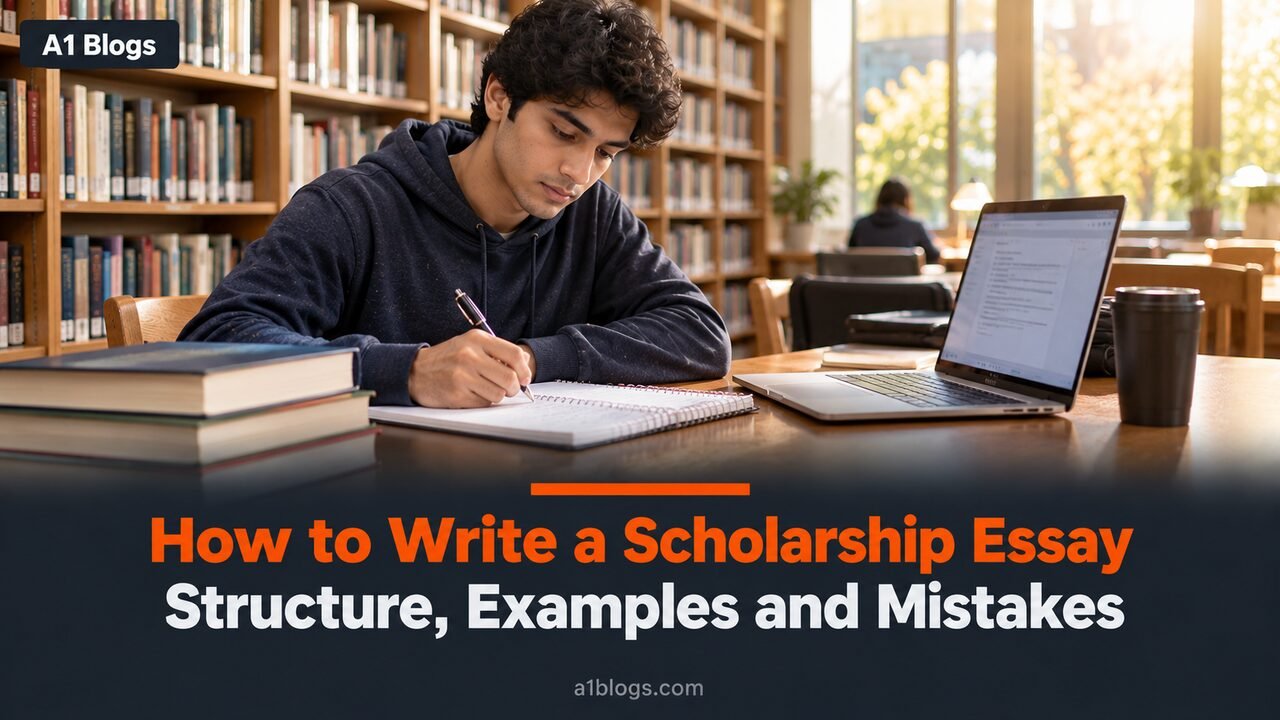
Most scholarship applicants have good grades. What separates the ones who win is usually the writing: a personal statement or set of essays that makes a tired selection panel stop and think, “this person has a plan, and they will do something with it.” The good news is that this is a skill, not a talent, and it can be learned.
This guide explains how to write a scholarship essay that stands out, with a structure you can reuse, examples of weak and strong answers, the prompts you are most likely to see, and the mistakes that sink otherwise strong applicants.
Table of Contents
What selection panels are looking for
Whether it is Chevening, Fulbright, Erasmus Mundus or a university award, readers ask similar questions:
- Does this person have a clear goal?
- Is the course or country the right step towards it?
- Is there evidence they can lead, influence or make things happen?
- Will the scholarship make a difference, to them and to others?
Every paragraph you write should help answer one of these. Anything that does not is using up words you could spend on something that does.
How to write a scholarship essay: start with your story
Before writing a single sentence, spend an hour on notes:
- Write down your career goal in one sentence, as specifically as you can.
- List five to ten moments from your studies, work or community life where you solved a problem, led people or changed something.
- For each, note what you did, who was involved and what happened as a result, with numbers where possible.
- Note why your chosen course and country are the right next step.
These notes become the raw material for every essay and personal statement you write, across all your applications.
Personal statement, scholarship essay or motivation letter?
The names overlap, and applicants often confuse them:
- A personal statement is a single piece about your background, motivation and goals, often used for university admission.
- A scholarship essay answers a specific question set by the scholarship, such as one about leadership or career plans. Some scholarships ask for several.
- A motivation letter explains why you want a particular programme and why you are a good fit, and is common in Europe, including for Erasmus Mundus.
The raw material is the same for all three: your goal, your strongest examples and your plan. What changes is the focus. A personal statement tells your story; a scholarship essay answers the question asked; a motivation letter proves fit with one programme. Knowing how to write a scholarship essay well makes the other two much easier, because the core skill, turning experience into specific, persuasive evidence, is identical. If a programme asks for a personal statement and a motivation letter together, make sure they complement rather than repeat each other.
A structure that works
For a typical 500 to 1,000-word scholarship essay or personal statement:
- Opening: a specific moment, problem or question that shows why you care about your field. Avoid starting with a dictionary definition or a famous quotation.
- What you have done: two or three concrete examples of relevant study, work or leadership.
- Why this programme: specific courses, research areas or features, and how they fill a gap in your skills.
- Your plan: what you will do afterwards, and the difference it will make.
- Close: bring it back to your opening, briefly.
Shorter, question-by-question essays, such as Chevening’s four answers, follow the same logic within each answer.
Show, do not tell: an example
A weak answer about leadership:
> “I am a natural leader with excellent communication skills. I have always taken initiative and inspired my team to achieve great results.”
A strong answer:
> “When our district office missed its vaccination targets two years running, I proposed sending reminders through local mosque committees instead of relying on posted notices. I persuaded my manager to trial it in four villages, trained twelve volunteers, and coverage there rose from 61% to 84% in six months. The district has since adopted the approach in nineteen villages.”
The second answer never uses the word “leader”, yet it proves leadership with a problem, an action, people persuaded and a measurable result. That is the standard to aim for. (The example is illustrative; use your own real figures.)
The most common scholarship essay prompts
- Leadership: describe a time you led or influenced others.
- Career goals: where do you want to be in five or ten years, and how will this degree help?
- Why this course or country: what will you gain that you cannot gain at home?
- Challenges: describe an obstacle you overcame and what you learned.
- Impact: how will you contribute to your community or country?
- Networking: how do you build relationships, and how will you use them?
Prepare one strong example for each in your notes, and you will be ready for almost any prompt.
Writing a motivation letter for a specific programme
A motivation letter for a master’s or an Erasmus Mundus programme is a scholarship essay focused on fit. Name modules, research groups or features that matter to you, and explain why. Then connect them to your background and plan. Never send the same motivation letter to different programmes with only the name changed; readers notice immediately.
Editing: where good essays become great
First drafts are always too long and too vague. When editing:
- Cut every sentence that would fit any applicant. “I am passionate about my field” adds nothing.
- Replace adjectives with evidence. Instead of “successful project”, give the result.
- Check you answered the question, exactly as asked.
- Respect the word limit. Going over can disqualify you, and coming in far under wastes space.
- Read it aloud. Awkward sentences become obvious.
- Ask someone honest to read it, ideally someone who does not know your story well.
Plan for at least three drafts spread over several weeks. Strong essays are rarely written in one sitting.
Should you use AI to write your essay?
Many scholarship programmes expect your essays to be your own work, and some ask you to confirm it. Beyond the rules, there is a practical reason not to rely on AI: generated essays tend to be generic, and selection panels who read hundreds of applications recognise the same phrases again and again. Your real experiences, in your own voice, are what make an essay memorable.
If you use a tool at all, use it the way you would use a friend: to point out unclear sentences or grammar mistakes in something you have already written. The content, examples and ideas must be yours.
Mistakes that sink strong applicants
- Writing about the scholarship’s prestige instead of your goals.
- Listing achievements without explaining their impact.
- A career plan too vague to be believed, or too grand to be realistic.
- Copying sample essays from the internet.
- Spelling the programme or university name wrong.
- Submitting at the last minute with no time to check.
How to write a scholarship essay: a final checklist
- Does the opening show something specific about you?
- Does every example include what you did and what changed?
- Is your goal clear in one sentence?
- Have you explained why this programme, not just any programme?
- Is it within the word limit and free of errors?
- Would a stranger finish it knowing what you want to do and why you will succeed?
If the answer to all six is yes, you have done the hard part.
Frequently asked questions
How long should a scholarship essay be?
Follow the limit set by the programme exactly. Most are between 300 and 1,000 words per essay.
Should I mention financial need?
Only if the scholarship asks about it or is need-based. Most merit scholarships focus on your goals and potential.
Can I reuse the same essay for different scholarships?
Reuse your notes and examples, but rewrite each essay to answer that scholarship’s questions and fit its goals.
How do I write about a weakness, such as low grades?
Briefly explain the context without excuses, then show what changed, such as later results or work achievements.
How early should I start?
Two to three months before the deadline gives time for proper drafting, feedback and revision.
Now put it into practice: see our guides to fully funded scholarships for 2027–28, the Chevening Scholarship and the Erasmus Mundus scholarship. Chevening’s own application timeline shows how much time to allow.