If you are new to hockey, the end of a tied NHL game can be confusing. In October a tied game turns into a five-minute 3-on-3 sprint and maybe a shootout. In May the same tie leads to full 20-minute periods that can run past midnight. NHL overtime rules are different in the regular season and the playoffs, and the standings points they award shape every playoff race.
This guide explains how NHL overtime works in both parts of the season, how the NHL shootout works, how points are awarded, and why some fans still argue about the system. It also covers penalties in overtime, standings tiebreakers and a few records worth knowing.
Table of Contents
NHL overtime rules at a glance
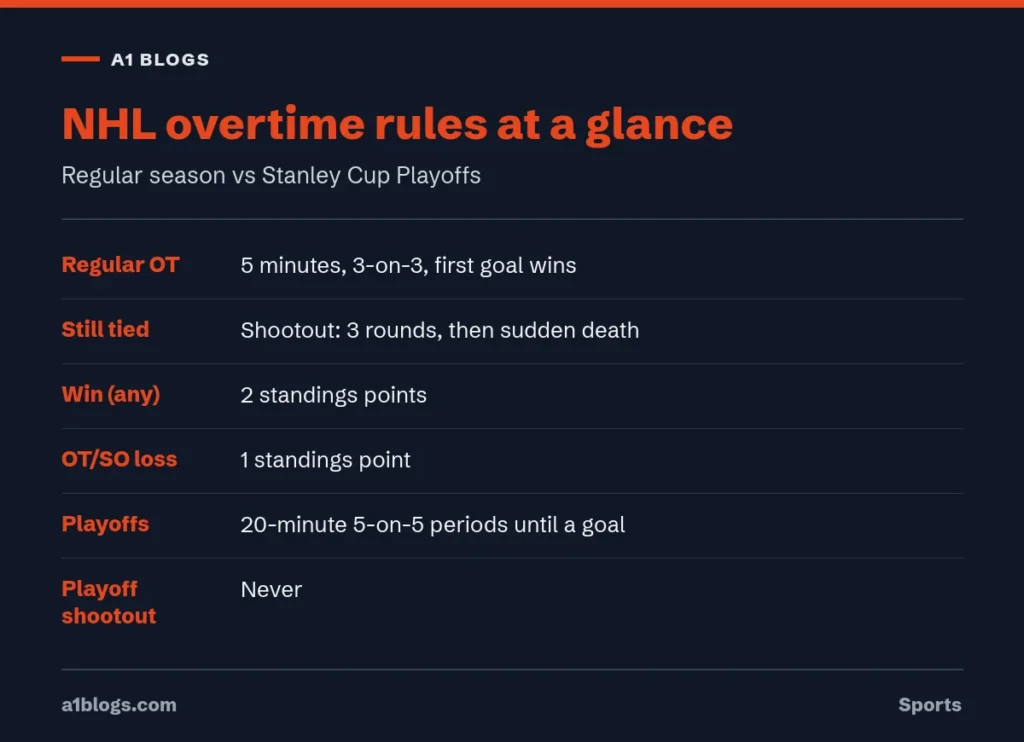
Here is the short version before we go into detail.
- Regular season: a tied game goes to one 5-minute overtime period with three skaters per side plus goalies. The first goal wins.
- If nobody scores: the game goes to an NHL shootout. Each team takes three shots, then sudden-death rounds if it is still tied.
- Standings points: a win in regulation, overtime or a shootout is worth 2 points. A loss in overtime or a shootout is worth 1 point. A regulation loss is worth 0.
- Playoffs: there is no shootout. Teams play full 20-minute periods at 5-on-5 until someone scores.
Those four lines cover most of what you need. The details explain why NHL overtime feels so different from overtime in other sports.
How regular-season NHL overtime works
When the third period ends in a tie, the teams get a short break and then come back for overtime. The period lasts up to five minutes and starts with a faceoff at center ice. The first team to score wins, and the game ends right away.
Why 3-on-3?
In regulation, each team has five skaters and a goalie on the ice. In regular-season NHL overtime, each team has only three skaters and a goalie. The NHL moved to this format in the 2015-16 season. Before that, overtime was played 4-on-4.
The reason was simple. The league wanted more games decided by real hockey and fewer by the shootout. With only six skaters on a full-size rink, there is far more open ice. Odd-man rushes, two-on-ones and breakaways happen all the time, and goals come faster. The change worked, and a large share of tied games now end in overtime.
How teams play 3-on-3
Overtime strategy looks different from regulation. Teams value the puck much more, because losing it can mean a breakaway the other way. You will often see a team carry the puck into the attacking zone, then pass it all the way back into its own zone to regroup and wait for a better chance. It can look strange, but it is a smart way to avoid giving up a rush.
Line changes matter too. Players get tired quickly with so much skating, and a bad change can leave a man open for a breakaway. Coaches usually start overtime with their best puck-moving defenseman and two skilled forwards.
Pulling the goalie in overtime
Teams are allowed to pull their goalie for an extra skater in NHL overtime, the same as in regulation. It is risky, because an empty net with only three defenders is easy to hit. Teams sometimes do it late in overtime or when they are on a power play and want a bigger advantage.
Penalties under NHL overtime rules
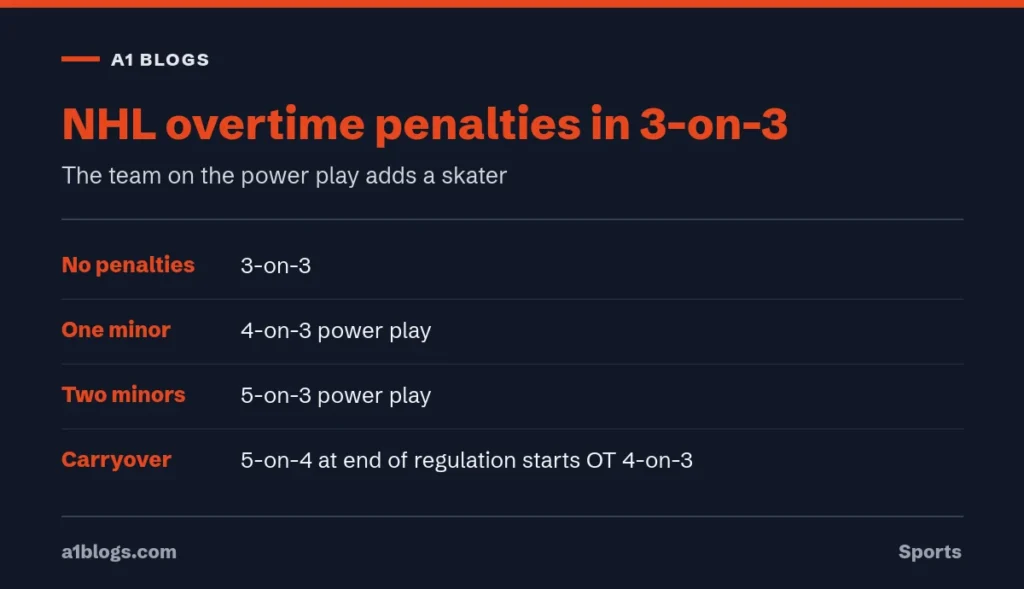
Penalties work differently with only three skaters a side. Instead of a team losing a player, the team that did not take the penalty adds one.
- One minor penalty during overtime makes it 4-on-3 for the team on the power play.
- Two minor penalties against the same team make it 5-on-3.
- When the penalty ends, the extra player leaves at the next stoppage or line change, and play goes back to 3-on-3.
If a power play carries over from regulation, NHL overtime starts with the advantage already in place. For example, a team that was on a 5-on-4 power play when the third period ended will start overtime 4-on-3.
A 4-on-3 power play in overtime is one of the most dangerous situations in hockey. There is so much space that a good power play unit often scores within a minute.
How the NHL shootout works
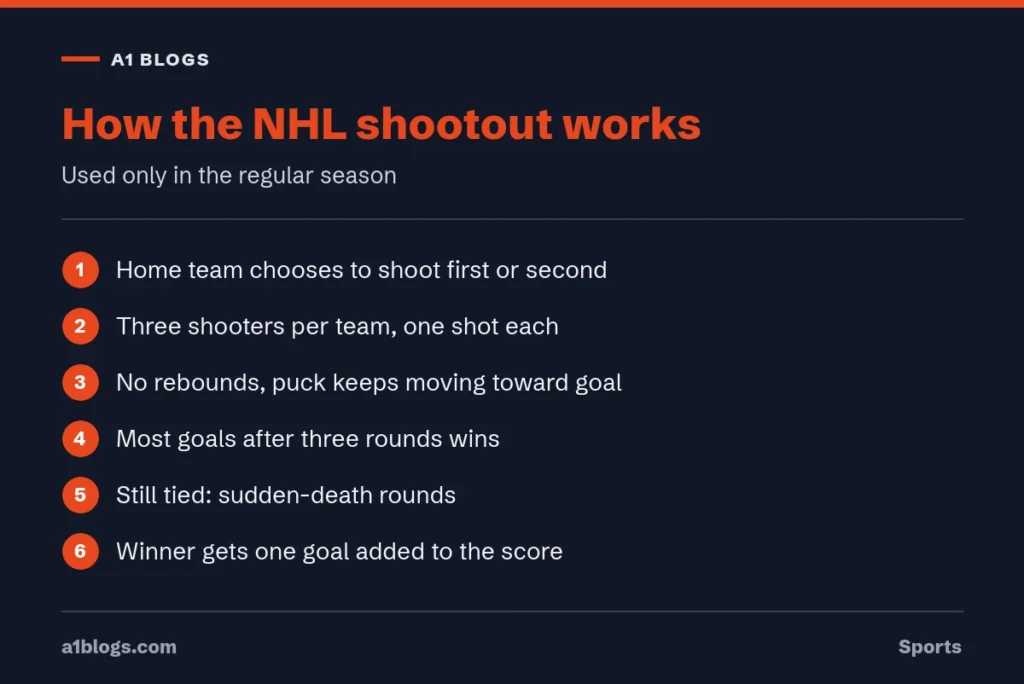
If overtime ends with no goals, the game goes to an NHL shootout. The shootout has been part of NHL overtime rules since the 2005-06 season, when the league stopped allowing tie games.
Shootout basics
- Each team picks three shooters. The home team decides whether to shoot first or second.
- Shooters take turns starting from center ice, skating in alone against the goalie.
- Each shooter gets one shot. There are no rebounds, and the puck must keep moving toward the goal.
- After three rounds, the team with more goals wins.
- If one team can’t catch up before using its three shooters, the NHL shootout ends early.
Sudden-death rounds
If the shootout is tied after three rounds, it moves to sudden death. Each team sends one shooter at a time. If one team scores and the other misses, the game is over. A player cannot shoot a second time until every eligible player on his team has taken a turn, so very long shootouts can reach defensemen who rarely take penalty shots.
How a shootout goal is scored
The team that wins the NHL shootout gets one goal added to its final score. If a game is tied 3-3 after overtime and the home team wins the shootout, the final score is listed as 4-3. Goals in the shootout do not count in individual player stats, and goalies do not get a save or goal against for shootout attempts.
How NHL standings points work
The NHL uses a points system for its standings. Each result gives teams a set number of points.
- Regulation win: 2 points
- Overtime or shootout win: 2 points
- Overtime or shootout loss: 1 point
- Regulation loss: 0 points
The extra point for losing in NHL overtime is often called the loser point. It means a game that goes past regulation gives out three points in total, while a game decided in regulation gives out two.
Why the loser point is controversial
Critics say the loser point rewards teams for playing it safe late in tied games. If both teams settle for overtime, each is guaranteed at least one point. Some fans and writers want a three-point system, with 3 points for a regulation win and 2 for an overtime win, so regulation wins count for more. The NHL has kept the current system so far.
Standings tiebreakers
When two teams finish with the same number of points, the NHL breaks the tie in this order:
- Regulation wins
- Regulation and overtime wins, not counting shootout wins
- Total wins, including shootouts
If teams are still tied, the league looks at points in games between them and then goal differential. Because shootout wins come last in the tiebreakers, a team that wins a lot of shootouts can lose a playoff spot to a team with the same points but more regulation wins.
NHL overtime rules in the playoffs
The Stanley Cup Playoffs use a completely different format. There is no 3-on-3 and no NHL shootout. If a playoff game is tied after three periods, the teams play full 20-minute periods at 5-on-5, with a normal intermission between periods. The first goal wins.
This is sudden-death hockey at its purest, and it can go on for a very long time. Two or three overtimes are not unusual in the playoffs, and every series seems to have at least one game that stretches past midnight on the East Coast.
The longest game in NHL history was a playoff game on March 24, 1936. The Detroit Red Wings beat the Montreal Maroons 1-0 when Mud Bruneteau scored in the sixth overtime period, after 116 minutes and 30 seconds of overtime. The NHL Records site lists this and other overtime records.
Penalties in playoff overtime work the same way as in regulation. A minor penalty takes a player off the ice for two minutes, and the other team goes on a 5-on-4 power play. Referees are often accused of calling fewer penalties in playoff overtime, although the rulebook does not change.
How tied games change late in the third period
The points system changes how teams play before overtime even starts. With a few minutes left in a tied game, both teams know that reaching overtime guarantees them at least one point. A team that pushes hard for the win risks giving up a goal and leaving with nothing.
That is why the last five minutes of a tied third period can feel quiet. Teams keep an extra player back, chip the puck out of their zone instead of trying a risky pass, and avoid long shifts. It is most noticeable late in the season, when one point can decide a playoff spot.
The situation is very different when a team is trailing by a goal. Then the coach may pull the goalie for an extra attacker with a minute or two left, because a regulation loss earns nothing. If the trailing team ties the game, it has already earned a point and gets a free shot at the second one.
Shootout strategy for shooters and goalies
The shootout is a skills contest, and teams prepare for it. Coaches pick shooters based on their record in past shootouts and how they look in practice. Some players are known for quick wrist shots from the top of the circle. Others prefer to skate in close and try a deke, moving the puck from forehand to backhand to pull the goalie out of position.
Goalies study shooters too. They know which players like to shoot early and which ones hold the puck until the last second. Many goalies stay deep in the crease against players who deke and come out farther against shooters, to cut down the angle.
The order matters. Some coaches put their best shooter first to set the tone. Others save him for third, so he takes the shot with the most pressure. The home team’s choice to shoot first or second is part of this thinking. Shooting second means you always know exactly what you need, which some coaches prefer.
What overtime means for player stats
A goal scored in overtime counts like any other goal. The scorer gets the goal, the players who set it up get assists, and the goalie who allowed it is charged with a goal against. Overtime goals also count as game-winning goals in player stats.
Shootout goals are different. They are not added to player goal totals, and they do not count against the goalie’s save percentage or goals-against average. The NHL keeps separate shootout stats, so you can look up which players score most often and which goalies stop the most attempts. Fantasy hockey leagues usually follow the same approach, giving points for overtime goals but not for shootout goals.
How NHL overtime compares with other sports
If you also follow the NFL, it is useful to compare the two systems. NFL overtime gives both teams a chance with the ball in the regular season since 2025, and regular-season games can still end in a tie. Our guide to NFL overtime rules explains those changes.
The NHL does not allow regular-season ties. Every game ends with a winner, either in overtime or in the NHL shootout. Baseball keeps playing extra innings, and the MLB regular season puts a runner on second base to start each extra inning. Soccer usually ends tied in league play, with extra time and penalty kicks only in knockout games.
Of all these systems, NHL overtime rules are the only ones that change the number of players on the field of play. That is what makes the 3-on-3 period so different to watch.
A short history of NHL overtime
Overtime has changed many times. The league used regular-season overtime in its early years, dropped it during World War II because of travel limits, and brought it back for the 1983-84 season as a five-minute 5-on-5 period. Games that stayed tied after overtime ended as ties.
In 1999-2000, the league moved overtime to 4-on-4 and introduced the overtime loss point, so a team that lost in overtime still got a point. The 2004-05 season was canceled by a lockout, and when play returned in 2005-06, the NHL shootout arrived and ties disappeared. The 3-on-3 format followed in 2015-16.
Each change aimed to make the end of tied games more exciting and to settle more games with goals rather than skills competitions.
Overtime terms you will see in the standings
NHL standings use a few short labels that are worth knowing.
- OT or OTL: overtime losses. In the NHL standings, this column counts losses in overtime and in the shootout together.
- RW: regulation wins. This is the first tiebreaker when two teams have the same number of points.
- ROW: regulation and overtime wins. It includes overtime wins but not shootout wins.
- P%: points percentage, the share of possible points a team has earned. It helps compare teams that have played different numbers of games.
- Three-point game: a game that goes past regulation, so the two teams share three points instead of two.
- Sudden death: the first goal ends the game. Both regular-season overtime and playoff overtime are sudden death.
Once you know these labels, it is easier to see why a team with more wins can sit below a rival in the standings.
Frequently asked questions
How long is overtime in the NHL?
Regular-season overtime is up to 5 minutes of 3-on-3 hockey. Playoff overtime periods are 20 minutes each at 5-on-5, and they continue until someone scores.
Is there a shootout in the NHL playoffs?
No. The NHL shootout is used only in the regular season. Playoff games continue with full overtime periods until a goal is scored.
How many points do you get for an overtime loss?
One point. A loss in overtime or in a shootout gives the losing team 1 point in the standings, while the winner gets 2.
Can NHL games end in a tie?
Not since the 2005-06 season. Under current NHL overtime rules, every regular-season game ends with a winner, in overtime or in a shootout.
Do shootout goals count in player stats?
No. The winning team gets one goal added to its final score, but shootout goals and saves do not count in player or goalie stats.
Why does the NHL use 3-on-3 overtime?
The extra space leads to more scoring chances, so more games end during overtime instead of in a shootout. The league adopted it in 2015-16 for that reason.
What happens if there is a penalty in NHL overtime?
The team that drew the penalty adds a skater, so a 3-on-3 becomes 4-on-3. Two penalties against one team make it 5-on-3.
You can follow how overtime results affect the playoff race in the official NHL standings.