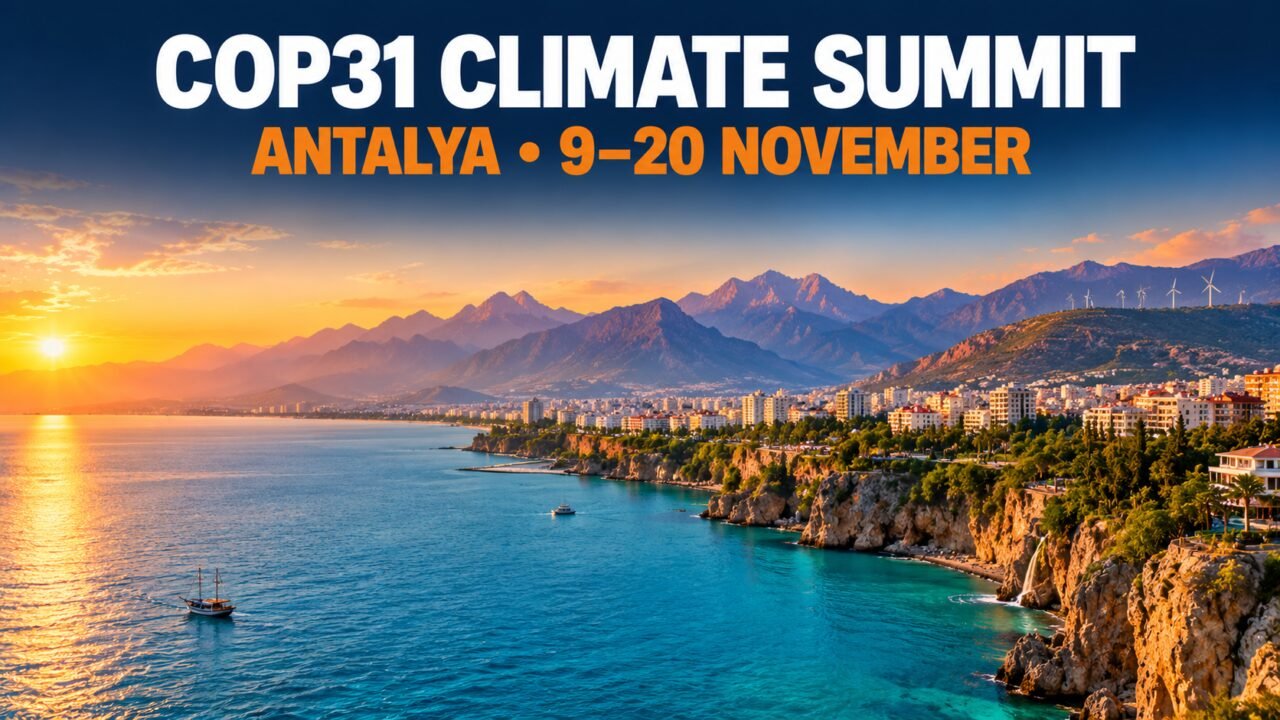
COP31, the United Nations climate summit, opens in Antalya on the Mediterranean coast of Türkiye on 9 November and runs until 20 November 2026. Negotiators from nearly 200 countries will meet at the Antalya Expo Center to argue over money, targets and the pace of the shift away from fossil fuels, in a year when the world’s largest historical emitter, the United States, is no longer part of the Paris Agreement.
This year’s summit also has an unusual set-up. Türkiye is hosting, but Australia will lead the formal negotiations, the result of a compromise struck after both countries refused to drop their bids. Here are seven questions that will shape whether the talks achieve anything, and what they mean for people in Britain, the United States and beyond.
Table of Contents
What is COP31?
COP stands for Conference of the Parties, the annual meeting of countries that have signed the UN Framework Convention on Climate Change. COP31 is the 31st such meeting. These summits are where the Paris Agreement was reached in 2015, and where countries return each year to review progress and negotiate new commitments.
The Paris Agreement’s central goal is to keep global warming well below 2°C above pre-industrial levels, while pursuing efforts to limit it to 1.5°C. The world is not on track for either. In 2024, the average global temperature was, for the first time over a full calendar year, more than 1.5°C above pre-industrial levels, although the Paris goal is measured over longer periods.
A COP brings together government negotiators, heads of state for the opening days, and thousands of scientists, campaigners, business leaders and journalists. The formal talks take place behind closed doors, while the host city fills with side events and protests.
1. Why is COP31 split between two countries?
Türkiye and Australia both bid to host the 2026 summit. Australia had hoped to hold it in Adelaide, with a strong focus on its Pacific neighbours, whose low-lying islands face some of the worst effects of rising seas. Neither side would withdraw.
After a week of negotiations during COP30 in Belém, Brazil, in November 2025, the two countries agreed a compromise. Türkiye hosts the summit and holds the COP presidency, led by its environment and climate change minister, Murat Kurum. Australia’s climate and energy minister, Chris Bowen, presides over the negotiations themselves.
No COP has been run this way before. Supporters say the deal gives Pacific nations a stronger voice inside the process. Critics worry that splitting responsibility could blur accountability if the talks stall. Papua New Guinea, which had backed Australia’s bid, publicly expressed disappointment at the outcome.
2. What happened at COP30 in Brazil?
COP31 picks up where COP30 left off. The Belém summit, held on the edge of the Amazon, ended with an agreement that called for more money to help countries adapt to climate change, but it stopped short of a formal global roadmap for moving away from fossil fuels, which many countries and campaigners had pushed for.
That leaves unfinished business for Antalya. The phrase “transitioning away from fossil fuels in energy systems” was agreed at COP28 in Dubai in 2023, the first time a COP text explicitly addressed fossil fuels. Turning that phrase into concrete timelines has proved much harder.
Finance also remains unresolved. At COP29 in Baku in 2024, richer countries agreed to provide at least $300 billion a year for developing countries by 2035, as part of a wider goal of raising $1.3 trillion a year from all sources. Many developing countries called that far too little.
3. What does the US withdrawal from the Paris Agreement mean?
President Donald Trump signed an order to withdraw the United States from the Paris Agreement shortly after returning to office in January 2025. The withdrawal took effect a year later, in January 2026. The United States did not send an official delegation to COP30.
The US departure matters because it is the world’s largest economy, the second-largest emitter today and the largest emitter in history. Its absence weakens pressure on other big emitters and removes a major source of potential climate finance.
It does not stop American involvement entirely. US states, cities, businesses and universities have continued to attend COPs and make their own commitments. States such as California have their own climate laws and targets, and many US companies operate under emissions rules in Europe and elsewhere.
4. Where does the UK stand?
The United Kingdom has positioned itself as one of the more ambitious major economies. At COP29, the UK announced a target to cut emissions by 81% below 1990 levels by 2035, one of the steepest targets among large economies.
The UK’s climate policies are debated fiercely at home. Supporters argue that clean energy, from offshore wind to heat pumps, will bring lower bills, new jobs and energy security in the long run. Critics argue that the cost of reaching net zero falls too heavily on households and businesses at a time when energy prices are already high. The gas-driven rise in the energy price cap from October has sharpened that argument.
At COP31, the UK is likely to push for stronger emissions targets and faster clean energy investment, while facing questions about its own delivery and its contributions to climate finance.
5. Will countries raise their climate targets?
Under the Paris Agreement, each country sets its own targets, known as nationally determined contributions, or NDCs. Countries were expected to submit new targets for 2035 during 2025, but many were late, and several major emitters submitted plans that analysts judged insufficient to meet the 1.5°C goal.
One job of COP31 will be to take stock of those plans and push for more ambition. That is difficult, because the Paris Agreement relies on peer pressure rather than enforcement. There is no penalty for missing a target.
Watch for the major economies outside the US, particularly China, the European Union and India. China’s decisions on coal and clean energy manufacturing have an enormous effect on global emissions, and the EU often plays a bridging role between rich and poor countries.
6. Who pays for climate damage and adaptation?
Money is almost always the hardest part of any COP. Developing countries argue that richer nations built their wealth on fossil fuels and should pay to help poorer countries cut emissions, adapt to heat and floods, and recover from disasters. Richer countries point to budget pressures at home and want large developing economies such as China and the Gulf states to contribute more.
Adaptation, meaning measures to cope with climate impacts that are already happening, has become a larger part of the debate. Sea walls, drought-resistant crops, early warning systems and cooler cities all need funding. Our report on the 2026 monsoon in Pakistan shows how deadly floods remain for countries that have done little to cause the problem.
There is also a fund for loss and damage, agreed in principle at COP27 in 2022, to help countries recover from climate disasters. How much money flows into it, and how quickly, will be watched closely in Antalya.
7. What role will the Pacific play?
Because of the deal with Australia, Pacific island nations will be more visible at this COP than usual. A pre-COP meeting was scheduled in Fiji from 5 to 8 October, including a leaders’ event in Tuvalu, designed to let world leaders see the effects of rising seas and stronger storms first-hand.
For countries like Tuvalu, Kiribati and the Marshall Islands, the difference between 1.5°C and 2°C of warming could decide whether large parts of their land remain habitable. Their negotiators are expected to push hard for faster emissions cuts and dedicated funding for small island states.
Whether that pressure changes the positions of major emitters is another question. Pacific leaders have made similar arguments at every COP for decades.
Why Antalya is a meaningful choice
Türkiye sits between Europe, the Middle East and Central Asia, and it has its own climate challenges, from heatwaves and wildfires to drought. In recent summers, wildfires have forced evacuations along parts of the Turkish coast, including near popular holiday resorts.
Türkiye is also a large emitter that still relies heavily on coal and imported gas, while expanding solar and wind power. Hosting COP31 puts its own energy plans under the spotlight, in the same way that previous hosts such as Egypt, the United Arab Emirates, Azerbaijan and Brazil faced scrutiny over their fossil fuel industries and forests.
For many British holidaymakers, Antalya is better known as a beach destination. For two weeks in November, it will be the centre of global climate diplomacy.
A short history of the climate summits
The first COP was held in Berlin in 1995. Two years later, the Kyoto Protocol set binding emissions cuts for richer countries, but the United States never ratified it, and big developing economies had no obligations under it.
The 2009 climate summit in Copenhagen was widely seen as a failure, ending without the binding global deal many had hoped for. The breakthrough came six years later in Paris, where almost every country agreed to set its own targets and update them over time. That flexible approach is why nearly the whole world signed up, and also why progress depends so heavily on political will.
The UK hosted COP26 in Glasgow in 2021, where countries agreed to “phase down” unabated coal power after a last-minute change of wording. Egypt’s COP27 in 2022 agreed in principle to create a fund for loss and damage. Dubai’s COP28 in 2023 addressed fossil fuels directly for the first time, and Baku’s COP29 in 2024 set a new finance goal. Each summit has moved the process forward a little, usually by less than scientists and campaigners wanted.
The science behind the talks
The negotiations rest on the work of the Intergovernmental Panel on Climate Change, the UN body that reviews climate research. Its most recent full assessment found that to keep warming to 1.5°C, global greenhouse gas emissions would need to fall by roughly 43% by 2030 compared with 2019 levels, and reach net zero carbon dioxide around the middle of the century.
Emissions have not fallen anywhere near that fast. Global emissions remain close to record levels, even as clean energy grows rapidly. Solar and wind power, electric vehicles and batteries have become much cheaper, which gives negotiators more tools than they had a decade ago, but fossil fuel use has not yet started to decline in a sustained way worldwide.
The IPCC is now working on its next major assessment. Its findings will feed into future COP negotiations, including the next formal review of global progress under the Paris Agreement.
Criticisms of the COP process
The COP system has plenty of critics, including people who strongly support climate action. Decisions are taken by consensus, so any single country can block or water down an agreement. That gives large fossil fuel producers significant influence over the final text.
The summits have also grown enormous, with tens of thousands of attendees. Campaign groups have repeatedly highlighted the number of fossil fuel industry representatives registered at recent summits, and questioned whether oil and gas producing nations should host the talks at all.
In 2024, a group of former world leaders and senior scientists published an open letter arguing that the climate summit process needed reform, including smaller, more frequent meetings and stricter rules on who can host. Supporters of the current system reply that, for all its flaws, the COP is the only forum where every country, from the largest economies to the smallest island states, has a seat at the same table.
What COP31 means for ordinary people
It is easy to dismiss COP summits as talking shops. They are slow, and their agreements often fall short of what scientists say is needed. But decisions made at these meetings shape national policies that affect daily life: how homes are heated, what cars are sold, how electricity is generated, and how much governments invest in flood defences.
In Britain, that includes debates over gas boiler replacements, electric vehicle rules and energy bills. In the United States, many of the most significant climate decisions are now being made by states, cities and companies rather than the federal government. In developing countries, COP finance decisions can determine whether a city builds new drains or a village gets a flood warning system.
Climate change also affects what is on sale in shops and how much it costs, through droughts, floods and heatwaves that damage crops and supply chains.
How to follow COP31
The UN Climate Change website publishes the official schedule, negotiating texts and livestreams of major sessions. News organisations and climate research groups run daily briefings during the two weeks of talks.
The first days usually bring speeches from world leaders. The real negotiating happens in the second week, often running late into the final night and sometimes past the scheduled end date. The final agreed text, known as the cover decision, is usually released at the very end.
When reading the final text, look at the verbs. Words like “urges” and “encourages” are weaker than “decides” or “requests”. Much of the argument at any COP comes down to a handful of words.
What success at COP31 would look like
Expectations for any climate summit are usually modest, so it helps to know what a good outcome would look like. Many observers will judge COP31 on a few things. First, whether countries agree clearer signals on how and when to move away from fossil fuels, building on the language agreed in Dubai. Second, whether the review of national targets pushes major emitters to strengthen plans that fall short of the Paris goals.
Third, whether money promised in earlier years actually starts flowing, particularly for adaptation and for the loss and damage fund. And fourth, whether the Pacific focus produces practical support for the countries most at risk from rising seas. A summit that makes progress on even two of these would be seen by many as a success. One that produces only general statements will add to doubts about the whole process.
COP31: common questions
When and where is COP31?
From 9 to 20 November 2026, at the Antalya Expo Center in Antalya, Türkiye.
Who is running COP31?
Türkiye hosts and holds the COP presidency, while Australia’s climate minister, Chris Bowen, leads the negotiations under a compromise agreed in 2025.
Is the United States taking part in COP31?
The US withdrew from the Paris Agreement, with the exit taking effect in January 2026, and did not send an official delegation to COP30. US states, cities and businesses still often attend.
What is the goal of the Paris Agreement?
To keep global warming well below 2°C above pre-industrial levels and pursue efforts to limit it to 1.5°C.
Where will COP32 be held?
COP32 is planned for Addis Ababa, Ethiopia, in 2027.
The COP31 climate summit starts in six weeks. We will report on the outcome when the talks close. For more world coverage, see our guide to the G20 summit 2026 and our world section.