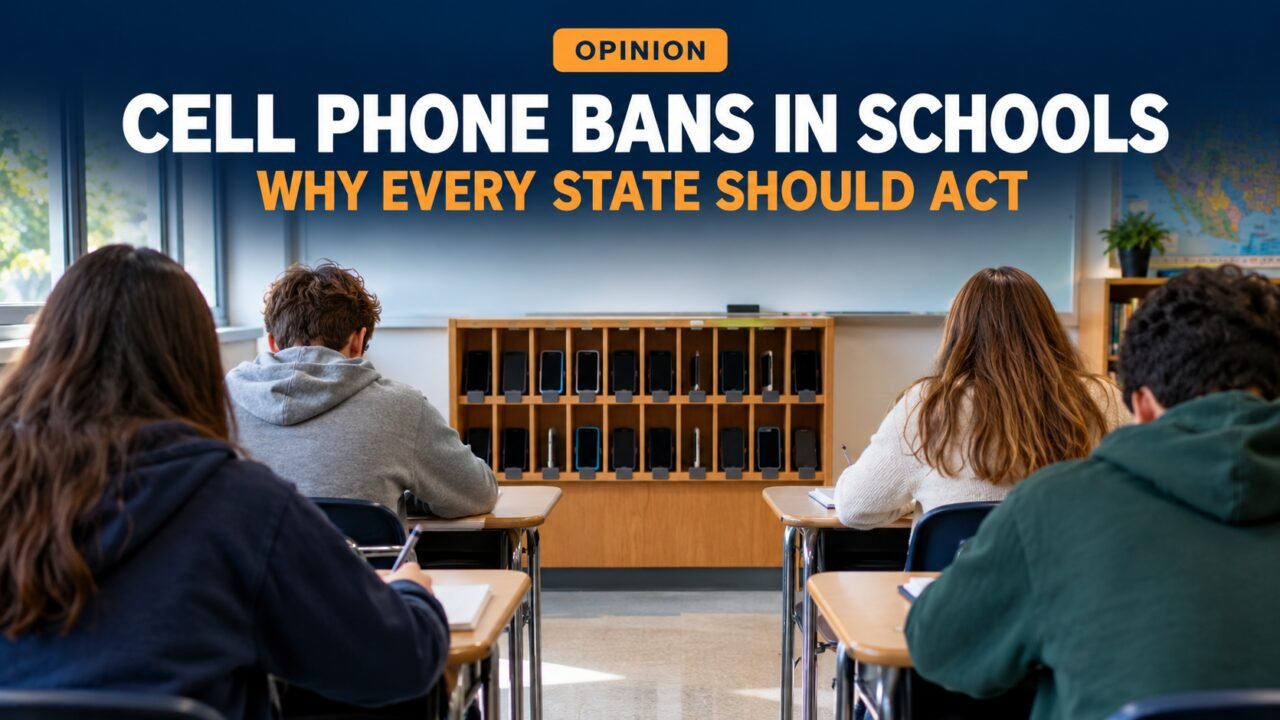
Opinion
Cell phone bans in schools have gone from a fringe idea to mainstream policy in just a few years. Dozens of states now restrict phones in classrooms, and some, including New York, have moved to bell-to-bell rules that keep phones away for the entire school day. Parents argue about it at school board meetings. Teachers mostly cheer. Students, unsurprisingly, have mixed feelings.
I think the states moving toward phone-free school days are right, and the rest should follow. Not because phones are evil, and not because today’s teenagers are somehow weaker than earlier generations, but because a school day is one of the few places where adults can still decide what children’s attention is spent on. Here are five reasons I believe every state should adopt clear, full-day phone rules, along with the strongest arguments against them.
Table of Contents
The problem teachers see every day
Ask teachers about phones and you will hear the same stories: students checking social media under their desks, texting friends in the next room, filming classmates, sneaking off to the bathroom to scroll. In a 2024 survey by the Pew Research Center, 72 percent of U.S. high school teachers said students being distracted by cellphones was a major problem in their classrooms.
Phones are not a small distraction, either. A 2023 study by Common Sense Media found that the typical teenager in its sample received more than 200 notifications a day, with many arriving during school hours. Each one pulls attention away from whatever the student was supposed to be doing, and research on attention suggests it takes time to refocus after each interruption.
Teachers are left trying to enforce a patchwork of rules, confiscating phones one at a time and arguing with students and sometimes parents. It is exhausting, and it takes time away from teaching.
Reason 1: Students learn better without constant interruptions
The basic case is about learning. Deep focus, the kind needed to work through a hard math problem or follow a long piece of writing, does not survive a steady stream of pings. Even a phone sitting silently on a desk can pull at a student’s attention.
Some research supports the idea that restrictions help. A well-known study of schools in England, published in 2015, found that test scores rose after schools banned phones, with the biggest gains among lower-achieving students. That last point matters to me. Strong students often manage distractions reasonably well. Students who are already struggling are the ones most likely to fall further behind when their attention is constantly split.
Cell phone bans in schools are, in that sense, an equity measure. They give every student the same chance to concentrate, regardless of their self-discipline or home situation.
Reason 2: Clear rules take the burden off teachers
When each teacher sets their own phone policy, every classroom becomes a negotiation. One teacher allows music during independent work, another bans phones completely, a third gives up because fighting over it is not worth the time. Students notice the inconsistency and push at the weakest point.
A statewide or districtwide rule changes the dynamic. The phone goes into a locker, a pouch or a storage cabinet at the start of the day and comes out at the end. There is nothing to argue about in each class, and teachers can get back to teaching. In districts that have moved to full-day policies, teachers often describe the change as the single biggest improvement in their working conditions in years.
Bell-to-bell rules also close the loopholes that make partial bans hard to enforce. If phones are allowed at lunch and between classes, students are pulled back into group chats and social media drama several times a day, and that follows them into the next lesson.
Reason 3: Kids talk to each other again
One of the most striking things teachers and principals report after phones disappear is noise. Cafeterias that used to be quiet, with every student bent over a screen, become loud again. Kids play cards, argue about sports and make awkward small talk with people they do not know well.
That awkwardness is valuable. Learning to start a conversation, sit with a new group or handle boredom without a screen are real social skills, and they are hard to learn if every free moment is filled by a phone. Social psychologist Jonathan Haidt, whose 2024 book The Anxious Generation helped fuel the current movement, argues that phone-free schools are one of the simplest ways to give young people back time for face-to-face friendship.
Not every student will make new friends overnight. But a school day without phones at least creates the conditions for it.
Reason 4: It eases the pressure of social media
For many students, the hardest part of the school day is not the work. It is what happens on their phones: group chats that exclude them, photos from parties they were not invited to, comparisons with classmates and strangers online, and sometimes outright bullying.
When phones are allowed all day, that pressure never stops. A cruel comment posted during first period follows a student through every class. Keeping phones away during school hours does not solve online bullying, but it creates a daily break from it, and it makes it harder for fights and humiliating videos to spread in real time inside the building.
Parents cannot fix social media alone, and neither can schools. But schools can make sure that for seven hours a day, students get some relief from it.
Reason 5: A statewide rule is fairer than a patchwork
Today, a student’s experience depends heavily on their district, their principal and even their individual teacher. Some schools have strong, well-enforced policies, while others have rules that exist only on paper.
State laws create a common floor. They also give principals backup when parents push back, because the rule comes from the state, not from one school administrator. States can still leave room for local choices about how phones are stored and how exceptions are handled, while setting a clear expectation that the school day is phone-free.
Florida was one of the first states to restrict phones during class time in 2023. Since then, states as different as New York, Texas, Virginia and Ohio have moved to limit phones in schools. When a policy wins support from both Democratic and Republican governors, it is a sign that it is responding to something parents and teachers across the political spectrum are seeing.
The best arguments against phone bans
An honest case for phone bans has to take the objections seriously. There are three that I think deserve real answers.
The first is safety. Many parents, especially after school shootings, want to be able to reach their children in an emergency. That fear is understandable. School safety experts have pointed out, though, that during an emergency, phones can also make things worse: ringing phones can reveal where students are hiding, and hundreds of calls can jam lines and distract students from following instructions. Schools need clear emergency communication plans that reach parents quickly without relying on every child’s phone.
The second is that students need to learn self-control, not have it imposed on them. There is something to this. But we do not teach young drivers by handing them the keys on day one. It is reasonable to build self-control gradually, with phone-free school days as the structure and more freedom as students grow older.
The third objection is evidence. Research on phone bans is mixed. A large 2025 study from the United Kingdom, for example, found no clear link between schools’ phone policies and students’ mental health or grades. That is a fair challenge. My answer is that the case for phone-free schools rests on more than test scores and mental health surveys. It also rests on what teachers see in their classrooms every day, and on the simple idea that school time should be protected for learning.
What good cell phone bans in schools look like
A poorly designed ban can cause as many problems as it solves. The policies that seem to work best share a few features:
- Phones are stored away for the entire school day, not just during lessons
- Storage is simple, whether that means lockers, lockable pouches or a classroom cabinet
- Exceptions are clear for students who need phones for medical reasons, such as monitoring diabetes, and for students with disabilities who rely on assistive technology
- Parents know exactly how to reach the school in an emergency
- Consequences are consistent and escalate fairly, rather than depending on each teacher
- Schools explain the reasons to students, instead of simply announcing a rule
Smartwatches, earbuds and tablets need to be covered too, or the rule will be easy to get around.
What parents can do
Parents have a big role in whether phone bans in schools succeed. Supporting the policy at home, instead of texting children during the school day or helping them get around the rules, makes a huge difference to teachers.
Parents can also think about what happens outside school. Many families are delaying smartphones until high school, keeping phones out of bedrooms at night and setting limits on social media. Coordinating with other parents in the same class helps, because no child wants to be the only one without a phone.
It is also worth teaching children how to spot online risks, such as scam messages and strangers who try to start conversations. Our guide on how to spot a scam text is a good place to start those conversations with older kids.
What students say about phone bans
It would be easy to assume teenagers are united against phone bans. The reality is more complicated. In a 2024 Pew Research Center survey, about four in ten U.S. teens said they spend too much time on their smartphones, and roughly seven in ten said they at least sometimes feel happy or peaceful when they do not have their phones with them.
That does not mean students love having their cell phones locked away. Many say they feel anxious at first, worry about missing messages from friends or family, and resent rules they had no part in making. But reports from schools that have gone phone-free often describe a shift after the first few weeks, as students get used to the routine and some admit, quietly, that the break is a relief.
The lesson for schools is to involve students early. Explain the reasons, ask for their ideas about lunch and break times, and listen to concerns about things like getting home safely or coordinating rides. Policies that feel imposed tend to be resisted harder than ones students helped shape.
How other countries handle phones in schools
The United States is part of a global trend. France banned phones for most students in primary and middle schools in 2018. The Netherlands introduced national guidance in 2024 that keeps phones out of most classrooms. In England, the government issued guidance the same year encouraging schools to prohibit phone use throughout the day. Brazil passed a law in 2025 restricting phones in its schools.
These countries have different school systems and cultures, but they reached similar conclusions after hearing from teachers and parents. Their experiences will add to the evidence about what works, and American states can learn from both their successes and their mistakes.
The cost of enforcement
Phone bans are not free. Lockable pouches, one of the most popular storage options, can cost around $25 to $30 per student, which adds up quickly for a large district. Lockers, cabinets and staff time for enforcement have costs too.
Some states have set aside money to help districts pay for storage, and others leave it to local budgets. Compared with the cost of lost instruction time and the energy teachers spend policing phones, the price is modest. But lawmakers who pass phone bans without funding them are handing schools another unfunded mandate. If states want phones out of schools, they should help pay for it.
Why this is not about hating technology
I am not arguing that phones are bad or that students should never use technology in school. Laptops, calculators, research tools and educational apps can all support learning when they are used with a purpose and guided by a teacher.
The United Nations education agency, UNESCO, made a similar point in its 2023 global education report, which recommended that phones in schools be used only when they clearly support learning. That is a sensible standard. Technology should serve the lesson, not compete with it.
Phones are different from classroom tools because they are built to capture attention. The same features that make them useful for adults, constant connection and endless content, make them a poor fit for a classroom full of teenagers.
What the next few years will show
Because so many states have acted recently, the next few years will produce much better evidence about what works. Researchers will be able to compare schools with full-day bans, partial bans and no restrictions, and look at attendance, grades, discipline and student well-being.
Policymakers should take that evidence seriously. If full-day bans turn out to have little effect, states should be willing to adjust. But I suspect that when teachers and students look back, most will say that a school day without phones was a better place to learn and to grow up.
Cell phone bans in schools: questions readers ask
Which states ban cell phones in schools?
Dozens of states have passed laws or policies restricting phones in schools, including Florida, New York, Texas, Virginia and Ohio. The details, such as whether bans cover the full day, vary by state.
What is a bell-to-bell phone ban?
It means students cannot use phones from the first bell of the school day to the last, including lunch and time between classes.
Can parents reach their children during a phone ban?
Yes, through the school office. Good policies include clear ways for parents to contact students and for schools to reach parents in emergencies.
Do phone bans improve grades?
Some studies have found improvements, especially for lower-achieving students, while others have found little effect. Research is still developing.
Do phone bans include smartwatches and earbuds?
Most full-day policies cover any device that can send messages or connect to the internet, including smartwatches, wireless earbuds and personal tablets. Without that, students can simply move their messaging to a watch. School-issued laptops and tablets used for classwork are usually allowed, because teachers control how they are used. Parents should check their school’s written policy, since rules on cell phones and other devices differ from district to district.
If your school board is debating a phone policy this year, go to the meeting and listen to the teachers first. For more opinion and analysis, see our opinion section.