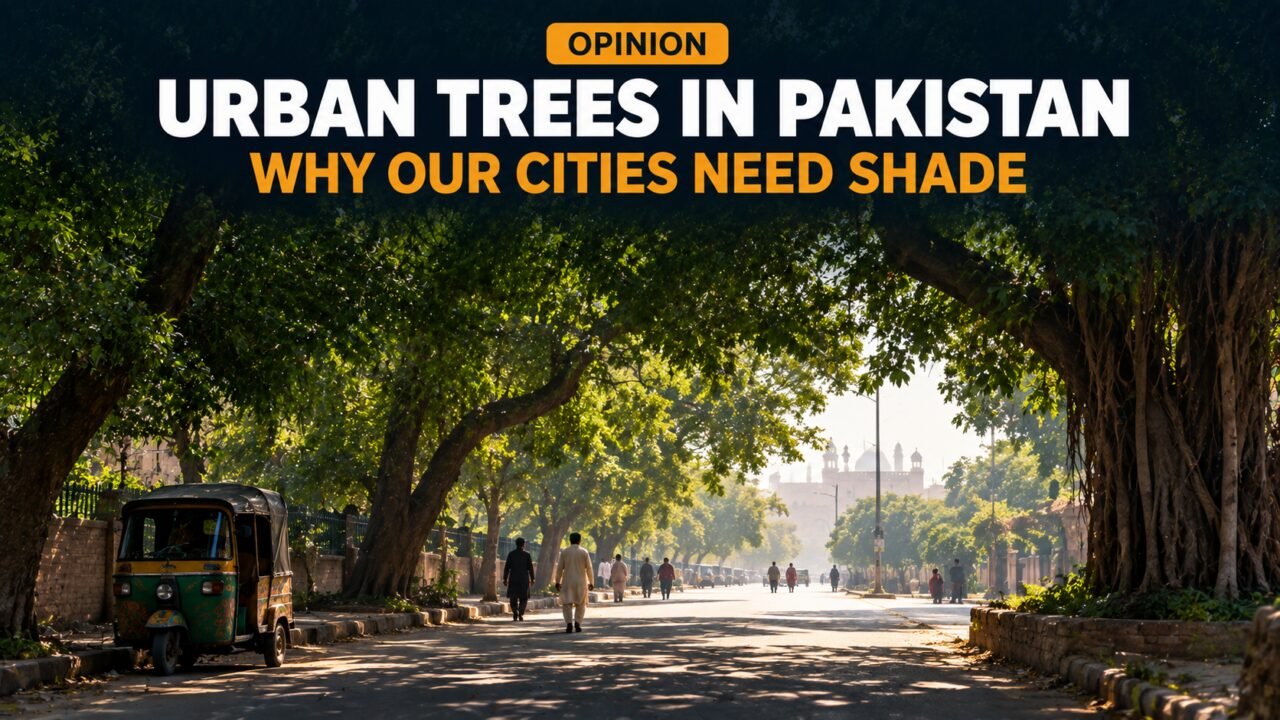
Opinion
Urban trees in Pakistan are usually discussed as decoration, something to plant on Independence Day, photograph with a minister and forget about by October. I think that is the wrong way to see them. In cities where summer temperatures now regularly cross 45°C and monsoon rain turns roads into rivers, trees are infrastructure. They belong in the same conversation as drains, power lines and hospitals, and they deserve the same budget and care.
This is not a romantic argument. It is a practical one. Below are five reasons our cities need far more shade, and what Karachi, Lahore and Islamabad have already taught us about doing it well and doing it badly.
Table of Contents
Heat is already killing people in our cities
In June 2015, a heatwave in Karachi killed more than 1,200 people in a matter of days. Morgues ran out of space. Hospitals filled with patients suffering from heatstroke, many of them elderly, poor or working outdoors. It was one of the deadliest heat events in the country’s history, and it happened in a coastal city that is usually spared the worst of Pakistan’s heat.
Since then, the warnings have kept coming. In May 2022, Jacobabad in Sindh crossed 50°C, and heatwaves hit much of the country weeks earlier than usual. Every summer, hospitals in Punjab and Sindh treat heatstroke patients, and every summer the people most at risk are the ones with the least protection: labourers, street vendors, rickshaw drivers, traffic police, and families in crowded homes without reliable electricity.
We cannot air-condition our way out of this. Most Pakistanis cannot afford it, the grid cannot support it, and load-shedding often switches off the fans exactly when they are needed most. Shade that does not depend on electricity is one of the few protections that reaches everyone.
Reason 1: Shade is the cheapest air conditioner we have
Cities are hotter than the countryside around them, and urban heat builds up in the densest neighbourhoods first. Concrete, asphalt and brick soak up heat during the day and release it at night, so neighbourhoods never cool down properly. This is known as the urban heat island effect, and it makes a heatwave in a dense city more dangerous than the same heatwave in a village.
Urban trees are one of the most effective ways to fight urban heat. According to the US Environmental Protection Agency, shaded surfaces can be 11 to 25°C cooler than the peak temperatures of unshaded materials, and the water that trees release through their leaves can lower peak summer air temperatures by 1 to 5°C.
Anyone who has walked down a tree-lined road in old Lahore on a June afternoon, and then stepped out onto a treeless new boulevard, has felt that difference on their skin. Shade on a bus stop, a school playground or a market street is not a luxury. For the people who spend their working day outside, it can decide whether they make it through the summer without falling ill.
Reason 2: Trees help with the air we breathe
Every winter, smog settles over Lahore, Faisalabad, Gujranwala and much of Punjab, and air quality readings reach levels that are dangerous for everyone, not only the sick and the elderly. Schools close. Flights are delayed. Hospitals fill with people struggling to breathe.
I want to be careful here, because trees are not a cure for smog. The main causes are vehicle exhaust, industry, brick kilns and crop burning, and no amount of planting will fix those without action on the sources. But urban trees do help at the margins. Their leaves trap some fine dust, and a dense line of trees along a busy road can reduce the pollution that reaches the homes and schools behind it.
It would be a mistake to sell tree planting as a smog solution. It would also be a mistake to ignore a benefit that comes free with the shade.
Reason 3: Trees soak up the rain that floods our streets
The same concrete that traps heat also sends rainwater straight into drains that cannot cope. When the monsoon arrives, water that once soaked into open ground now runs off roofs and roads, and low-lying neighbourhoods flood within hours.
Trees and the soil around them slow that water down. Their canopies catch some of the rain, their roots open up the soil so it can absorb more, and green strips along roads hold water that would otherwise rush into the nearest nullah. None of this replaces proper drainage, but every patch of soil that can absorb rain takes a little pressure off the system.
This summer’s floods showed how much that pressure matters. Our report on the 2026 monsoon describes how streets in Lahore and other Punjab cities disappeared under water after just a few hours of heavy rain.
Reason 4: Green streets are healthier streets
People walk more when streets are shaded and pleasant, and they spend more time outdoors in parks that actually have trees. In a country where diabetes and heart disease are rising, anything that makes walking easier deserves attention.
There is also growing evidence that green spaces are good for mental health, lowering stress and giving people somewhere calm to go in crowded cities. For a young person in a small flat in a dense neighbourhood, a shaded park may be the only open space within reach.
Trees make streets quieter too, and they bring birds back into neighbourhoods where many children have never heard anything but traffic and generators.
Reason 5: Trees cost less than the damage they prevent
A city tree needs a few years of watering and care. After that, it provides shade, cooling, flood protection and cleaner air for decades, often longer than the buildings around it.
Compare that with the costs we already pay. Heatwaves fill hospitals and cut the working hours of labourers who cannot afford to lose a day’s wage. Floods destroy roads and homes. Air conditioners strain the grid and push up electricity bills for everyone. Shade from a mature tree can lower the temperature of a house enough to reduce how often the fan or cooler runs, and that saving adds up across a whole neighbourhood.
When a city plans a new road, it should budget for trees along it as a basic part of the project, the same way it budgets for lights and drains.
What Karachi and Lahore have already shown
The good news is that we are not starting from zero. In Karachi, Shahzad Qureshi began planting small, dense Miyawaki forests in 2016, using a method developed by the Japanese botanist Akira Miyawaki. The idea is to plant many native species close together on a small plot, so they compete for light and grow quickly into a thick patch of woodland.
Those first urban forests in Karachi grew faster than many people expected and attracted birds, butterflies and insects that had not been seen in those neighbourhoods for years. The approach spread. Lahore’s Parks and Horticulture Authority began planting Miyawaki forests in the city in 2020, and other cities followed with their own plots.
Miyawaki forests are not a complete answer. They work best on small plots, they need care in the early years, and they cannot replace street trees along roads where people actually walk. But they proved something important: urban trees in Pakistan can grow well and quickly when the right species are planted in the right way.
The wrong urban trees can do real harm
Planting the wrong tree can be worse than planting nothing. Karachi learned this with conocarpus, a fast-growing species planted widely in the 2000s because it stayed green and needed little care. It later drew criticism from botanists and doctors for its heavy water use, its roots damaging pipes and foundations, and its links to allergies. Birds rarely nest in it. Authorities have since moved to stop planting it.
Islamabad has its own lesson in the paper mulberry, planted in large numbers in the city’s early years. Its spring pollen has made the capital notorious for severe allergies, and the city has spent years trying to remove it.
The better choices are usually native or long-established species that suit our climate and support local wildlife: neem, sheesham, peepal, banyan, jamun, amaltas, kachnar and others that have grown in the region for generations. They may take longer to reach full size, but they belong here.
Planting drives are not enough
Pakistan is good at planting days. Ministers, schools and companies plant saplings with great publicity during the monsoon and on national days, and national programmes such as the Ten Billion Tree Tsunami set enormous targets.
The problem is what happens afterwards. A sapling planted in July needs water through its first two or three summers, protection from goats and vandals, and someone who notices when it is dying. Too often, nobody is given that job. The photo is taken, the target is ticked off, and the plants die quietly by the next summer.
I would rather see a city plant a thousand trees and keep nine hundred alive than plant a hundred thousand and lose most of them. Survival rates, not planting numbers, should be the figure that officials report and that the public demands.
How to pay for urban trees in Pakistan
The usual objection is money, and it does not hold up well. Compared with the cost of a flyover, an underpass or a single year of emergency flood response, the cost of planting and caring for urban trees is small. The expensive part is not the sapling. It is the watering, protection and replacement over the first few years, and that is mostly a question of organising labour and water, not of finding huge sums.
There are several ways to fund it. Cities can set aside a fixed share of every road and development budget for trees along the new project, including three years of care. Housing societies and commercial developers can be required to plant and maintain urban trees as a condition of approval, with deposits returned only when the trees are alive after three summers. Companies that want to sponsor planting for their public image can be asked to fund maintenance contracts rather than one-day events.
Communities can play a part too. Many neighbourhoods already pay private guards and sweepers. A small monthly contribution for a gardener who waters the street’s trees in summer would cost each household very little and protect an investment that raises property values for everyone.
The point is that money for urban trees can be found when trees are treated as infrastructure. It disappears when they are treated as a photo opportunity.
What city governments should do for urban trees
These steps are not radical, and most do not need new laws:
- Set a target for shade cover in each neighbourhood, starting with the poorest and hottest ones
- Plant along bus routes, school roads and markets first, where people are exposed to the sun for longest
- Use native species and publish a list of approved trees for every city
- Assign responsibility for watering and care for at least three years after planting
- Report survival rates publicly every year, not just planting numbers
- Protect existing mature trees during road widening and construction, and make cutting them the last option
- Leave space for soil and roots in new pavements, instead of sealing every surface in concrete
What you can do on your own street
Citizens do not have to wait for the government. Many of the best urban trees in our cities were planted by residents who simply decided their street needed shade.
- Plant one native tree outside your house or in your building’s compound, and water it through its first summers
- Talk to your neighbours and your union council about a planting plan for the whole street
- Ask your children’s school to plant trees along its boundary and give each class one to look after
- Speak up when mature trees are cut for road projects, and ask whether there is an alternative
- Support local groups that plant and maintain urban forests
It is also worth planting with the future in mind. A tree planted this year will not cast much shade until our children are teenagers. That is exactly why it should be planted now.
Urban heat will get worse, so plant for 2050
Climate scientists expect heatwaves in South Asia to become hotter, longer and more frequent over the coming decades. At the same time, our cities keep growing, and every new housing scheme adds more concrete and asphalt. Unless we change how we build, urban heat will rise faster in our cities than in the countryside around them.
That makes this a long game. A neem or peepal planted today will not give full shade for 15 or 20 years. The street trees that will protect Karachi, Lahore and Rawalpindi in the hot summers of the 2040s and 2050s need to go in the ground now, while the saplings still have time to grow.
It also means thinking beyond individual trees. Our cities need connected green corridors along drains and rivers, shaded routes for people who walk to work, and parks spread evenly across neighbourhoods rather than concentrated in wealthy areas. Urban trees in Pakistan have mostly been planted wherever there happened to be space. They should be planted wherever people need them most.
The cities that will cope best with the heat of the next few decades are the ones that start planning for it now. I would like ours to be among them.
Urban trees in Pakistan: questions readers ask
Which trees are best for Pakistani cities?
Native and long-established species such as neem, sheesham, peepal, banyan, jamun, amaltas and kachnar are usually good choices. Ask your city’s horticulture department or a local nursery which ones suit your soil and space.
What is a Miyawaki forest?
It is a small, dense forest planted using a method developed by Japanese botanist Akira Miyawaki. Many native species are planted close together so they grow quickly into thick woodland.
Do trees really cool a city?
Yes. Shade and the water released by leaves lower temperatures in the surrounding area, and shaded surfaces stay much cooler than exposed concrete and asphalt.
When is the best time to plant trees in Pakistan?
The monsoon and spring seasons are the usual planting seasons in most of the country, because the soil is moist and temperatures are milder.
Can one household really make a difference?
Yes, more than most people expect. A single well-placed tree can shade a house, a stretch of pavement or a bus stop for decades. When neighbours on the same street each plant and care for one, the combined shade changes how the whole street feels on a June afternoon, and it often persuades the next street to do the same.
The next heatwave is not a question of if. The trees we plant and protect this year will decide how many of our neighbours can find shade when it comes. For more views and reporting from A1 Blogs, visit our latest stories or read about how we work.