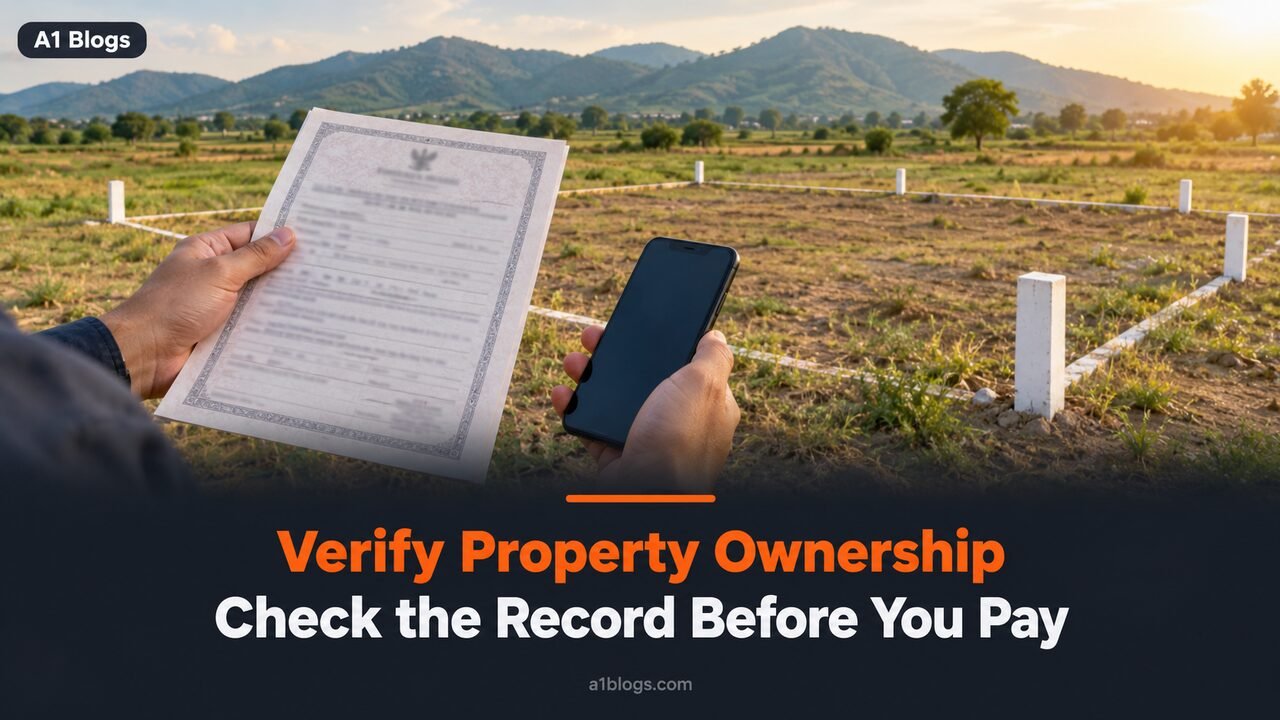
Property fraud in Pakistan usually works because the buyer never checks the official record. A seller shows convincing papers, sometimes a fake power of attorney, and the money is gone before anyone looks up who the land actually belongs to. Today you can verify property ownership online for most land in Punjab and for CDA properties in Islamabad, often in a few minutes.
This guide explains where the official records are, how to read them, and the checks to complete before you pay a token amount for any plot or house.
Table of Contents
Why you must verify property ownership
Papers in a seller’s hand prove very little on their own. Documents can be forged, an owner may have already sold the property, a relative may be selling without authority, or the land may be mortgaged to a bank or caught up in a court case. The only reliable answer comes from the record kept by the authority responsible for that land.
Who keeps the record depends on where the property is:
- Rural and most non-society land in Punjab: the Punjab Land Records Authority (PLRA).
- CDA sectors in Islamabad: the Capital Development Authority.
- Land outside CDA sectors in Islamabad Capital Territory: the ICT Administration’s revenue office.
- Plots and files in housing societies such as DHA or Bahria: the society’s own transfer records.
How to verify property ownership in Punjab
The PLRA was created in 2017 under the Board of Revenue Punjab to computerise land records and replace the old patwari system. It offers several ways to check the record:
- The PLRA portal at punjab-zameen.gov.pk, with property search and other services.
- Online fard at onlinefard.punjab-zameen.gov.pk, where you can obtain a digital ownership extract.
- The Punjab Zameen app for Android and iOS.
- Arazi Record Centres, the PLRA’s service centres, for issuing printed fards and handling mutations in person.
To search, select the district, tehsil and mauza (revenue estate), then enter property details such as the khewat or khasra number, or the owner’s details. For privacy reasons, a CNIC alone often does not return a full record; you usually need some property details as well.
What a fard tells you
A fard is an extract from the record of rights. It shows:
- the registered owner or owners, and each owner’s share;
- the khewat and khasra numbers that identify the land;
- the area of the land;
- remarks such as a registered mortgage.
Compare the fard with the seller’s CNIC. The name and share on the fard must match the person selling to you. If several family members are listed as owners, all of them, or someone with valid authority from each, must agree to the sale.
Also ask for the mutation history, called intiqal. It shows how the land changed hands over the years and can reveal recent transfers that look suspicious.
How to verify property ownership in Islamabad
Islamabad has more than one system, so first identify where the property is.
CDA sectors. For houses and plots in CDA-developed sectors, the CDA keeps the ownership record. The CDA offers an online ownership verification service through its e-services, and transfers in CDA sectors go through its one-window process. Ask the seller for the CDA allotment and transfer documents and confirm them with the CDA directly.
Land outside CDA sectors. Rural and other land in Islamabad Capital Territory is recorded by the ICT Administration’s revenue office. Visit the relevant office with the property details to confirm the record.
Housing societies. In DHA, Bahria and other societies, plots and files are transferred through the society’s own records. Ask the society for written confirmation of the current owner and a no-demand certificate showing no unpaid dues. Before that, check that the society itself is legal; our guide to CDA approved housing societies explains how.
Seven checks before you pay a token
- Get the official record from PLRA, CDA, ICT revenue or the society, as described above.
- Match identity. The seller’s CNIC must match the owner in the record.
- Check every owner. Joint ownership needs every owner’s consent.
- Verify any power of attorney. If someone is selling on another person’s behalf, confirm the power of attorney at the office where it was registered, and ideally speak to the owner yourself.
- Look for mortgages and cases. Check the fard’s remarks for a mortgage, and ask a lawyer to check for pending litigation or stay orders.
- Visit the site. Confirm the land exists where the papers say, and that nobody else is in possession.
- Check dues and taxes. Ask for a no-demand certificate and budget for transfer taxes.
Red flags
- The seller is in a hurry and offers a large discount for a quick deal.
- The seller cannot show original documents, only photocopies.
- A power of attorney was signed very recently, or the owner is “abroad” and unreachable.
- The record shows a different area or location from the one you are shown.
- The fard shows a transfer to the seller only days or weeks earlier.
Any one of these is a reason to slow down and dig deeper.
Common types of property fraud
Knowing how fraud usually works makes it easier to spot:
- Double sale: the owner sells the same property to two buyers and disappears with both payments.
- Fake power of attorney: someone sells using a forged or cancelled authority from the real owner.
- Impersonation: a person pretends to be the owner using a fake or borrowed CNIC.
- Forged documents: printed fards, allotment letters or transfer papers that do not match the official record.
- Selling land that cannot be sold: state, forest or disputed land offered at a tempting price.
Every one of these is caught by the same habit: check the official record yourself, directly with the authority, before paying anything.
Inherited property
When land passes to heirs, the record must be updated through an inheritance mutation before it can be sold properly. In Punjab this is handled through the PLRA and its Arazi Record Centres. Until it is done, the fard still shows the deceased owner, and a sale by one heir alone is open to challenge by the others.
If you are buying inherited property, confirm that the inheritance mutation is complete, that every heir appears in the record, and that all of them consent to the sale. Disputes between heirs are one of the most common reasons property deals end up in court.
Overseas Pakistanis buying property
Buyers abroad are a favourite target because they cannot easily visit the land or the office. You can still verify property ownership from abroad for Punjab land through the online fard service and the Punjab Zameen app, and for CDA properties through the CDA’s online services.
Beyond that, hire a lawyer you trust in Pakistan rather than relying on the dealer, give any power of attorney only for a specific property and transaction, and send money only to verified accounts at the stage of registration, never to a dealer’s personal account. If someone presses you to pay before the record has been checked, walk away.
After the checks: completing the deal
Once you verify property ownership and are satisfied, complete the sale through the proper legal process: a written sale agreement, payment through banking channels rather than cash, and registration of the transfer with the relevant authority. Keep copies of every document and receipt.
Taxes at transfer can be significant, especially for non-filers. Our guide to property tax in Islamabad explains the 2026-27 rates for buyers and sellers.
Frequently asked questions
Can I check land ownership in Punjab with just a CNIC?
Often not completely. For privacy, the PLRA usually needs property details such as the district, mauza and khewat or khasra number as well as a CNIC.
What is a fard?
An extract from the record of rights showing who owns a piece of land, their share, its area and any remarks such as a mortgage.
Does PLRA cover Islamabad?
No. PLRA covers Punjab. In Islamabad, the CDA keeps records for its sectors, and the ICT Administration’s revenue office covers other land.
How do I verify a plot in DHA or Bahria?
Through the society’s own records. Ask the society for written confirmation of ownership and a no-demand certificate.
Is an online check enough?
It is the essential first step, but a careful buyer also visits the site, verifies any power of attorney and asks a lawyer to check for court cases before paying.
An Urdu checklist is available in our guide اسلام آباد میں پلاٹ خریدنے سے پہلے.