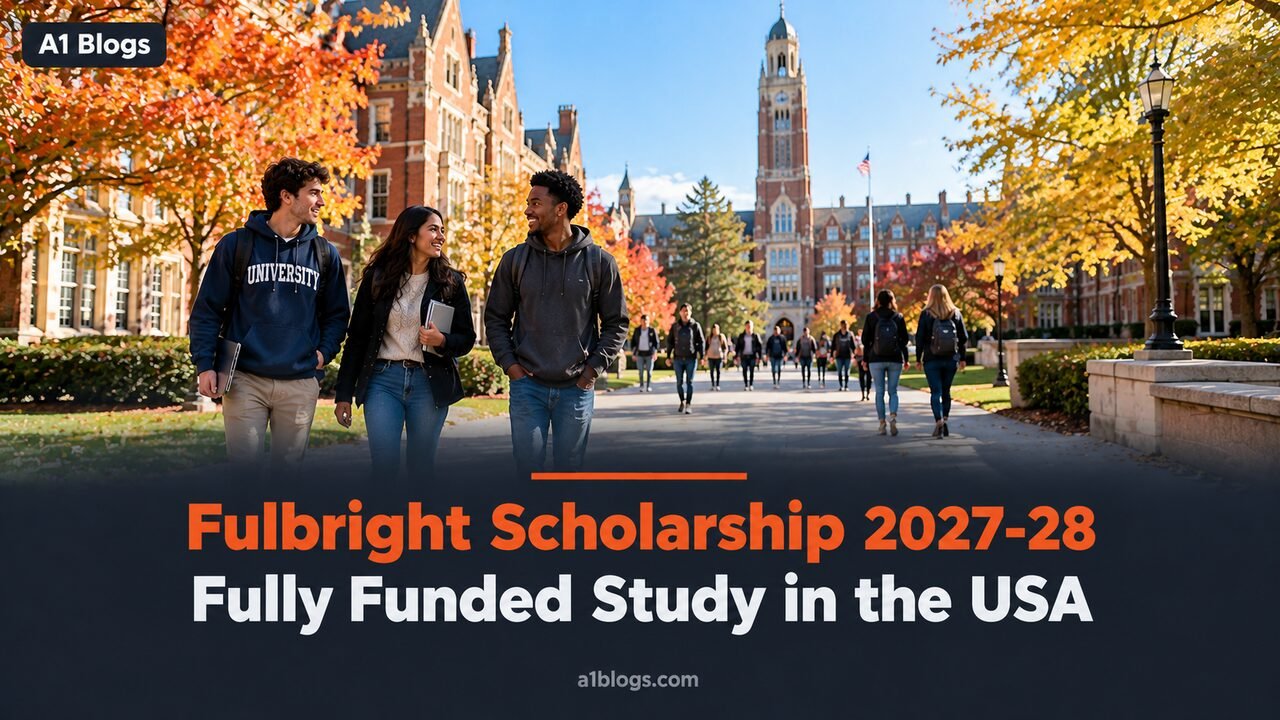
The Fulbright scholarship is the United States government’s flagship international exchange programme, and for students outside the US it is one of the most valuable routes to a fully funded master’s or PhD at an American university. It covers tuition, living costs, flights and insurance, and it is open in more than 160 countries.
The catch is that there is no single global application. Each country runs its own Fulbright competition, with its own deadline and rules. This guide explains how the Fulbright scholarship works, what it covers, and the details for Pakistani applicants, where the programme is run by the United States Educational Foundation in Pakistan (USEFP).
Table of Contents
How the Fulbright scholarship works worldwide
Fulbright’s programme for non-US students, known as the Foreign Student Program, is managed in each country by a binational Fulbright commission or by the US embassy. That body sets the application window, chooses candidates and places them at US universities, often working with partner organisations that handle university applications on the student’s behalf.
Because each country’s calendar is different, the first step is always to find your own country’s Fulbright office and its current call. Deadlines you see online for American applicants, such as early October, usually do not apply to students from other countries.
What the Fulbright scholarship covers
In Pakistan, USEFP says the scholarship funds graduate study at US universities for a master’s or PhD, including:
- tuition;
- required textbooks;
- airfare;
- a living stipend;
- health insurance.
Coverage in other countries is similar, though details vary.
Fulbright scholarship in Pakistan: eligibility
According to USEFP, applicants must:
- be Pakistani citizens with strong academic records, residing in Pakistan throughout the selection process;
- be committed to returning to Pakistan and serving the country;
- for a master’s, hold a four-year bachelor’s degree or a bachelor’s and master’s combination totalling 16 years of education;
- for a PhD, hold a master’s, MPhil or comparable degree totalling 18 years of education;
- take the GRE General Test before the deadline.
All fields are eligible except clinical medicine. TOEFL is not required with the application. Experience in teaching, research or the public sector is described as strongly preferred.
Successful candidates sign a contract with USEFP, and PhD grantees sign a bond with the Higher Education Commission requiring them to return to Pakistan after their studies.
The GRE requirement
The GRE General Test is compulsory for all Pakistani Fulbright applicants and must be taken before the deadline. USEFP has published a minimum of 145 in each section in recent cycles, but a higher score makes an application far more competitive. Book the test months ahead: seats in Pakistan fill up close to the deadline, and you may want time for a second attempt.
The Fulbright timeline in Pakistan
The most recent student round, for study starting in 2027, opened on 20 February 2026 and closed on 1 April 2026. If the pattern holds, the next round for 2028 entry will open around February 2027.
A realistic plan is to take the GRE in late 2026 or early 2027, prepare your essays and references in January, and submit well before the deadline.
For academics and researchers who already hold a PhD, USEFP also runs the separate Fulbright Scholar Program, which funds research or teaching stays of up to ten months at a US institution. Its 2027 round is open now, with a deadline of 28 October 2026, and requires a PhD or terminal degree held for at least two years.
What a strong Fulbright application includes
USEFP lists the application form, three reference letters, a GRE score report and scanned transcripts, including an explanation of the grading scale. The essays are where applications are won or lost. They should show:
- a clear study objective: what you want to study and why in the US;
- evidence of leadership and impact in your work or community;
- a convincing plan for returning and applying what you learn in Pakistan;
- academic strength, supported by grades, research or publications.
USEFP describes merit broadly, including grades, test scores, leadership potential and commitment to contributing to Pakistan’s development. Recent calls have particularly encouraged applicants in science, technology, artificial intelligence, trade, economics and natural resource management.
Choosing universities and programmes
Unlike many scholarships, Fulbright usually helps place selected candidates at American universities, often through partner organisations that submit applications on their behalf. You still need a clear idea of where you want to study and why.
Research programmes before you write your essays. Look at the courses offered, the faculty working in your area, and the kind of graduates each programme produces. For a PhD, identify professors whose research matches yours and read some of their recent work. Naming realistic, well-matched programmes shows the selection panel that your study plan is serious.
Keep an open mind, though. The US has thousands of universities, and some of the best programmes in specialised fields are at institutions that are not household names abroad.
Life as a Fulbright student
The living stipend is designed to cover reasonable costs in your university town, not a lavish lifestyle, and costs differ widely between a small college town and a big coastal city. Grantees are usually invited to enrichment events that bring together Fulbright students from many countries, which is one of the programme’s most valued parts. Many alumni say the network they build in the US matters as much as the degree.
A 12-month preparation plan
- 12 months before the deadline: read the official call, check eligibility and start researching programmes.
- 9 months: begin test preparation and book a test date with time for a retake.
- 6 months: draft your study objective and personal essays, and ask referees early.
- 3 months: take or retake the test, finalise transcripts and collect references.
- 1 month: polish essays, check every document and submit early, before the portal gets busy.
Starting early is the single biggest advantage most successful applicants have.
The J-1 visa and the return requirement
Fulbright grantees travel to the US on a J-1 exchange visitor visa. Grantees are generally subject to a rule requiring them to spend two years in their home country after the programme before they can apply for certain US visas or permanent residence. Together with the USEFP contract and HEC bond, this makes Fulbright a scholarship for people who genuinely plan to return.
Fulbright vs Chevening
Pakistani applicants often weigh these two:
- Degree: Fulbright funds master’s and PhD degrees in the US; Chevening funds one-year master’s degrees in the UK.
- Test: Fulbright Pakistan requires the GRE; Chevening needs no admission test for the scholarship itself, though universities require English.
- Work experience: Chevening requires at least 2,800 hours; Fulbright prefers relevant experience but focuses on academic merit and leadership.
- Return: both require you to return home.
Many strong candidates apply to both, since the timelines do not overlap. See our Chevening Scholarship guide.
Frequently asked questions
When is the Fulbright deadline for Pakistan?
The 2027 student round closed on 1 April 2026. The next round is expected to open around February 2027. The Fulbright Scholar Program for PhD holders closes on 28 October 2026.
Is the GRE compulsory for Fulbright Pakistan?
Yes. USEFP requires the GRE General Test for all master’s and PhD applicants, taken before the deadline.
Does Fulbright fund bachelor’s degrees?
No. The degree programme in Pakistan funds master’s and PhD study only.
Can medical graduates apply?
All fields are eligible except clinical medicine. Public health and related fields are eligible.
Do I need TOEFL?
TOEFL is not required with the Pakistan application. Selected candidates may be asked to take it later.
For other funded options, see our guide to fully funded scholarships for 2027–28. Official details are on the USEFP Fulbright Degree page.