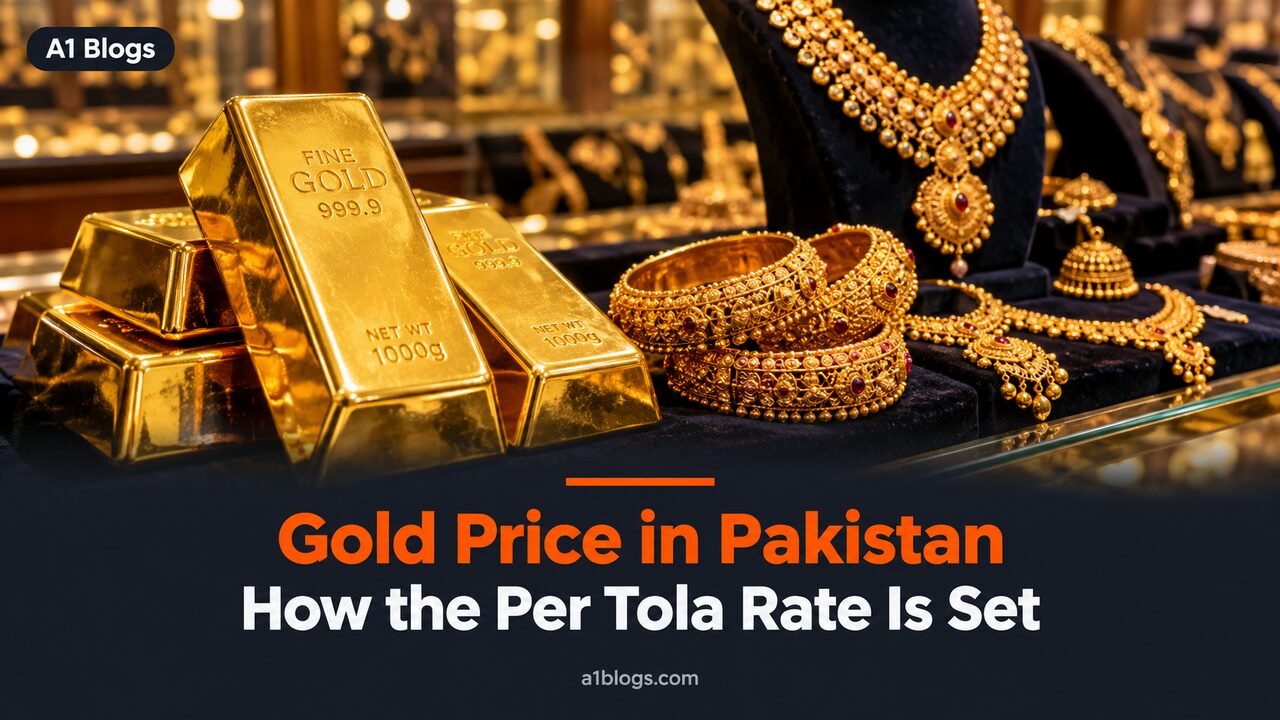
Gold has always been more than jewellery in Pakistan. It is wedding savings, emergency money and, for many families, the one investment they trust when the rupee is falling. In 2026 it has also become eye-wateringly expensive, with a tola of 24 karat gold costing well over Rs400,000.
This guide explains how the gold price in Pakistan is set each day, how to work it out yourself from the international price, what the different karats mean, what to check when you buy or sell, and how gold compares with other ways to save.
*This article is for information only and is not investment advice. Gold prices can fall as well as rise.*
Table of Contents
The gold price in Pakistan today
On 3 October 2026, the All Pakistan Sarafa Gems and Jewellers Association set the price of 24 karat gold at Rs436,336 per tola, down Rs4,300 on the day, with 10 grams at about Rs374,000. Internationally, gold fell by $43 to about $4,138 an ounce.
The day before, the price had risen by Rs2,000 to Rs440,636 per tola. Swings of several thousand rupees a day have become normal, because the international price itself is near record levels and moves sharply.
Who sets the gold price in Pakistan
The benchmark rate is published every day by the Sarafa Association, the national body of gold traders and jewellers. Jewellers across Karachi, Lahore, Islamabad and other cities base their prices on it, although the price you pay in a shop can be slightly higher or lower depending on the city and the dealer.
The Sarafa Association does not invent the price. It follows two things: the international gold price, set in global markets in dollars per ounce, and the rupee’s exchange rate against the dollar.
How to work out the price yourself
You can estimate the gold price in Pakistan with simple arithmetic. You need three facts:
- A tola is 11.6638 grams.
- A troy ounce, the unit used for international gold prices, is 31.1035 grams.
- So one tola is 0.375 of a troy ounce.
The formula is:
Price per tola ≈ (international price per ounce + local premium) × dollar rate × 0.375
Taking 3 October 2026 as an example: an international price of about $4,138, a local premium of around $20 an ounce, and a dollar rate of about Rs277 give roughly ($4,158 × 277 × 0.375), or about Rs432,000 per tola. The Sarafa Association’s rate that day was Rs436,336. The small difference reflects local factors such as the premium, the dollar rate dealers actually pay and trading margins.
The useful insight is that the gold price in Pakistan has two drivers. If the international price rises or the rupee weakens, the local price goes up. If both move in your favour, it falls.
What 24 karat, 22 karat and 21 karat mean
Karat measures purity out of 24:
- 24 karat is pure gold, about 99.9%. It is soft, so it is mainly used for bars and coins.
- 22 karat is 22 parts gold out of 24, about 91.7% pure, and is the most common for traditional jewellery.
- 21 karat is 87.5% pure and is also widely used in jewellery.
- 18 karat is 75% pure and is harder, so it suits jewellery with stones.
To estimate the price of lower karats, multiply the 24 karat price by the karat and divide by 24. At Rs436,336 for 24 karat, a tola of 22 karat gold is worth about Rs400,000 in gold content, and 21 karat about Rs382,000, before making charges.
Why gold is so expensive in 2026
The international gold price has climbed to more than $4,100 an ounce in 2026, pushed up by central banks buying gold, geopolitical tension and investors looking for safety. Pakistani prices have followed. Because the rupee has been relatively stable in 2026, most of the recent rise in the local price reflects the international market rather than a weaker rupee.
What to check when you buy gold
Buying gold safely is mostly about knowing exactly what you are paying for.
- Check the day’s rate from the Sarafa Association or a reliable news source before you go to the shop.
- Ask for the karat and weight in writing on your receipt, including the weight in grams.
- Understand making charges. Jewellery prices include labour charges for the design, which can be significant and are usually not paid back when you sell.
- Ask about the buy-back policy. Many jewellers deduct an amount when they buy gold back, so know the terms in advance.
- Have purity tested for large purchases, especially from a dealer you do not know. Testing machines in major markets can check purity quickly.
- Keep the receipt safely. It makes selling easier and helps if there is ever a dispute.
Jewellery, bars or coins?
If you are buying gold mainly as savings rather than to wear, bars and coins usually make more sense than jewellery. You pay little or nothing in making charges, purity is clearly marked, and it is easier to get close to the market rate when you sell. Jewellery has emotional and practical value, but a large part of its price is labour you will not recover.
Selling gold
When you sell, the jeweller will test the purity and weigh the gold, then offer a price based on the day’s rate minus a deduction. Get quotes from two or three jewellers before you sell a significant amount, and sell to established dealers in recognised markets.
Common gold scams and how to avoid them
High prices make gold fraud more profitable, and the tricks are well known:
- Lower karat sold as higher. A piece sold as 22 karat may be 21 or less. Purity testing and a written receipt protect you.
- Short weight. Scales can be tampered with. Watch the item being weighed and check the weight in grams on the receipt.
- Plated or filled items. Some pieces have a thin gold layer over another metal. These are hard to spot by eye, which is why testing matters for large purchases.
- “Gold investment” schemes. Offers that promise monthly profits on gold you deposit, or gold at well below the market rate, are almost always frauds.
- Fake buyers. When selling privately, insist on meeting at a jeweller’s shop or bank, never at home, and never accept a cheque you have not seen clear.
As a rule, if a deal beats the day’s gold price in Pakistan by a wide margin, ask why.
Storing gold safely
Once you own gold, keeping it safe is part of the cost:
- Bank lockers are the safest option for large amounts, though they cost a yearly fee and are not available everywhere.
- At home, keep gold out of obvious places and avoid telling people how much you have.
- Keep records: receipts, weights, karat and photos of each piece. They help with insurance, selling and any police report if something is stolen.
- Consider insurance for valuable collections, and check whether your home policy covers jewellery.
Gold that is lost or stolen is gone; the cost of storing it properly is small by comparison.
Is gold a good way to save in Pakistan?
Gold has real strengths and real weaknesses.
Strengths:
- It has protected Pakistanis against a falling rupee over long periods.
- It is easy to understand and can be sold quickly almost anywhere.
- It does not depend on any company or bank.
Weaknesses:
- It pays no income, unlike National Savings or dividend-paying shares.
- It can fall in price, sometimes for years.
- Storing it at home carries a theft risk, and bank lockers cost money.
- Making charges and buy-back deductions eat into returns on jewellery.
Many families keep some gold alongside other savings rather than putting everything into one asset. For comparison, see our guides to National Savings profit rates, mutual funds in Pakistan and the dollar rate in Pakistan.
Zakat on gold
Zakat applies to gold you own above the nisab, traditionally set at 7.5 tola of gold, once a full lunar year has passed. How jewellery for personal use is treated differs between schools of thought, so ask a scholar you trust about your own case.
Frequently asked questions
What is the gold price in Pakistan per tola today?
On 3 October 2026 it was Rs436,336 for 24 karat, according to the Sarafa Association. The rate changes every day, so check before you buy or sell.
Why is the gold price in Pakistan different from the international price?
The international price is in dollars per ounce. The Pakistani price converts it into rupees per tola using the exchange rate, and adds a local premium and dealer margins.
How many grams are in a tola?
11.6638 grams, which is 0.375 of a troy ounce.
Does the gold price in Pakistan go up when the rupee falls?
Yes. A weaker rupee makes gold more expensive in rupees even if the international price does not change.
Sources: daily rates reported from the Sarafa Association by Bloom Pakistan and Business Recorder.