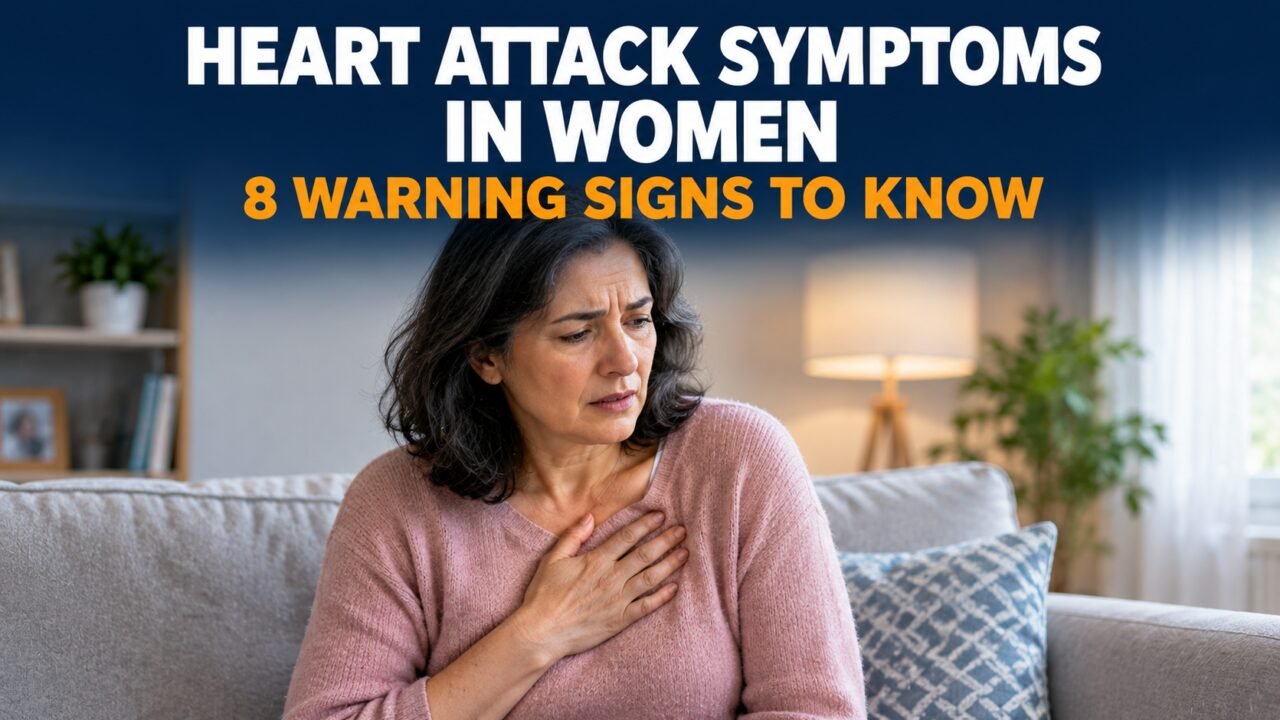
Heart attack symptoms in women do not always look like the scene from the movies, where a man clutches his chest and falls to the floor. Many women do feel chest pain, but they are also more likely than men to have symptoms that are easy to explain away: shortness of breath, nausea, pain in the jaw or back, or an exhaustion that feels like the flu. Too often, those signs are ignored until it is too late.
Heart disease is the leading cause of death for women in the United States, responsible for about one in every five female deaths, according to the Centers for Disease Control and Prevention. This guide explains the eight warning signs to know, how women’s symptoms can differ from men’s, who is at higher risk, and exactly what to do if you think a heart attack is happening.
Table of Contents
Why heart attacks in women are often missed
For decades, most heart research focused on men, and the classic picture of a heart attack was built around male patients. Women themselves often grew up thinking of heart disease as a man’s problem and breast cancer as the bigger threat, even though heart disease kills far more women each year.
That gap has real consequences. Studies have found that women tend to wait longer than men before calling for help during a heart attack. They are more likely to put their symptoms down to stress, indigestion, anxiety or tiredness. Some are told the same thing by doctors, especially when their symptoms do not match the textbook pattern.
The good news is that awareness has grown. Campaigns such as the American Heart Association’s Go Red for Women have helped more women recognize the signs. But knowledge is only useful if it leads to action in the moment.
What happens during a heart attack
A heart attack happens when blood flow to part of the heart muscle is blocked, usually by a blood clot that forms where fatty plaque has built up in a coronary artery. Without oxygen-rich blood, that part of the heart begins to die.
The longer the blockage lasts, the more heart muscle is damaged. That is why doctors say “time is muscle.” Treatments that reopen the artery, such as clot-dissolving drugs or a procedure to insert a stent, work best when given as early as possible, ideally within the first hour or two.
This is the most important point in this entire article: getting help quickly can be the difference between a full recovery and permanent damage or death.
Heart attack symptoms in women: 8 warning signs
These are the heart attack symptoms women report most often. You may have one, several or all of them, and they can come and go.
1. Chest pain, pressure or discomfort
Chest discomfort is still the most common symptom in both women and men. It may feel like squeezing, fullness, tightness or heavy pressure in the center of the chest rather than a sharp pain. It can last more than a few minutes, or go away and come back.
2. Shortness of breath
Feeling suddenly short of breath, with or without chest discomfort, is a common heart attack symptom in women. It can happen at rest or with very light activity, such as walking across a room.
3. Pain in the jaw, neck, back or arms
Pain or discomfort can spread to one or both arms, the back, the neck, the jaw or the stomach. In women, pain in the upper back, between the shoulder blades, or in the jaw is especially easy to dismiss as a pulled muscle or a dental problem.
4. Nausea or vomiting
Feeling sick to your stomach, vomiting or having what feels like severe indigestion can be a sign of a heart attack, particularly in women. It is often mistaken for food poisoning or a stomach bug.
5. Cold sweat
Breaking out in a cold sweat for no obvious reason, especially alongside other symptoms, is a warning sign. It is different from the hot sweat of exercise or a warm room.
6. Lightheadedness or dizziness
Feeling faint, lightheaded or dizzy, or actually fainting, can happen during a heart attack as the heart struggles to pump enough blood.
7. Unusual or extreme fatigue
Many women describe a sudden, overwhelming tiredness that is out of proportion to what they have been doing. Everyday tasks like making the bed or carrying groceries may suddenly feel exhausting.
8. A sense that something is very wrong
Some women report a strong feeling of anxiety or impending doom before or during a heart attack. Doctors take this seriously. If your body is telling you something is badly wrong, listen to it.
How women’s symptoms can differ from men’s
Women and men both most commonly experience chest pain during a heart attack, so it is a myth that women “don’t get” chest pain. The difference is that women are somewhat more likely to also have the other symptoms: shortness of breath, nausea, back or jaw pain, dizziness and fatigue.
Women’s chest discomfort may also be less intense or feel more like pressure than pain. Some women have symptoms while resting or even while asleep, rather than during physical effort. Emotional stress can also trigger heart problems in some women.
Because these heart attack symptoms can be less dramatic, both women and the people around them may not realize what is happening. That is why it helps to know the full list, not just the chest pain.
Warning signs that can appear days or weeks before
Some women notice changes in the days or weeks before a heart attack. The most commonly reported is unusual fatigue. Others include trouble sleeping, shortness of breath with activities that used to be easy, indigestion and a vague feeling of anxiety.
These symptoms are common and have many possible causes, so they do not mean a heart attack is coming. But if you notice new or worsening symptoms, particularly if you have risk factors for heart disease, it is worth making an appointment with your doctor soon rather than waiting.
If symptoms are severe or sudden, do not wait for an appointment. Call 911.
What to do right now if you think it is a heart attack
If you or someone near you has possible heart attack symptoms, act immediately:
- Call 911. Do not wait to see if the symptoms pass, and do not call your doctor’s office first.
- Do not drive yourself to the hospital. Paramedics can begin treatment on the way, check your heart rhythm and alert the hospital before you arrive.
- If the 911 dispatcher tells you to, chew a regular aspirin, as long as you are not allergic to it and have not been told to avoid it.
- Sit down, stay calm and unlock the front door so emergency responders can get in.
- If the person becomes unresponsive and is not breathing normally, start CPR.
Many women hesitate because they do not want to make a fuss or feel embarrassed if it turns out to be nothing. Emergency teams would much rather check a false alarm than arrive too late.
Heart attack or cardiac arrest?
The two terms are often used as if they mean the same thing, but they are different. A heart attack is a circulation problem: a blocked artery cuts off blood to part of the heart. The person is usually awake and may be talking.
Cardiac arrest is an electrical problem. The heart suddenly stops pumping effectively, and the person collapses, becomes unresponsive and stops breathing normally. Without immediate CPR and a shock from a defibrillator, death can follow within minutes.
A heart attack can trigger cardiac arrest, which is one reason why calling 911 quickly is so important.
Who is at higher risk
The major risk factors for heart disease apply to both women and men:
- High blood pressure
- High LDL cholesterol
- Diabetes, which raises heart risk even more in women than in men
- Smoking or vaping nicotine
- Obesity, especially fat around the waist
- Physical inactivity
- A family history of early heart disease
Some risk factors are specific to women or more common in women. These include high blood pressure or diabetes during pregnancy, preeclampsia, preterm delivery, early menopause, polycystic ovary syndrome and autoimmune diseases such as lupus and rheumatoid arthritis. If any of these apply to you, tell your doctor, because they may not show up on a standard checklist.
Risk also rises after menopause, as the protective effects of estrogen decline.
Heart conditions that are more common in women
A few types of heart problems affect women much more often than men and can look like a typical heart attack.
Spontaneous coronary artery dissection, or SCAD, happens when a tear forms in the wall of a coronary artery. It often affects younger, otherwise healthy women, including women who are pregnant or have recently given birth.
Takotsubo cardiomyopathy, sometimes called broken heart syndrome, is a sudden weakening of the heart muscle often triggered by intense emotional or physical stress. Most people who experience it are women, usually after menopause.
Women are also more likely than men to have heart attacks without large blockages in the major arteries, a condition doctors call MINOCA. It still needs careful treatment, even though it may not show up clearly on standard tests.
Heart attack symptoms in younger women
Heart attacks are less common in younger women, but they do happen, and younger patients are among the most likely to be sent home without a correct diagnosis. Rates of risk factors such as obesity, diabetes and high blood pressure have been rising among younger adults.
If you are in your 30s or 40s and have symptoms like those described above, do not assume you are too young for a heart problem. Mention any pregnancy complications, a family history of early heart disease and any autoimmune conditions to the emergency team.
How doctors check for a heart attack
In the emergency room, doctors usually start with an electrocardiogram, or ECG, which records the heart’s electrical activity and can show signs of a heart attack within minutes. They will also take blood tests for troponin, a protein released when heart muscle is damaged. Because troponin levels rise over several hours, the test is often repeated.
Depending on the results, you may have an echocardiogram, a stress test or a coronary angiogram, which uses dye and X-rays to show blockages in the arteries. If an artery is blocked, doctors may open it with a balloon and stent during the same procedure.
If you are sent home and your symptoms return or get worse, go back. It is reasonable to ask whether your troponin was checked more than once and whether a heart problem has been fully ruled out.
Recovery after a heart attack
Surviving a heart attack is the start of a longer process. One of the most effective parts of recovery is cardiac rehabilitation, a supervised program of exercise, education and support that usually runs for several weeks. Research has linked cardiac rehab to a lower risk of another heart attack and a lower risk of death, yet women are referred to it less often than men and are less likely to finish it.
If your doctor does not mention cardiac rehab, ask about it. Many programs are covered by Medicare and private insurance, and some now offer home-based or virtual options for people who cannot travel to a clinic several times a week.
The emotional side of recovery matters too. Depression and anxiety are common after a heart attack, and they can make it harder to exercise, take medications and return to normal life. Talking to your care team, a counselor or a support group is part of healing, not a sign of weakness.
Most women can gradually return to work, exercise, driving and sex after a heart attack, but the timing depends on the severity of the damage and the treatment received. Ask your cardiologist for a clear plan, and keep taking prescribed medicines even when you feel well.
How to lower your risk
Most heart disease is linked to factors you can influence. The American Heart Association groups them into eight areas it calls Life’s Essential 8: eating a healthy diet, being physically active, avoiding nicotine, getting enough sleep, managing weight, and keeping cholesterol, blood sugar and blood pressure in healthy ranges.
Small changes add up. Walking for 30 minutes on most days, cutting back on processed foods and sugary drinks, getting seven or more hours of sleep and quitting smoking all lower heart risk. Our guide to a healthy morning routine has practical ideas for building habits that stick.
Know your numbers. Ask your doctor for your blood pressure, cholesterol and blood sugar results, and what they mean for you. Many people with high blood pressure or high cholesterol feel perfectly well, which is why regular checkups matter.
Questions to ask your doctor
If you are worried about your heart, these questions can help you get the most from an appointment:
- What is my personal risk of heart disease, based on my history and test results?
- Are my blood pressure, cholesterol and blood sugar in healthy ranges?
- Do my pregnancy history or other conditions raise my risk?
- Should I have any additional tests?
- What symptoms should make me call 911 right away?
Write down your symptoms before the appointment, including when they happen, how long they last and what makes them better or worse.
Learn hands-only CPR
If someone collapses and is not breathing normally, hands-only CPR can double or even triple their chance of survival. Call 911, then push hard and fast in the center of the chest, at a rate of about 100 to 120 compressions a minute, until help arrives. If an automated external defibrillator, or AED, is nearby, use it. The device gives spoken instructions.
The American Heart Association offers short videos and classes that teach the basics in a few minutes. It is one of the most useful skills anyone can learn.
Heart attack symptoms in women: common questions
What is the most common heart attack symptom in women?
Chest pain or discomfort is still the most common symptom in women, but women are more likely than men to also have shortness of breath, nausea, and back or jaw pain.
Can a woman have a heart attack without chest pain?
Yes. Some women have no chest pain at all and only feel symptoms such as shortness of breath, fatigue, nausea or pain in the back or jaw.
Should I take aspirin during a heart attack?
Only if the 911 dispatcher tells you to, and only if you are not allergic to aspirin or have not been told to avoid it.
Can stress cause a heart attack in women?
Intense emotional stress can trigger heart problems, including broken heart syndrome, which mostly affects women.
Should I drive myself to the hospital?
No. Call 911. Paramedics can start treatment right away and alert the hospital.
Save this list, share it with the women in your life and, if symptoms appear, call 911 without hesitation. For more health guides, see our health section.
This article is general information and not a substitute for medical advice. If you think you or someone else is having a heart attack, call 911 immediately.