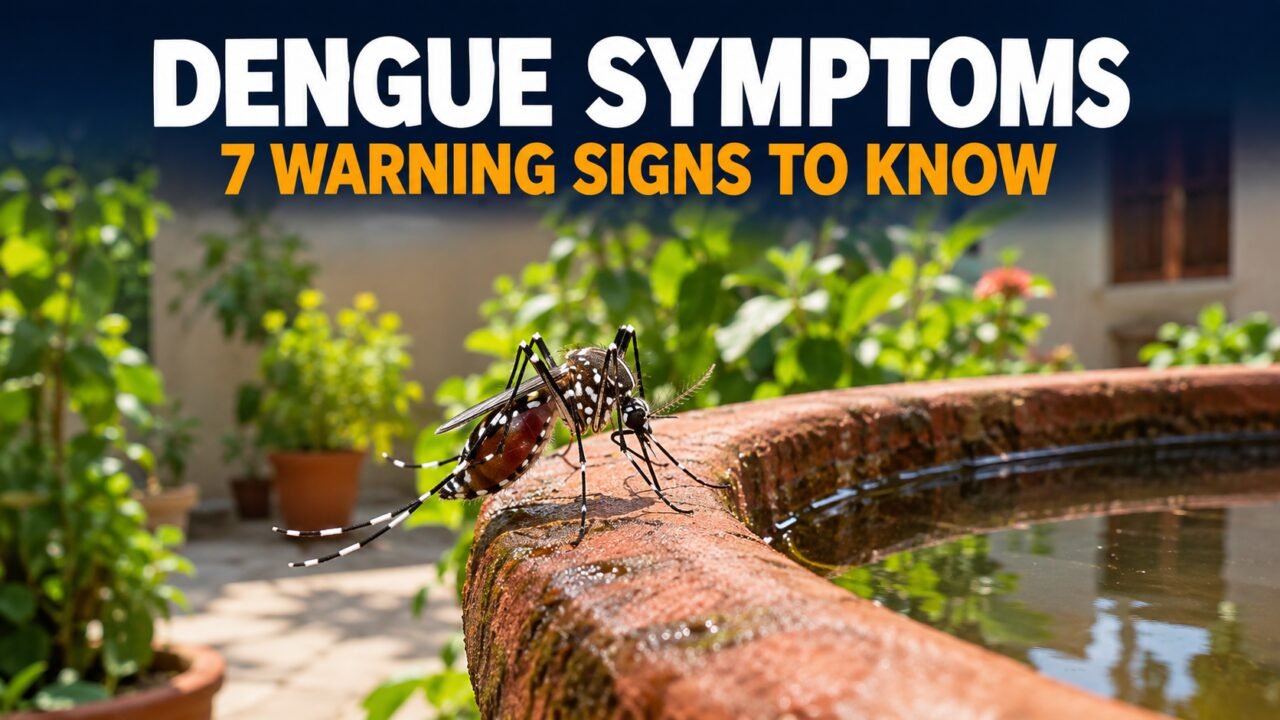
Dengue symptoms can look like an ordinary flu for the first day or two, which is why so many families in Pakistan wait too long before seeing a doctor. A high fever, a pounding headache and aching joints are easy to blame on the weather. Most people who catch dengue fever recover at home within a week or so. A small number get much sicker, and for them the timing of a hospital visit matters a great deal.
This guide explains what dengue symptoms look like from day one, the seven warning signs that should send you straight to hospital, and the prevention steps that make the biggest difference in a Pakistani home. It is written for ordinary readers, not doctors, and it does not replace a medical check-up.
Table of Contents
What dengue fever is and how it spreads
Dengue fever is a viral infection carried by Aedes mosquitoes, mainly Aedes aegypti and, to a lesser extent, Aedes albopictus. You cannot catch it by sitting next to someone who has it. The virus moves from person to mosquito to person: a mosquito bites an infected person, picks up the virus, and passes it on with its next bites.
There are four types of dengue virus, known as DENV-1 to DENV-4. Recovering from one type protects you against that type for life, but not against the other three. That detail matters, because a second infection with a different type is one of the main reasons some people develop severe dengue.
The Aedes mosquito is not the one that whines around your ear at 2 a.m. It bites mostly during the day, with peaks in the early morning and in the late afternoon before sunset. It breeds in clean, still water: a flower pot tray, a water cooler, an old tyre on the roof, a bucket left in the courtyard. Its eggs can survive dry for months and hatch when water returns, which is why the weeks after the monsoon are the dangerous ones.
Early dengue symptoms: what the first days feel like
According to the World Health Organization, most people infected with dengue have no symptoms at all or only a mild illness. When dengue symptoms do appear, they usually start 4 to 10 days after the bite and last for two to seven days.
The classic picture looks like this:
- A sudden high fever, often around 40°C (104°F)
- A severe headache
- Pain behind the eyes, which often gets worse when the person moves their eyes
- Muscle and joint pain, the reason dengue was once called “breakbone fever”
- Nausea and vomiting
- Swollen glands
- A rash, which can appear a few days into the illness
Not everyone gets all of these dengue symptoms. Children in particular may only have a fever and a rash, or a fever that looks like any other viral infection. Adults often say the tiredness is the worst part, and it can hang around for weeks after the fever has gone.
The trouble is that malaria, typhoid, chikungunya and ordinary viral flu share many of these early dengue symptoms. In September and October, a doctor in Rawalpindi or Lahore will usually think of dengue first, but only a blood test can confirm it.
The 7 dengue warning signs that mean hospital, now
Doctors separate cases into two broad groups: dengue without warning signs, which can usually be managed at home with close follow-up, and dengue with warning signs, which needs hospital care. The signs listed by WHO and the US Centers for Disease Control and Prevention are worth memorising, or at least saving on your phone.
Take the patient to hospital straight away if you notice any of these dengue warning signs:
- Severe abdominal pain or tenderness
- Vomiting that keeps coming back, at least three times in 24 hours
- Bleeding from the gums or nose
- Blood in vomit or stool, which can look black
- Rapid breathing or difficulty breathing
- Extreme tiredness, restlessness or irritability
- Pale, cold or clammy skin, or feeling faint
Being very thirsty and passing much less urine than usual are also reasons to go. A child who suddenly becomes floppy, sleepy or hard to wake needs a doctor even if none of the other signs are present.
These signs often show up just as the fever is coming down, which catches many families off guard.
Why feeling better can be misleading
Dengue usually moves through three phases. The first is the fever phase, lasting roughly two to seven days. Then comes what doctors call the critical phase, which starts around the time the fever drops and lasts about 24 to 48 hours. After that, most patients enter the recovery phase.
In the critical phase, a small share of patients develop plasma leakage, where fluid seeps out of the blood vessels into the chest and abdomen. Blood pressure can fall, and the person can go into shock. This is what makes severe dengue dangerous, and it is also why the day the fever breaks is not the day to stop paying attention.
In practice, a relative who “feels a bit better” on day four or five still needs watching. Keep an eye on how much they drink, how often they pass urine and whether any of the warning signs appear. If they have been seen by a doctor, go back for the follow-up blood test even if the fever has gone.
Who is more likely to get severe dengue
Anyone can develop severe dengue, but some people need extra care:
- People who have had dengue before and are now infected with a different type
- Infants and young children
- Pregnant women
- Older adults
- People with diabetes, high blood pressure, heart disease, kidney disease or obesity
There is also a practical risk group that no textbook lists: people who live alone. Someone with a high fever and no one around may not notice their own warning signs in time. If you have an elderly neighbour or a relative living on their own, check on them during dengue season.
If someone in any of these groups develops dengue symptoms, get them tested early rather than waiting to see how things go.
How doctors test for dengue fever
In the first few days of dengue fever, the most useful test is usually the NS1 antigen test, which detects a protein made by the virus. After about five days, antibody tests (IgM and IgG) become more reliable. Many labs in Pakistan offer a combined dengue panel.
Your doctor will also order a complete blood count (CBC). Two numbers on that report get most of the attention. The first is the platelet count, which often falls in dengue. The second is the haematocrit (HCT), which shows how concentrated the blood is. A rising haematocrit alongside a falling platelet count can suggest plasma leakage, and doctors watch that trend closely during the critical phase.
Repeat blood tests are normal. A single CBC tells you how things stand on that day, not where they are heading, so doctors often ask for a new one every day or two while the patient is unwell.
Treating dengue fever at home: what helps and what to avoid
There is no antiviral medicine that cures dengue. Treatment means supporting the body while the infection runs its course, and catching complications early. For patients without warning signs, this usually happens at home.
Things that help:
- Rest, as much as possible
- Plenty of fluids: water, oral rehydration solution (ORS), soups, fresh juices and coconut water
- Paracetamol for fever and pain, at the dose your doctor recommends
- Sponging with lukewarm water if the fever is high
- A mosquito net or repellent for the patient, so mosquitoes in the house cannot pick up the virus and pass it to others
Things to avoid:
- Ibuprofen, aspirin, diclofenac and other painkillers in the NSAID group, which can raise the risk of bleeding
- Injections for fever given at small clinics without a proper diagnosis
- Steroids or antibiotics, unless a doctor prescribes them for a specific reason
The painkiller point is worth repeating because it causes real harm every season. Many households keep ibuprofen or aspirin in the medicine drawer, and people reach for it without thinking. During dengue fever, stick to paracetamol unless a doctor tells you otherwise.
Keep a simple record at home: the temperature a few times a day, what the patient drinks, and when they pass urine. Doctors find this surprisingly useful, and it helps you notice when something is changing.
Platelets, papaya leaves and other arguments at home
Few things cause more worry in a Pakistani household during dengue season than a platelet count. A normal count is roughly 150,000 to 450,000 per microlitre, and in dengue it can fall well below that. Families understandably panic when they see the number drop.
A low platelet count on its own does not always mean a transfusion is needed. Many patients recover with counts that look frightening on paper, because the body starts producing platelets again as the illness passes. Doctors decide on transfusions based on bleeding and the overall clinical picture, not the number alone. Pushing a hospital for platelets the patient does not need uses up blood that someone else may need more.
Papaya leaf juice is the other big topic. Some small studies have reported faster platelet recovery with papaya leaf extract, but the evidence is limited, and it does not treat the virus. If your family wants to try it, tell the doctor, and never use it in place of fluids, monitoring and hospital care when warning signs appear. The same goes for goat milk, kiwi and the other remedies that circulate on WhatsApp every autumn.
Dengue in Rawalpindi and Islamabad this season
Dengue in Pakistan follows the monsoon. Cases usually start to climb in late August and September and often peak in October and November, before cooler weather slows the mosquitoes down.
So far, 2026 has been quieter in Rawalpindi than some recent years. According to district health officials quoted by APP, the district had confirmed 12 dengue cases this year by September 21, with no deaths, after screening 4,459 patients.
That is not a reason to relax. Surveillance teams have found mosquito larvae at more than 157,000 homes in the district this year, The Nation reported. Numbers can also change fast. In 2024, Dawn reported that by early November, 5,652 patients had come to Rawalpindi’s three main government hospitals with dengue that season, and 11 had died.
In that same season, doctors at those hospitals said more than a third of their dengue patients came from Islamabad. The mosquito does not care about city limits, and neither should our prevention.
Dengue prevention that works at home
Fogging trucks get the headlines, but the most effective dengue prevention happens inside your own boundary wall. Aedes mosquitoes rarely travel far from where they hatch, so the breeding site is often in your house or your neighbour’s.
Once a week, walk around the house and check:
- Water cooler and air cooler tanks, which should be emptied and scrubbed
- Flower pots and the trays underneath them
- Buckets, drums and water tanks, which should be tightly covered
- Old tyres, broken pots and plastic containers on the roof
- Pet water bowls and bird baths
- Blocked gutters and drains, and the spots under outdoor taps and air conditioner drip pipes
Scrub containers instead of just emptying them, because the eggs stick to the inside walls. Rinsing a cooler tank without scrubbing can leave them behind.
For personal protection:
- Use a mosquito repellent on exposed skin, especially in the morning and late afternoon
- Wear long sleeves and trousers when you can, and dress children in full sleeves during dengue season
- Fit mesh screens on windows and doors, and keep them closed
- Sleep under a net if you nap during the day
- Use coils, vaporisers or electric mats in closed rooms
If several people in your street fall ill, report it to the district health authority. Your careful cleaning will not help much if the empty plot next door is full of old tyres.
Protecting children and older relatives
Children spend their days in places adults rarely check: school grounds, parks, the corner of the courtyard where rainwater collects. Ask your child’s school how often its water tanks and planters are checked, and pack repellent in school bags during September and October.
With young children, dengue symptoms can be vague. A baby may just be unusually fussy, feed poorly or sleep more than normal. Fever in an infant always needs a doctor, and during dengue season, ask directly about a dengue test.
Older relatives are more likely to have diabetes, heart problems or kidney disease, and they often take medicines that need adjusting during an illness. If an elderly parent gets dengue, make sure their regular doctor knows, and ask how their usual medicines, especially blood thinners, should be managed.
Is there a dengue vaccine?
Two dengue vaccines have been approved in different countries. The first, Dengvaxia, is only recommended for people who have already had a confirmed dengue infection, because it can increase the risk of severe dengue in people who have never been infected. The second, TAK-003 (sold as Qdenga), was recommended by WHO in 2023 for children aged 6 to 16 in areas with high transmission.
Dengue vaccination is not part of Pakistan’s routine immunisation schedule. If you are interested, ask your doctor whether a vaccine is available and suitable for you or your child. For now, avoiding bites and removing breeding sites remain the main dengue prevention tools.
Dengue symptoms FAQ
How many days do dengue symptoms last?
The fever phase usually lasts two to seven days. Tiredness and weakness can continue for several weeks after that.
Can you get dengue twice?
Yes. There are four types of dengue virus. Infection with one type does not protect you from the others, and a second infection with a different type raises the risk of severe dengue.
Which painkiller is safe during dengue fever?
Paracetamol is generally the recommended choice. Avoid ibuprofen, aspirin and other NSAIDs unless a doctor has specifically told you to take them, because they can increase the risk of bleeding.
At what platelet count is dengue dangerous?
There is no single number that decides this. Doctors look at bleeding, blood pressure, haematocrit and the patient’s overall condition. A low count needs close monitoring, but it does not automatically mean a transfusion.
Does dengue spread from person to person?
Not through normal contact. It spreads through mosquito bites. It can pass from a pregnant mother to her baby, and very rarely through blood transfusion or organ donation.
When should I go to hospital with dengue symptoms?
Go immediately if you notice any of the dengue warning signs: severe stomach pain, repeated vomiting, bleeding gums or nose, blood in vomit or stool, fast breathing, extreme tiredness or restlessness, or cold, clammy skin.
If anyone at home develops dengue symptoms this autumn, get a test early and keep paracetamol, ORS and a thermometer within reach. For more health and local news, see our latest stories or sign up for the A1 Blogs newsletter.
This article is general information and not a substitute for advice from a qualified doctor. Our editorial policy explains how we research and check health stories.