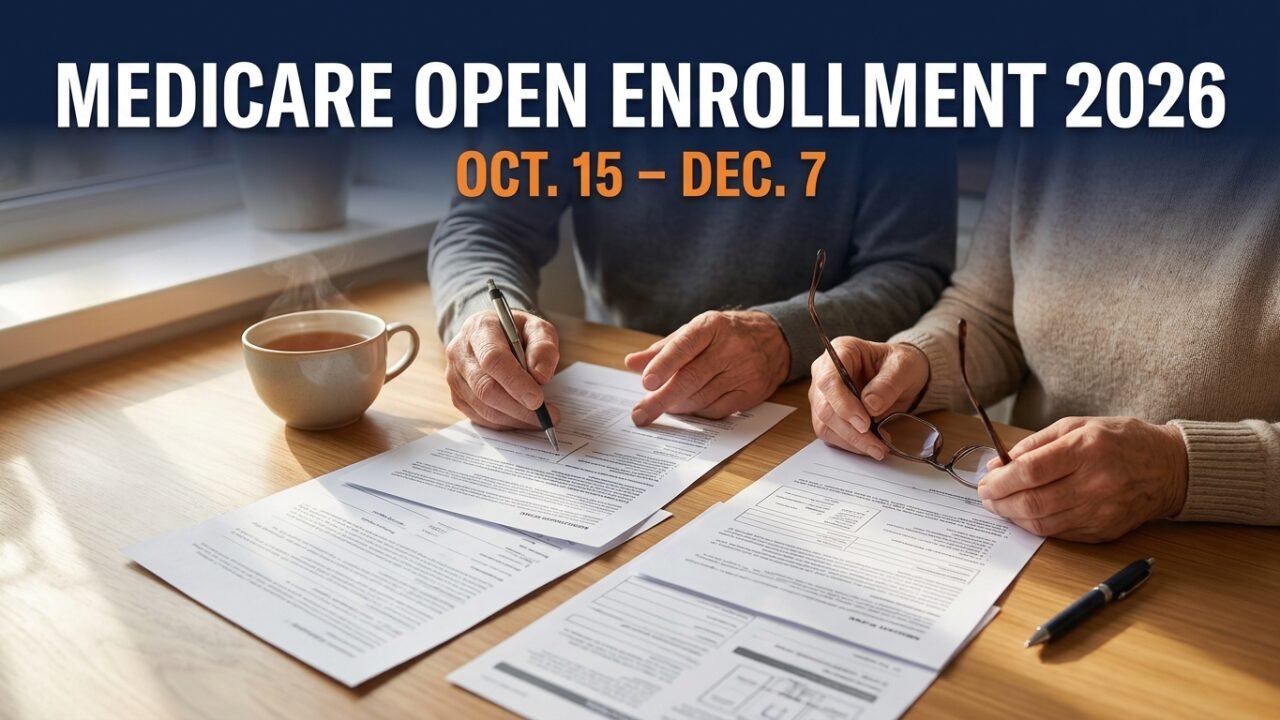
Medicare open enrollment runs from Oct. 15 to Dec. 7, 2026, and it is the one time each year when most people with Medicare can change their coverage for the following year. Any changes you make take effect on Jan. 1, 2027. If you do nothing, your current plan usually renews automatically, even if its costs, drug list or doctor network have changed.
Plans change every year, sometimes a lot. A drug that was covered this year might be dropped next year, a premium might jump, or your doctor might leave the network. Taking an hour or two during open enrollment to review your options can save money and prevent unpleasant surprises. Here are seven essential steps to do it well.
Table of Contents
What is Medicare open enrollment?
Medicare open enrollment, also called the annual enrollment period, is a fixed window each fall. During it, you can:
- Switch from Original Medicare to a Medicare Advantage plan, or back again
- Switch from one Medicare Advantage plan to another
- Join, switch or drop a Medicare Part D prescription drug plan
The window opens on Oct. 15 and closes on Dec. 7. The last plan you choose during the window is the one that takes effect on Jan. 1.
It is separate from the Health Insurance Marketplace open enrollment for people under 65, which in most states runs from Nov. 1 to Jan. 15 on HealthCare.gov or a state exchange.
Original Medicare vs. Medicare Advantage
The biggest decision many people face is between Original Medicare and Medicare Advantage.
Original Medicare is run by the federal government. Part A covers hospital care, and Part B covers doctor visits, outpatient care and preventive services. You can see any doctor or hospital in the country that accepts Medicare. Most people add a separate Part D drug plan, and many also buy a Medicare Supplement Insurance policy, known as Medigap, to help cover deductibles and coinsurance.
Medicare Advantage plans, sometimes called Part C, are offered by private insurance companies approved by Medicare. They bundle hospital, medical and usually drug coverage into one plan, often with extra benefits such as dental, vision or hearing coverage. In exchange, most use provider networks, and many require prior authorization for certain services.
Neither choice is right for everyone. Original Medicare offers more freedom to choose providers. Medicare Advantage can cost less month to month but may limit where you get care.
Medicare open enrollment: 7 essential steps
1. Read your Annual Notice of Change
If you have a Medicare Advantage or Part D plan, your insurer should have sent an Annual Notice of Change by the end of September. It explains what will change next year: premiums, deductibles, copays, covered drugs and network changes.
Read it carefully. It is the quickest way to spot problems, such as a medication being dropped or moved to a more expensive tier.
2. List your doctors, pharmacies and prescriptions
Before comparing plans, write down every doctor and specialist you see, the pharmacies you use, and every prescription you take, with the dose and how often. This list is the foundation of a good comparison.
3. Use the Medicare Plan Finder
The official Medicare website has a Plan Finder tool that lets you compare plans in your area. Enter your drugs and pharmacies, and it will estimate your total yearly costs under each plan, including premiums and drug costs.
Sort by estimated total cost, not just by premium. A plan with a low premium can end up costing more if your drugs are expensive under it.
4. Check provider networks
If you are considering a Medicare Advantage plan, confirm that your doctors, specialists and preferred hospitals are in the plan’s network for next year. Call the doctor’s office as well as checking the plan’s directory, because directories are not always up to date.
5. Look at the total cost, not just the premium
Consider premiums, deductibles, copays, coinsurance and the plan’s out-of-pocket maximum. Medicare Advantage plans have an annual limit on what you pay for covered medical services, while Original Medicare does not, unless you add Medigap.
For drug coverage, the Part D out-of-pocket cap, created by the Inflation Reduction Act, limits what you pay each year for covered prescriptions. It was $2,000 in 2025 and rose to $2,100 for 2026, and it is adjusted each year. Check the figure for 2027 when you compare plans.
6. Check star ratings and extra benefits
Medicare rates plans from one to five stars based on quality and member experience. Higher-rated plans tend to perform better on care and customer service.
Extra benefits in Medicare Advantage plans, such as dental, vision, hearing aids or gym memberships, can be valuable, but look at the details. Some benefits have low annual limits or narrow networks.
7. Get free help if you need it
You do not have to do this alone. Every state has a State Health Insurance Assistance Program, known as SHIP, which offers free, unbiased counseling about Medicare. You can find your local program through the SHIP national website. You can also call 1-800-MEDICARE.
Prescription drug costs in 2027
Drug coverage changes more than any other part of Medicare from year to year. Insurers can change which drugs they cover, move drugs between cost tiers, and change which pharmacies are preferred.
A few protections help. The annual out-of-pocket cap on covered Part D drugs limits your total spending. Insulin costs for people with Medicare are capped at $35 for a month’s supply of each covered insulin product. The Medicare Prescription Payment Plan lets you spread your out-of-pocket drug costs into monthly payments across the year, instead of paying large amounts at the pharmacy early in the year.
If you take expensive medications, compare Part D or Medicare Advantage drug coverage carefully every year.
What about Part B premiums?
Most people pay a standard monthly premium for Part B, deducted from their Social Security benefits. The standard Part B premium for 2026 is $202.90. The figure for 2027 is usually announced in the fall, often in November.
People with higher incomes pay more, through an income-related adjustment. If your income has dropped because of retirement or another life-changing event, you can ask Social Security to reconsider the adjustment.
Help paying for Medicare
If your income and savings are limited, you may qualify for help. Extra Help, also called the Low-Income Subsidy, lowers Part D premiums, deductibles and copays. Medicare Savings Programs, run by states, can help pay Part B premiums and other costs. Medicaid can cover additional costs for people who qualify for both programs.
Apply even if you are not sure you qualify. Many eligible people never enroll.
Switching back to Original Medicare and Medigap
If you move from Medicare Advantage back to Original Medicare, you can add a Part D plan during open enrollment. Getting a Medigap policy can be harder. In most states, outside certain protected situations, Medigap insurers can review your health history and may charge more or refuse coverage.
That is why the first choice between Original Medicare with Medigap and Medicare Advantage matters so much. Some states have extra protections, so check the rules where you live before making a switch.
The Medicare Advantage open enrollment period
There is a second chance for people in Medicare Advantage. From Jan. 1 to March 31, anyone enrolled in a Medicare Advantage plan can switch to a different Medicare Advantage plan, or drop their plan and return to Original Medicare, adding a Part D plan. You can make one change during this period.
It is a useful safety net if a new plan turns out not to work for you.
Key dates this fall
It helps to put the important dates on your calendar:
- By Sept. 30: plans send their Annual Notice of Change for next year
- Early October: new plan details appear in the online Plan Finder
- Oct. 15: the Medicare open enrollment window opens
- Nov. 1: Marketplace open enrollment opens for people under 65 in most states
- Dec. 7: the last day to make changes for Jan. 1 coverage
- Jan. 1: new coverage begins
- Jan. 1 to March 31: a second, limited window for people already in Advantage plans
Do not leave everything to the first week of December. Customer service lines and counselors get busier as the deadline approaches.
Questions to ask before you switch
Before choosing a new plan, it helps to answer a few questions honestly:
- Are all my doctors and hospitals covered next year?
- Are all my prescriptions covered, and at what cost?
- What is the most I could pay in a bad year, not just a typical one?
- Do I travel often, or spend part of the year in another state?
- Does the plan require referrals or prior approval for services I use?
- How is the plan rated for quality and customer service?
- Would I be able to switch back later if the plan does not work for me?
If you spend winters in another state, check how a plan handles care away from home. Many network-based plans cover only emergencies outside their service area.
Special enrollment periods
Open enrollment is not the only time you can make changes. Special enrollment periods allow changes outside the usual window when certain life events happen.
Common examples include moving to a new address outside your plan’s service area, losing other health coverage such as employer insurance, moving into or out of a nursing home, and changes in eligibility for Medicaid or Extra Help. There is also a special period that lets people switch into a five-star rated plan once during the year.
If something changes in your life, check whether you qualify before assuming you must wait until next fall.
Preventive care you may be missing
Medicare covers many preventive services at no cost to you if your provider accepts Medicare. These include a yearly wellness visit, many cancer screenings, cardiovascular screenings, diabetes screenings and a range of vaccines, including the annual flu shot.
Many people with Medicare do not use all the preventive care they are entitled to. A yearly wellness visit is a good time to review medications, update screenings and talk about any health concerns. For more on flu vaccination, see our guide to the NHS flu jab, which also includes a short section for American readers.
Helping a parent with Medicare
Many adult children help parents choose plans or deal with Medicare problems. To speak to Medicare on a parent’s behalf, the parent usually needs to give permission, either by phone at the start of the call or by completing an authorization form so Medicare can share information with you in future calls.
Sit down with your parent to gather their list of doctors, medications and pharmacies, and compare plans together. Keep copies of their Medicare card, plan documents and any correspondence in one place. If you are not sure about something, a free SHIP counselor can help you both understand the options.
Most importantly, make sure your parent understands and agrees with any decision. It is their coverage and their care.
Watch out for Medicare scams and pushy marketing
Open enrollment brings a flood of television ads, mailers and phone calls. Some come from legitimate plans and brokers. Others are misleading or outright scams.
Medicare will not call you to sell a plan or ask for your Medicare number. Be wary of anyone who promises extra benefits or cash back if you switch, pressures you to decide quickly, or asks for personal information over the phone. Never give your Medicare or Social Security number to an unsolicited caller. Our guide on how to spot a scam text covers common tricks that also appear in calls and emails.
If you want to use a broker, ask whether they represent all plans in your area or only a few.
Common mistakes during open enrollment
The most frequent mistake is doing nothing without checking. Automatic renewal is convenient, but a plan that worked well this year may cost more or cover less next year.
Other common mistakes include choosing a plan based only on the monthly premium, assuming your doctors will stay in network, forgetting to enter all your prescriptions into the Plan Finder, and waiting until the last few days, when help lines are busiest. Some people also sign up for a plan after a persuasive phone call without comparing alternatives.
Write down why you chose your plan and keep a copy of your comparison. It makes next year’s review much easier.
Medicare if you are still working
If you are 65 or older and still working, the rules depend on your employer coverage. If you have health insurance through your own or your spouse’s current job at a large enough employer, you may be able to delay enrolling in Part B without paying a penalty later. When that job or coverage ends, a special enrollment period lets you sign up.
The rules are strict, and mistakes can be costly. Part B has a late enrollment penalty that adds to your premium for as long as you have Part B, and Part D has its own penalty if you go without creditable drug coverage. Talk to your employer’s benefits team and check with Medicare or a SHIP counselor before deciding to delay.
Dental, vision and hearing coverage
Original Medicare generally does not cover routine dental care, eyeglasses or hearing aids, which surprises many new enrollees. Many Medicare Advantage plans include some of these benefits, which is one reason they are popular. Check the details carefully, since coverage limits, networks and annual maximums vary widely.
If you stay with Original Medicare, you can buy separate dental, vision or hearing plans, or use discount programs. Compare what you would actually use with what each option costs over a year.
Medicare open enrollment: common questions
When is Medicare open enrollment in 2026?
From Oct. 15 to Dec. 7, 2026. Changes take effect on Jan. 1, 2027.
Do I need to do anything if I am happy with my plan?
Not necessarily, since most plans renew automatically. But review your Annual Notice of Change to make sure your plan still meets your needs next year.
Can I switch from Medicare Advantage to Original Medicare?
Yes, during open enrollment, or from Jan. 1 to March 31 during the Medicare Advantage open enrollment period.
Where can I compare Medicare plans?
Use the Plan Finder on Medicare.gov, call 1-800-MEDICARE, or get free counseling from your state’s SHIP program.
What is the Part D out-of-pocket cap?
It limits yearly spending on covered prescription drugs. It was $2,100 in 2026 and is adjusted each year.
Set aside an afternoon before Dec. 7 to review your plan with your medication list in hand. For more health guides, see our health section.
This article is general information and not medical, legal or financial advice. Plan details vary, so confirm coverage with Medicare, your plan or a SHIP counselor.