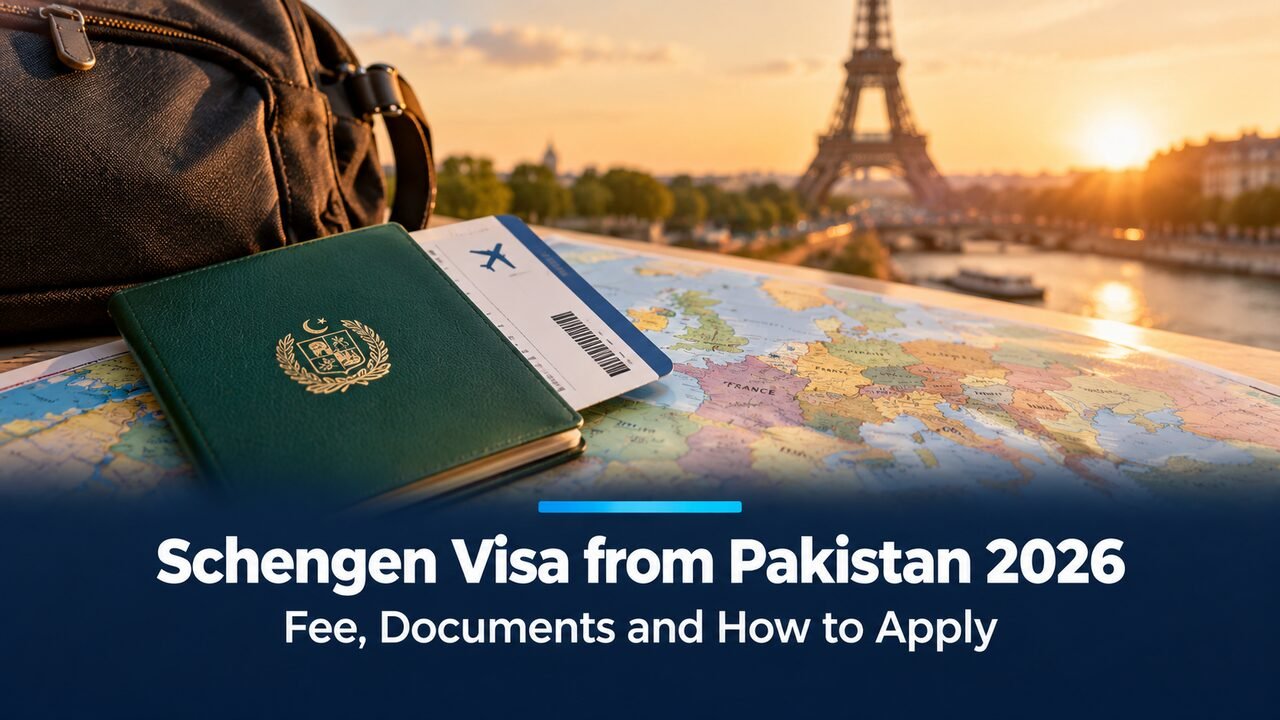
A Schengen visa from Pakistan opens 29 European countries on a single sticker, including France, Germany, Italy, Spain, the Netherlands and Switzerland. Refusal rates for Pakistani applicants are high, but most refusals come down to the same few problems: weak bank statements, unclear travel plans and too little proof that you will come home. This guide covers the Schengen visa fee, the documents embassies expect from Pakistani applicants, how to apply, and what changed at Europe’s borders in 2026.
Table of Contents
What a Schengen visa covers
The short-stay Schengen visa (type C) lets you visit for tourism, family visits or business for up to 90 days in any 180-day period. It does not allow work. With it you can move between Schengen countries without further border checks.
You must apply to the embassy of the country where you will spend the most nights. If your nights are split evenly, apply to the country you will enter first. Applying to an easier country while really planning to stay elsewhere is a common reason for refusal, and it can cause problems at the border.
Schengen visa fee in 2026
The official fees are the same at every Schengen embassy:
- Adults: €90
- Children aged 6 to 11: €45
- Children under 6: free
Most embassies in Pakistan accept applications through an outsourced centre such as VFS Global or TLScontact, which adds a service charge. Optional extras such as SMS updates or courier delivery cost more. The visa fee is not refunded if your application is refused.
Documents for a Schengen visa from Pakistan
Each embassy publishes its own checklist, but expect to provide:
- Passport issued within the last ten years, valid for at least three months after you leave Europe, with two blank pages
- Old passports, especially if they contain previous visas
- Application form, completed and signed
- Two photographs meeting Schengen specifications
- NADRA Family Registration Certificate (FRC) for family travel or if asked
- Travel insurance with at least €30,000 of medical cover, valid in all Schengen countries
- Flight reservation for the round trip (a reservation, not a paid ticket)
- Hotel bookings for every night, or an invitation letter if staying with family
- Bank statements for the last six months, stamped by the bank, plus a bank maintenance letter
- Employment proof: a letter from your employer with your salary and approved leave, plus recent payslips
- Business owners: company registration, tax returns and business bank statements
- Tax returns from FBR for recent years, which help show a stable income
- Cover letter explaining your trip, your itinerary, who pays, and why you will return
If you need a new passport before applying, our guide to the passport fee in Pakistan lists current normal, urgent and fast-track charges.
What to put in your cover letter
The cover letter is short, but officers read it to understand your trip in one minute. Keep it to one page and cover these points in order:
- Who you are: name, passport number, job or business, and city
- Purpose: tourism, a family visit, a conference or a business meeting
- Dates and route: arrival and departure dates and the cities you will visit, with nights in each
- Main destination: why you are applying to this embassy
- Funding: who pays and from which account
- Ties to Pakistan: your job and approved leave, business, family, property or studies
- Previous travel: countries visited in recent years, especially Schengen, the UK, the US or the Gulf
A simple ten-day plan might be four nights in Paris, three in Amsterdam and three in Brussels. That makes France the main destination, so you apply at the French visa centre. Make sure the same dates appear on your hotel bookings, flight reservation, insurance and employer’s leave letter.
Write in plain English and avoid exaggeration. A short, consistent letter supported by the right documents is far more convincing than a long one. If you are applying for a Schengen visa from Pakistan for the first time, attach a list of enclosed documents in the same order as the checklist, which makes the officer’s job easier.
How much money to show
There is no single amount for all countries, but each sets a daily minimum, and officers look at your whole financial picture. A rough guide used by many applicants is €50 to €70 per day on top of prepaid hotels and flights, but the stronger test is whether your statement looks natural.
Officers look for:
- A steady salary or business income arriving each month
- A balance that has built up over time, not a large deposit just before applying
- Spending that matches your declared income
If someone else is sponsoring you, include their statements, a sponsorship letter and proof of the relationship. Unexplained cash deposits, sometimes called funds parking, are one of the most common reasons Pakistani applications are refused.
How to apply for a Schengen visa from Pakistan
- Decide your main destination and check that embassy’s checklist on its website or the visa centre’s site.
- Book an appointment at VFS Global or TLScontact in Islamabad, Lahore or Karachi. Slots fill fast in spring and summer.
- Fill in the application form online or on paper, depending on the country.
- Gather documents in the order of the checklist, with copies.
- Attend the appointment, pay the fees and give fingerprints and a photo.
- Track your application and collect your passport.
You can apply up to six months before travel and no later than 15 days before. Standard processing is 15 calendar days, but it can be extended to 45 days in busy periods. Apply six to eight weeks ahead for summer trips.
Why Schengen visas are refused
The refusal letter ticks one or more standard reasons. The ones Pakistani applicants see most often are:
- Purpose and conditions of the stay not justified
- Insufficient means of subsistence
- Reasonable doubts about your intention to leave before the visa expires
- Information or documents considered unreliable
The fix is usually better evidence rather than more paper: a clear itinerary, natural bank history, proof of a job or business, family ties, property, and a good previous travel record. Travelling first to countries such as Malaysia, Thailand, Turkey or the UAE builds a passport history that helps later.
What changed at the border in 2026
The EU’s Entry/Exit System (EES) became fully operational at Schengen external borders on 10 April 2026. Instead of passport stamps, border guards now register your fingerprints and a facial image when you first enter, and the system records each entry and exit automatically. Expect slightly longer queues on your first trip.
ETIAS, the online travel authorisation, is for nationalities that do not need a visa. Pakistani citizens still need a Schengen visa, so ETIAS does not replace it.
Tips for a stronger application
- Keep your itinerary simple and realistic for the number of days
- Make sure dates match across your form, bookings, insurance and leave letter
- Do not submit fake bookings or bank documents. Embassies verify them, and a fraud finding can lead to a long ban
- If refused, read the reasons carefully and fix them before reapplying, or use the appeal process explained in the letter
Frequently asked questions
How much is the Schengen visa fee from Pakistan?
€90 for adults and €45 for children aged 6 to 11, plus the visa centre’s service charge.
How much bank balance do I need for a Schengen visa from Pakistan?
There is no fixed national figure. Show enough for your daily costs plus a stable six-month history. Many applicants plan for about €50 to €70 a day on top of prepaid costs.
Which Schengen country is easiest for Pakistanis?
No country is officially easier. Apply to your genuine main destination, because that is what officers check.
How long does a Schengen visa take?
Usually 15 calendar days, sometimes up to 45 in busy seasons.
If your flight to Europe is later delayed or cancelled, our guide to EU flight delay compensation explains what you can claim. The official rules are on the European Commission’s Schengen visa page.