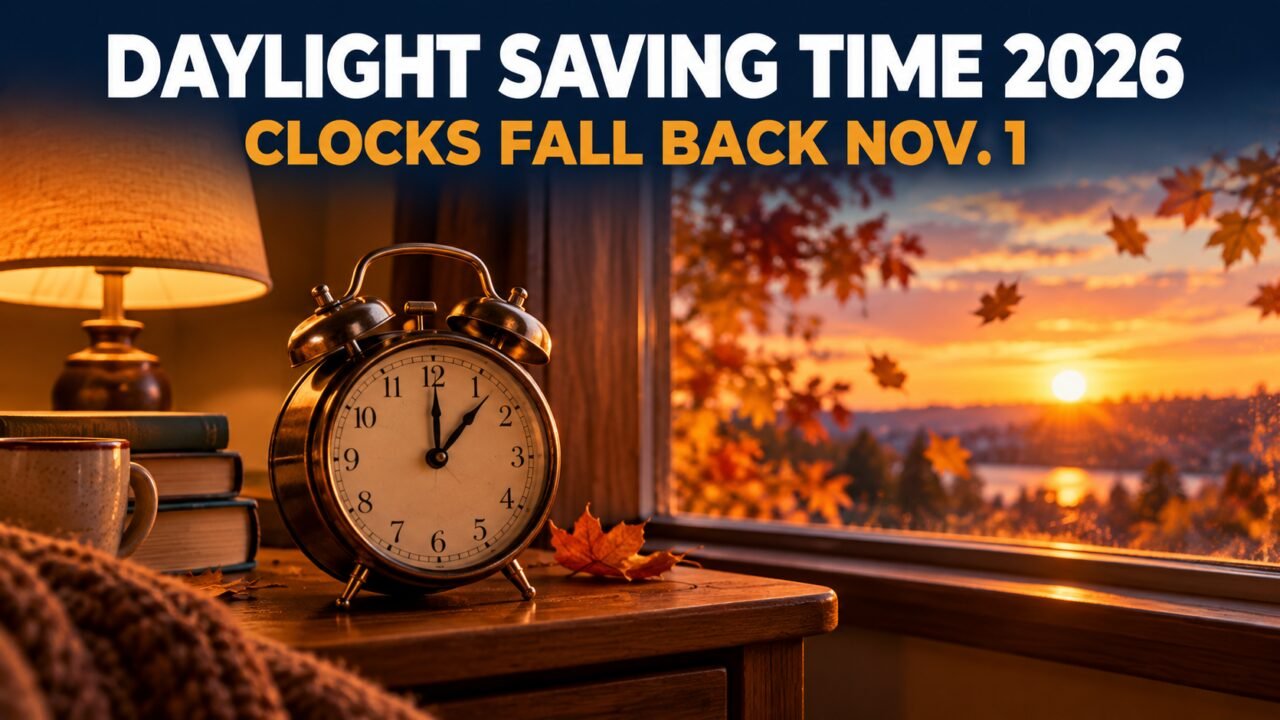
Daylight saving time 2026 ends at 2 a.m. on Sunday, Nov. 1, when clocks across most of the United States fall back one hour to 1 a.m. You get an extra hour of sleep that night, brighter mornings for a few weeks, and a sunset that suddenly arrives before many people have left work.
It happens every year, and every year the same questions come up. Do I need to change my clocks, or will my phone do it? Why do Arizona and Hawaii skip it? Didn’t Congress vote to end this? And why do I feel off for a week afterward?
This guide answers all of it, with seven simple tips to make the switch easier on your body, your kids and your pets.
Table of Contents
When does daylight saving time 2026 end?
Daylight saving time 2026 ends on Sunday, Nov. 1. At 2 a.m. local time, clocks go back to 1 a.m., which means the hour between 1 a.m. and 2 a.m. happens twice that night.
The change happens at 2 a.m. in each time zone, so it rolls across the country over several hours, starting on the East Coast and finishing in Alaska. Daylight saving time began this year on March 8, when clocks sprang forward an hour.
For most people, the practical effect is simple. On Sunday morning, it will be lighter outside when you wake up. By Sunday evening, it will be dark about an hour earlier than it was on Saturday. In much of the northern U.S., that means sunset before 5 p.m. within a few weeks.
Why we fall back on the first Sunday in November
The current schedule comes from the Energy Policy Act of 2005. Starting in 2007, it moved the start of daylight saving time to the second Sunday in March and the end to the first Sunday in November. Before that, the clocks changed on the first Sunday in April and the last Sunday in October.
The idea was to save energy by shifting daylight into the evening, when people are awake and using lights. Whether it actually saves much energy is still debated. Studies have produced mixed results, partly because air conditioning and modern lighting have changed how we use power since the policy was first designed.
The early November date also has a less official benefit that retailers and candy makers lobbied for: an extra hour of evening light on Halloween.
A short history of daylight saving time in America
The United States first adopted daylight saving time in 1918, during World War I, as a way to save fuel. The same law created the country’s official time zones. It was so unpopular that Congress repealed the daylight saving part the following year, overriding President Woodrow Wilson’s veto.
During World War II, the country went on year-round “War Time” from 1942 to 1945. After the war, states and cities made their own choices, which created chaos. At one point, a bus ride between two cities could cross several time changes. The Uniform Time Act of 1966 set national rules, while still letting states opt out.
The country even tried year-round daylight saving time once. During the energy crisis in January 1974, Congress put the clocks on permanent daylight time. It quickly became unpopular, largely because of dark winter mornings and worries about children going to school in the dark, and Congress reversed it later that year.
Which states and territories don’t change their clocks
Not every American changes clocks. Hawaii stays on standard time all year. So does most of Arizona, where extra evening sunshine in summer is the last thing people want. The Navajo Nation in northeastern Arizona is the exception and does observe daylight saving time, which creates a patchwork of time zones inside one state.
Five U.S. territories also skip it: Puerto Rico, Guam, the U.S. Virgin Islands, American Samoa and the Northern Mariana Islands.
If you live in one of these places, nothing changes on Nov. 1, except that the time difference between you and the rest of the country shrinks by an hour until March.
Where the push to end the clock changes stands
The biggest recent attempt to stop changing the clocks was the Sunshine Protection Act, which would make daylight saving time permanent nationwide. In March 2022, the Senate passed it by unanimous consent, surprising many people, including some senators. The House never voted on it, and the bill died at the end of that Congress.
It has been reintroduced since, and President Donald Trump has said he supports ending the twice-yearly switch, though he has also described the choice between permanent daylight time and permanent standard time as a close call. As of this writing, Congress has not passed a law to end the clock changes, so the Nov. 1 switch goes ahead as normal.
Many states have tried to act on their own. About 20 states have passed laws or resolutions supporting permanent daylight saving time, but most of those laws only take effect if Congress changes federal law first. Under current federal rules, states can choose to stay on standard time all year, as Hawaii and Arizona do, but they cannot choose permanent daylight time.
Permanent daylight time or permanent standard time?
If the country does stop switching, the next fight is over which time to keep. The two camps disagree sharply.
Supporters of permanent daylight saving time want lighter evenings all year. They argue it helps businesses, encourages outdoor activity after work and school, and may reduce some crime and traffic accidents in the evening.
Sleep scientists mostly argue for the opposite. The American Academy of Sleep Medicine supports permanent standard time, because it lines up better with the sun and the body’s natural clock. With permanent daylight time, winter sunrises in many northern and western cities would come after 8 a.m., and in some places closer to 9 a.m. That is exactly what made the 1974 experiment so unpopular.
Polls usually find that most Americans want to stop changing the clocks, but they are split on which time to keep. That split is one reason the issue keeps stalling in Congress.
What the extra hour does to your body
Falling back is generally easier on the body than springing forward, because you gain an hour rather than lose one. Most research linking the time change to health problems focuses on March. Studies have found small increases in heart attacks and fatal car crashes in the days after clocks spring forward, when millions of people are suddenly short on sleep.
The November change has its own effects. Your internal clock is still set to the old time for several days, so you may wake up earlier than you want, feel hungry at odd times, or get sleepy in the early evening. Early risers and young children often feel it most, because they wake with the light regardless of what the clock says.
The bigger change for many people is the darkness. Losing an hour of evening light, just as the days are already getting shorter, can affect mood and energy. For people prone to seasonal affective disorder, the weeks after the change can be hard.
7 simple tips for an easy switch
Most adults adjust within a few days, but a little planning makes it smoother.
1. Shift bedtime gradually
Starting a few days before Nov. 1, push your bedtime about 15 minutes later each night. By Sunday, your body will already be close to the new schedule. This works especially well for young children, who can otherwise wake at 5 a.m. for a week.
2. Keep your wake-up time steady
The single most helpful thing is to get up at the same clock time on Sunday and Monday as you normally would, even if you feel awake earlier. A steady wake-up time resets your internal clock faster than anything else.
3. Get bright light in the morning
Morning light is the strongest signal your body clock uses. Open the curtains, take a short walk or have breakfast by a window. Our guide to a healthy morning routine has more simple habits that help here.
4. Use the evening darkness wisely
With sunset suddenly earlier, move outdoor exercise to the morning or lunchtime when you can. Keep indoor lights bright in the early evening if you feel sluggish, and dim them an hour before bed.
5. Watch the caffeine and the late nap
It is tempting to fight the early-evening sleepiness with coffee or a nap. Both can make it harder to fall asleep at your normal bedtime. If you need a nap, keep it short and early in the afternoon.
6. Adjust meal and medication times
If you take medicine at a fixed time of day, such as insulin or birth control, check with your doctor or pharmacist about how to handle the one-hour shift. For most people, simply taking it at the usual clock time is fine, but it is worth asking if you are unsure.
7. Give pets a few days
Dogs and cats do not know about daylight saving time, but they do know when dinner is late. Shift their feeding and walking times by 10 or 15 minutes a day in the days before the change.
Safety checks to do the same weekend
Many fire departments use the clock change as a reminder to check smoke alarms and carbon monoxide detectors. The U.S. Fire Administration recommends testing alarms monthly and replacing them every 10 years, but the clock change is an easy way to remember at least twice a year.
While you are at it, check the batteries in flashlights and your emergency kit, especially if you live somewhere with winter storms or hurricane season still running. It is also a good weekend to swap out expired medicines from the bathroom cabinet.
Darker evenings and road safety
The weeks after clocks fall back are dangerous for people on foot. The evening commute suddenly happens in the dark, and drivers have not yet adjusted. Research has found a jump in pedestrian deaths in the early evening hours after the change.
If you walk or run in the evening, wear bright or reflective clothing and carry a light. If you drive, slow down in neighborhoods and near schools, and watch for children heading home from after-school activities. The National Highway Traffic Safety Administration has pedestrian safety advice for both drivers and walkers.
Wildlife is another risk. In many states, deer are most active at dawn and dusk in the fall, and the time change puts rush hour right in that window.
How other countries handle the clock change
The United States is far from alone in changing its clocks, but it does not follow the same calendar as everyone else. Most of Europe changes on the last Sunday in October and the last Sunday in March. That means for about a week each fall, the gap between New York and London is four hours instead of the usual five, which catches out travelers and anyone with transatlantic meetings.
The European Union has had its own long argument about ending the switch. The European Parliament voted in 2019 to stop changing clocks, but member countries never agreed on which time to keep, and the plan stalled.
Much of the world does not bother at all. Most countries in Asia and Africa do not use daylight saving time. Mexico ended it in 2022, except in some areas along the U.S. border that keep in step with American cities. Russia tried permanent daylight time in 2011 and switched to permanent standard time in 2014 after complaints about dark winter mornings, a story that sounds a lot like America’s 1974 experiment.
In the Southern Hemisphere, the calendar runs the other way. Australia and New Zealand move their clocks forward in the spring months of September and October and back in April.
Night-shift workers and travelers
If you work overnight on Oct. 31 into Nov. 1, your shift will be an hour longer than usual, because the hour from 1 a.m. to 2 a.m. happens twice. Under federal wage rules, hourly employees must be paid for the hours they actually work, so that extra hour should show up in your paycheck. It is worth checking your pay stub if you are not sure.
Transportation systems handle the change in different ways. Some overnight trains simply stop and wait for an hour at 2 a.m. so they can stay on their published schedule. Airlines schedule flights by local time, so an overnight flight may appear to take an hour longer or shorter than usual on paper. Check your arrival time carefully if you are flying or picking someone up that night.
If you are traveling abroad in late October or early November, double-check meeting times and connections with countries that change their clocks on different dates. A calendar app set to update time zones automatically will do most of the work, but a quick check avoids missed calls.
Which devices change on their own
Smartphones, computers, smart speakers and most cable boxes update automatically, as long as they are set to update the time zone automatically. You do not need to do anything with them.
The devices that usually need a manual change are older ones: microwave and oven clocks, many car dashboards, wall clocks, some thermostats and older alarm clocks. Set them before bed on Saturday night, or on Sunday morning, so you are not confused on Monday.
If you want to check the exact official time, time.gov, run by federal time scientists, shows the correct time for your zone.
When daylight saving time starts again in 2027
If nothing changes in federal law, clocks will spring forward again on Sunday, March 14, 2027. The following fall back will be on Sunday, Nov. 7, 2027.
That gives Congress several months to act, if it wants to. Based on the track record of the past few years, most Americans should plan on changing their clocks again next spring.
Daylight saving time 2026: common questions
What time do clocks fall back in 2026?
At 2 a.m. local time on Sunday, Nov. 1, 2026. Clocks go back to 1 a.m.
Do we gain or lose an hour?
You gain an hour. The night of Oct. 31 into Nov. 1 is one hour longer.
Which states do not observe daylight saving time?
Hawaii and most of Arizona. The Navajo Nation in Arizona does observe it. Puerto Rico, Guam, the U.S. Virgin Islands, American Samoa and the Northern Mariana Islands do not.
Is daylight saving time being abolished?
Not yet. The Sunshine Protection Act passed the Senate in 2022 but never passed the House. As of this writing, Congress has not passed a law ending the clock changes.
When does daylight saving time start in 2027?
On Sunday, March 14, 2027, when clocks spring forward one hour.
Enjoy the extra hour of sleep on Nov. 1, and set your oven clock before you go to bed. For more news from A1 Blogs, see our news section and latest stories.