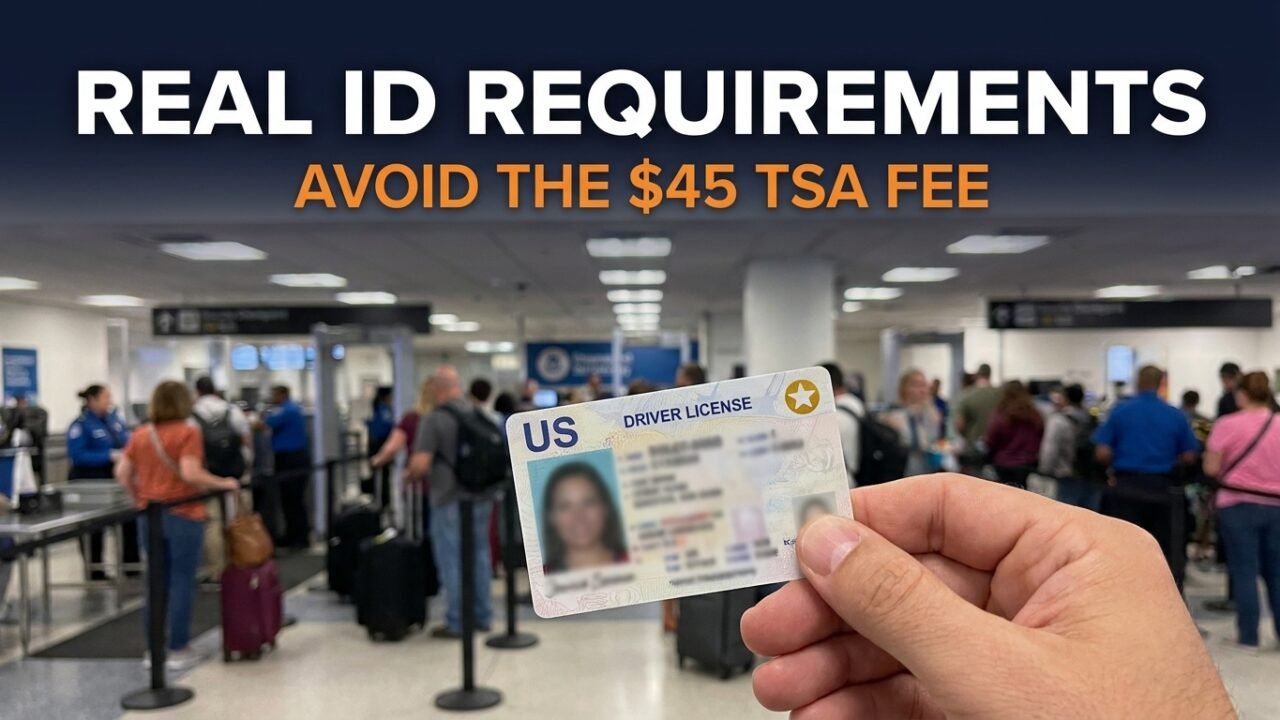
REAL ID requirements are now fully in force at airport security checkpoints, and flying without the right card can cost you money as well as time. Since Feb. 1, 2026, travelers who show up without a REAL ID or another acceptable ID have been asked to pay a $45 fee to verify their identity through a system called TSA Confirm.ID, and even then, clearance is not guaranteed.
With Thanksgiving and the December holidays approaching, this is the busiest stretch of the year for air travel and for DMV appointments. This guide explains exactly what counts as acceptable ID, how the $45 fee works, what to bring to the DMV to get a REAL ID, and a few mistakes that trip up travelers.
Table of Contents
What is REAL ID?
REAL ID is a federal standard for state-issued driver’s licenses and identification cards. Congress passed the REAL ID Act in 2005, following a recommendation from the 9/11 Commission to make identity documents harder to forge and to standardize how states verify who people are before issuing them.
The law set minimum security standards for how cards are made and what documents people must show to get one. For years, enforcement was delayed again and again. Full enforcement at airport checkpoints finally began on May 7, 2025.
A REAL ID is not a separate national ID card. It is simply a state driver’s license or ID card that meets the federal standards. Most states mark compliant cards with a star in the upper corner, often gold or black, inside a circle or a shape. California uses a bear with a star.
REAL ID requirements for flying
To pass through a TSA security checkpoint for a domestic flight, adults need to show one of the following:
- A REAL ID-compliant driver’s license or state ID card
- A valid U.S. passport or passport card
- A DHS trusted traveler card, such as Global Entry, NEXUS, SENTRI or FAST
- A U.S. military ID
- A permanent resident card
- Certain other federally approved documents, such as a tribal ID or a foreign government passport
The full, current list is on the TSA REAL ID page. If your ID is not on it, you will be referred to the Confirm.ID process before you can enter the security line.
One important detail: a temporary paper driver’s license is not an acceptable form of ID on its own. If you have just renewed your license and are waiting for the card in the mail, bring your passport.
How the $45 TSA Confirm.ID fee works
TSA announced in late 2025 that travelers without acceptable ID could pay to use its updated identity verification system, Confirm.ID. The agency first proposed an $18 fee, then set it at $45, saying the real cost of running the system was higher than expected.
The fee is nonrefundable and covers a 10-day travel period, so a round trip within that window is covered by one payment. The process uses checks against databases and questions about your personal history to confirm who you are. According to reporting on TSA’s rollout, it can take anywhere from 10 to 30 minutes or more, and paying does not guarantee that you will be cleared to fly.
Children under 18 are exempt from the fee. TSA does not require children traveling with an adult companion on domestic flights to show ID, although airlines may have their own rules for unaccompanied minors.
TSA says more than 94% of passengers already show a REAL ID or other acceptable ID. For the other 6%, the fee and the delay are a strong incentive to sort out their ID before the next trip.
Pay online before you travel
If you know you do not have acceptable ID, TSA urges you to pay the fee online before you get to the airport. Payment details are also available at marked locations near checkpoints at most airports, but paying at the airport adds time to an already slow process.
Be careful where you pay. Whenever a new government fee appears, fake websites follow, designed to look official and steal card details. Start from TSA.gov and follow its links, rather than searching for “TSA fee” and clicking the first result, and never pay through a link sent by text message. Our guide on how to spot a scam text explains the warning signs.
How to tell if your license is REAL ID-compliant
Look for a star in the upper portion of your driver’s license or state ID. If you see one, your card is almost certainly REAL ID-compliant. If you see wording such as “Not for Federal Identification” or “Federal Limits Apply,” it is not.
If you are unsure, check your state DMV’s website, which usually shows examples of compliant and non-compliant cards. Some people who renewed online or by mail over the years kept older cards without realizing they had never upgraded.
Enhanced driver’s licenses count too
Five states issue enhanced driver’s licenses: Michigan, Minnesota, New York, Vermont and Washington. These cards are designed for land and sea border crossings with Canada and Mexico, and they are accepted by TSA in place of a REAL ID, even though they may not display the REAL ID star.
If you live in one of these states and have an enhanced license, you are covered for domestic flights.
What to bring to the DMV
Getting a REAL ID usually requires an in-person visit, because the DMV must see and copy your original documents. Requirements vary a little by state, but you will typically need:
- Proof of identity, such as a certified birth certificate or a valid U.S. passport
- Proof of your Social Security number, such as your Social Security card or a W-2
- Two documents proving your current address, such as a utility bill, bank statement or lease
- Proof of any legal name change, such as a marriage certificate or court order, if the name on your identity document is different from your current name
Photocopies are not accepted in most states. Bring originals or certified copies. Many states let you upload documents in advance or book an appointment online, which can save a long wait.
The name-change problem
The most common reason people are turned away at the DMV is a name mismatch. If you have married, divorced or legally changed your name, your birth certificate will show a different name from your current license. You will need documents that show each change, in order, linking your birth name to your current name.
If you have changed your name more than once, you may need several documents. Gather them before your appointment, and order certified copies from the relevant county or state office if you cannot find the originals.
Is a passport a better option?
If you already have a valid U.S. passport, you do not need a REAL ID to fly domestically. Many travelers simply carry their passport. A passport card, which costs less than a passport book and fits in a wallet, is also accepted for domestic flights, although it cannot be used for international air travel.
The downside is the risk of losing your passport on a domestic trip, which could disrupt international travel plans later. For people who fly often within the U.S., getting a REAL ID and keeping the passport at home is usually more convenient.
What about digital IDs?
TSA has been expanding the use of digital IDs stored on phones, such as mobile driver’s licenses issued by participating states and IDs stored in Apple Wallet or Google Wallet. These are accepted at a growing number of airports and checkpoints.
Because availability varies by state and airport, TSA advises travelers to carry their physical ID as well. If your phone battery dies or the checkpoint does not support digital ID, you will still need an acceptable card.
Where else REAL ID matters
REAL ID requirements apply to more than airports. You also need a REAL ID or other acceptable ID to enter certain federal facilities, such as some federal office buildings and military bases, and to visit nuclear power plants.
You do not need a REAL ID to drive, to vote, to register to vote, to apply for or receive federal benefits such as Social Security or veterans’ benefits, or to access health services. Your regular license is still valid for driving until it expires, even if it is not REAL ID-compliant.
Tips for holiday travelers
Thanksgiving week and the days around Christmas and New Year are among the busiest travel periods of the year. A few steps make the checkpoint easier:
- Check your ID today, not the night before your flight
- If you need a REAL ID, book a DMV appointment now, because slots fill up before the holidays
- If you cannot get one in time, bring your passport or passport card
- If you must use Confirm.ID, pay online in advance and arrive much earlier than usual
- Make sure your ID has not expired, since TSA may accept recently expired IDs only in limited cases
If you are flying to a big event, such as the G20 summit 2026 in Miami in December, expect heavier security and longer lines than usual.
Domestic flights vs. international travel
It is worth being clear about what a compliant driver’s license does and does not do. It lets you board domestic flights within the United States. It does not replace a passport for international travel. To fly to another country, including Canada and Mexico, you still need a passport book.
A passport card works for domestic flights and for land and sea crossings to Canada, Mexico, the Caribbean and Bermuda, but not for international flights. If you are planning a trip abroad next year, check your passport’s expiration date now. Many countries require it to be valid for at least six months after you arrive, and passport processing times can stretch during busy seasons.
Green card holders and visitors from abroad
Permanent residents can use their green card at TSA checkpoints, and foreign visitors can use a valid passport from their home country. Visitors do not need any U.S. state-issued ID to fly domestically.
If you are hosting relatives from overseas who plan to take domestic flights during their visit, remind them to carry their passport rather than leaving it in a hotel safe or at your home. It is their accepted ID for every flight within the U.S.
If your ID is lost or stolen before a trip
Losing your wallet the day before a flight is stressful, but it does not always mean you cannot travel. Report the loss to the police if it was stolen, and request a replacement from your state DMV as soon as possible. If you have a passport, use that instead.
If you have no acceptable ID at all, you can still go to the airport and use the Confirm.ID process, paying the $45 fee and answering identity questions. Bring any other documents that help prove who you are, such as a credit card, a Social Security card, a birth certificate or a work ID. Arrive much earlier than normal, because verification takes time and is not guaranteed.
What the change means at airports
TSA has warned that travelers who do not bring an acceptable ID should expect longer waits. Many airports have set up marked areas near checkpoints where people are directed for identity verification before they enter the regular line.
For everyone else, the effect should be small. The vast majority of travelers already carry a compliant license or a passport, and the checkpoint process for them is unchanged. Programs such as TSA PreCheck and CLEAR can still speed up screening, but they do not replace the need for an acceptable ID. PreCheck members still need to show a compliant license or other approved document.
Why it took nearly 20 years
The REAL ID Act became law in 2005, and the original plan was for enforcement to begin within a few years. Instead, deadlines slipped again and again. Many states objected to the cost and to privacy concerns about the new standards, and the federal government repeatedly granted extensions.
Later delays came from the practical difficulty of getting millions of people to visit a DMV in person, and the COVID-19 pandemic pushed the deadline back several more times. Full enforcement finally arrived in May 2025, and the paid Confirm.ID option followed in February 2026.
A quick checklist before you fly
Run through these points a week before any trip:
- Look for the star on your driver’s license, or confirm you have an enhanced license
- Check the expiration date on whatever ID you plan to use
- Pack your passport or passport card if your license is not compliant
- If you have no acceptable ID, pay the Confirm.ID fee online through official TSA channels before you leave
- Allow extra time at the airport, especially around holidays
- Carry your physical ID even if you plan to use a digital ID on your phone
Five minutes of checking now can save you $45 and a stressful wait at the checkpoint.
Common mistakes to avoid
A few problems come up again and again at checkpoints:
- Assuming a renewed license is automatically REAL ID-compliant
- Traveling with only a temporary paper license
- Bringing photocopies of documents to the DMV
- Forgetting name-change documents
- Paying a TSA fee on an unofficial website
- Leaving everything until the week of a holiday trip
Most of these can be avoided with a quick look at your wallet and your state DMV’s website.
REAL ID requirements: common questions
Do I need a REAL ID to fly?
You need a REAL ID or another acceptable form of ID, such as a passport, to pass through TSA security for domestic flights.
What happens if I do not have a REAL ID at the airport?
You can pay a $45 fee to use TSA Confirm.ID to verify your identity. It covers a 10-day travel period, takes extra time and does not guarantee you will be cleared.
Do children need a REAL ID to fly?
No. TSA does not require children under 18 traveling with an adult to show ID on domestic flights.
How do I know if my license is a REAL ID?
Most compliant cards have a star in the upper corner. Check your state DMV’s website if you are unsure.
Do I need a REAL ID to drive or vote?
No. REAL ID is only required for boarding domestic flights and entering certain federal facilities.
Take out your driver’s license now and look for the star. If it is not there, book a DMV appointment before the holiday rush. For more news, see our news section and the official DHS REAL ID page.