Scroll through Pakistani social media for five minutes and you will see someone selling forex trading as the way to earn in dollars from home: screenshots of profits, “signal” groups, account managers promising steady monthly returns. The reality is very different, and the legal position is not what most of those posts claim.
This guide explains where forex trading in Pakistan stands legally in 2026, the one regulated route that exists, the risks of offshore brokers, the scams that target Pakistani traders, and safer ways to protect your savings from a falling rupee.
*This article is for information only and is not investment advice. Leveraged trading carries a high risk of losing money quickly.*
Table of Contents
Is forex trading in Pakistan legal?
The honest answer is that it depends on how you do it.
Two regulators are involved. The State Bank of Pakistan (SBP) controls foreign exchange under the Foreign Exchange Regulation Act of 1947, which governs how money can move in and out of the country. The Securities and Exchange Commission of Pakistan (SECP) licenses brokers and exchanges.
The key facts are these:
- No local licence exists for online margin forex brokers. The SECP does not license any company to offer leveraged online forex or CFD trading to the Pakistani public, because there is no such licence category.
- There is one regulated route: PMEX. The Pakistan Mercantile Exchange is the country’s only SECP-licensed futures exchange, and it lists futures contracts on international currency pairs as well as commodities.
- Funding offshore brokers is restricted. SBP rules restrict using banking channels to send money abroad to unauthorised brokers, and buying dollars in the open market for that purpose is not allowed.
So trading on PMEX through a licensed broker is clearly legal. Trading with an offshore broker sits in a legal grey area: it is not regulated in Pakistan, you have no local protection, and the way the money gets there can breach foreign exchange rules.
What PMEX offers
The Pakistan Mercantile Exchange works like the stock exchange but for futures contracts. Through a broker licensed by the SECP, you can trade contracts based on major currency pairs, gold, oil and other commodities, settled in rupees.
The advantages are legal clarity and protection. Your broker is supervised by the SECP, your money is handled within Pakistan’s financial system, and disputes go to Pakistani regulators rather than a company registered on a small island.
The disadvantage is that PMEX is still leveraged trading. Futures magnify gains and losses in the same way, and most beginners who trade them frequently lose money. Regulation protects you from fraud, not from the market.
Offshore brokers: what you are really dealing with
Most Pakistanis who trade forex online use international brokers regulated, if at all, in other countries. Some are large and reputable in their home markets. Others are lightly regulated offshore entities or outright frauds.
If you use one, understand what you give up:
- No Pakistani protection. Neither the SECP nor the SBP supervises these offshore brokers, so you cannot complain to them if something goes wrong.
- Withdrawal risk. Many complaints are not about losing trades but about brokers refusing or delaying withdrawals.
- Payment problems. Deposits often go through card payments, e-wallets or crypto because bank transfers for this purpose are restricted. Each route has its own risks, including frozen accounts.
- Leverage. Offshore brokers often offer extreme leverage, such as 500 times your deposit. That means a small move against you can wipe out your account in minutes.
The pattern for beginners is well documented. Brokers regulated in Europe are required to publish the share of their retail clients who lose money on these products, and the figures they report are typically well over half.
The SECP’s warnings about fake trading platforms
The SECP has repeatedly warned the public about unlicensed online trading platforms. In December 2025 it warned about platforms marketing aggressively on social media with fake dashboards, invented profit figures and impersonation of licensed brokers.
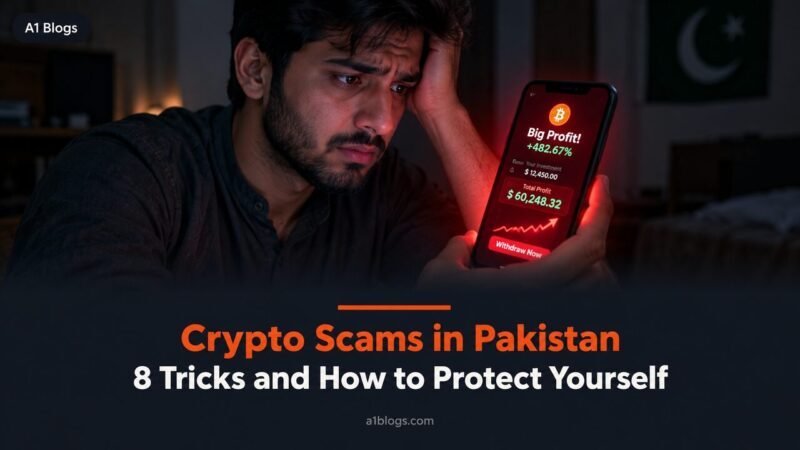
The typical story goes like this: you are added to a WhatsApp or Telegram group, shown impressive profits, and encouraged to deposit a small amount. Early “profits” appear on your screen. You deposit more. When you try to withdraw, you are asked for fees or taxes first, and then the platform disappears.
Common forex scams in Pakistan
- Account managers who offer to trade for you and promise a fixed monthly return. Legitimate trading never guarantees returns.
- Signal groups that charge for trading tips and show only their winning trades.
- Multi-level schemes that pay you for recruiting others into a forex “investment”.
- Fake apps that look like real trading platforms but simply display invented numbers.
- Recovery scams that target people who have already lost money and promise to get it back for a fee.
If you have been targeted, our guide to crypto scams in Pakistan explains where to report fraud; the warning signs are almost identical.
Is forex trading in Pakistan halal?
Religious views differ. Spot currency exchange is generally accepted, but many scholars object to leveraged trading with interest-like overnight charges, and some brokers offer “Islamic” swap-free accounts to address this. If this matters to you, ask a qualified scholar about the specific product rather than relying on a broker’s label.
Tax on trading profits
Profits from forex trading in Pakistan are income and can be taxable. Keep records of every deposit, withdrawal and trade, and declare your income when you file your return. Being on the Active Taxpayer List also lowers the tax you pay on many other financial transactions.
How to check a broker or platform
Before you send money anywhere, spend half an hour on these checks:
- For PMEX trading, confirm that the broker is licensed by the SECP and listed as a PMEX broker on the exchange’s website.
- Search the SECP’s public warnings. The regulator regularly names unlicensed platforms and schemes.
- For offshore brokers, find the exact company name and licence number and check them on the regulator’s own website in that country, not through a link the broker gives you.
- Look for withdrawal complaints. Search the broker’s name with words like “withdrawal problem” or “scam”. A pattern of complaints is a clear warning.
- Test a withdrawal with a small amount before depositing more.
- Never trust a screenshot. Profit screenshots are trivial to fake.
A realistic look at trading as an income
The adverts sell forex trading in Pakistan as a job you can do from your phone. In practice, professional traders work with large amounts of capital, strict risk limits and years of experience, and many still have losing years.
A small account cannot produce a living wage without taking huge risks. To earn Rs100,000 a month from a Rs500,000 account, you would need returns of 20% every month, which no honest trader can promise and almost nobody achieves for long. Chasing that kind of return with high leverage is how most accounts are wiped out.
If what you really want is income in dollars, skills such as freelancing usually offer a far more reliable path than trading.
Safer ways to protect your savings from a weak rupee
Many people turn to forex trading because they want protection from the falling rupee. There are simpler and safer ways to get that:
- A foreign currency account at a Pakistani bank lets you hold dollars legally.
- Gold has historically protected Pakistanis against devaluation. See our guide to the gold price in Pakistan.
- Shares and funds in companies that earn in dollars or benefit from inflation can also help over the long term. See how to invest in PSX.
- Understanding the exchange rate helps you avoid panic decisions. Our explainer on the dollar rate in Pakistan shows what moves it.
If you still want to trade
If you decide to try forex trading in Pakistan despite the risks, a few rules limit the damage:
- Prefer PMEX through an SECP-licensed broker.
- Practise on a demo account for several months before using real money.
- Use low or no leverage.
- Risk only a small amount you can afford to lose completely.
- Never give anyone access to your trading account or let them trade for you.
- Test withdrawals early with a small amount.
Frequently asked questions
Is forex trading in Pakistan legal for individuals?
Trading futures on PMEX through an SECP-licensed broker is legal. Online margin trading with offshore brokers is not regulated in Pakistan, and funding those accounts can breach foreign exchange rules.
Which forex brokers are licensed by the SECP?
None are licensed for online margin forex or CFD trading for the public, because no such licence exists. SECP-licensed brokers operate on PMEX.
Can I lose more than I deposit?
With leverage, losses build very quickly. Many brokers close positions automatically before your balance goes negative, but you can still lose your entire deposit in a short time.
Why are there so many forex adverts if it is risky?
Because brokers and promoters earn from your deposits and trading, whether you win or lose. Promoters often earn commissions for each person they sign up.