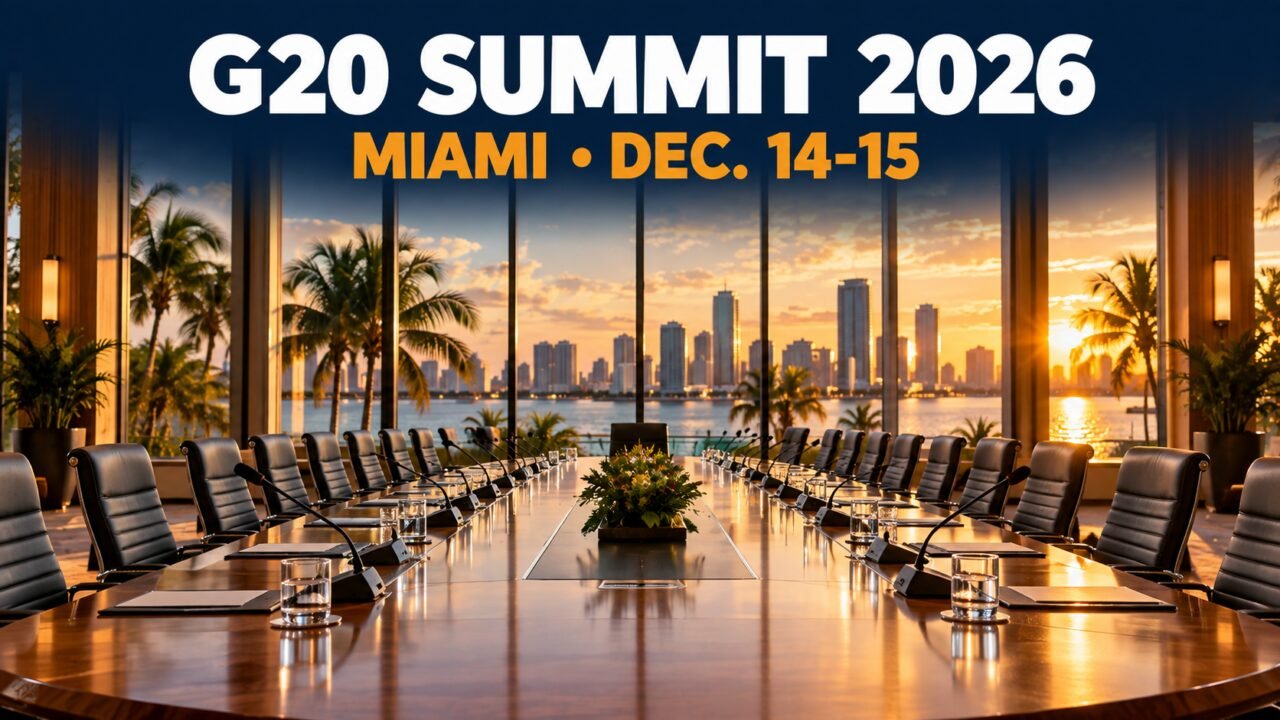
The G20 summit 2026 will bring leaders of the world’s biggest economies to Miami on Dec. 14 and 15, and it is shaping up to be one of the most unusual meetings in the group’s history. The United States is hosting for the first time since 2009, at a golf resort owned by the president. One member, South Africa, has been told it is not invited. And the Trump administration has cut the agenda down to three themes, dropping climate change and development altogether.
For most Americans, the G20 is a distant acronym. But the decisions and disagreements at these meetings shape trade, energy prices and how the world responds to financial crises. Here is what you need to know about this year’s summit and why it matters.
Table of Contents
What is the G20?
The Group of Twenty is a forum where the leaders of 19 large economies, plus the European Union and the African Union, meet to coordinate on the global economy. Together its members account for roughly 85 percent of the world’s economic output, about three-quarters of global trade and around two-thirds of the world’s population.
It started in 1999 as a meeting of finance ministers and central bank governors after the Asian financial crisis. It became a leaders’ summit in 2008, when President George W. Bush invited heads of government to Washington in the middle of the global financial crisis. The next year, President Barack Obama hosted the summit in Pittsburgh.
The G20 has no permanent headquarters and no binding power. Its influence comes from getting the most powerful economies in one room and, when things go well, getting them to agree on a direction.
When and where is the G20 summit 2026?
The summit is scheduled for Dec. 14 and 15, 2026, at the Trump National Doral Miami resort in Doral, Florida, just west of Miami International Airport.
The United States took over the rotating G20 presidency on Dec. 1, 2025, for a year that coincides with the country’s 250th anniversary. Throughout 2026, American officials have hosted working groups and ministerial meetings leading up to the leaders’ summit in December.
The summit falls on a Monday and Tuesday in mid-December, which also means it arrives six weeks after the 2026 midterm elections, when the political mood in Washington may look quite different.
1. The US is hosting for the first time since 2009
The G20 presidency rotates among members, and it has been 17 years since the United States last hosted a summit. The administration has framed the meeting as a chance to showcase American innovation and entrepreneurship during the 250th anniversary year.
The host country has real power. It sets the agenda, chooses the working groups, drafts the summit statement and decides which non-member guests to invite. That power is why this year’s summit looks so different from recent ones.
Secretary of State Marco Rubio has described the approach as a “new G20,” focused on the core economic issues that led to the group’s creation rather than the broader agenda it has taken on over the past decade.
2. South Africa has been shut out
The biggest break with tradition is the treatment of South Africa, which hosted the G20 in 2025. The Trump administration boycotted the Johannesburg summit in November 2025. President Trump objected to South Africa’s theme of “Solidarity, Equality, Sustainability” and repeated claims that white farmers in South Africa are being persecuted, which South Africa’s government rejects.
On Nov. 27, 2025, Trump announced that South Africa would not be invited to the 2026 summit in Miami. According to the Carnegie Endowment for International Peace, the administration said Poland would be invited in its place. The dispute was sharpened by an argument over the formal handover of the presidency, when South Africa refused a U.S. request to pass the gavel to a junior embassy official.
South Africa called the exclusion regrettable. President Cyril Ramaphosa’s office said the country is a G20 member in its own right and that its membership depends on all members, not on the host. Excluding a full member is without precedent in the group’s history, and it has left other governments uneasy about what it means for the forum’s future.
3. A much narrower agenda
The administration has built the 2026 presidency around three themes: removing regulatory burdens, unlocking affordable and secure energy supply chains, and pioneering new technologies and innovation. Four working groups are handling that agenda.
Just as notable is what has been left out. According to the South African Institute of International Affairs, writing for the Council on Foreign Relations’ Council of Councils, climate change, debt, development, inequality and sustainability are no longer on the formal agenda. Those topics had become central to recent G20 meetings hosted by India, Brazil and South Africa.
Supporters of the new approach argue that the G20 had tried to do too much and that returning to economic growth, regulation and energy is the best way to keep it relevant. Critics, especially in developing countries, say the issues being dropped are exactly the ones where they most need the world’s largest economies to act together.
4. The venue has drawn criticism
Holding the summit at a resort owned by the sitting president has raised ethics concerns. Critics argue that foreign delegations, security teams and media will spend money at a property that benefits the president’s family business. Trump has argued that the resort’s size and its location near Miami International Airport make it a practical choice.
This is not the first time the idea has come up. In 2019, during his first term, Trump announced that the 2020 G7 summit would be held at Doral, then reversed the decision two days later after criticism from both parties. This time, the plan has gone ahead.
For people who live and work around Doral, the practical effects will be heavy security, road closures and traffic in the days around the summit. Local officials typically announce those details a few weeks in advance.
5. Some common ground still exists
Despite the tension, the G20 is not only a story of division. Analysts at Carnegie point out that some interests quietly overlap. Sovereign debt restructuring is one example. Treasury Secretary Scott Bessent has repeatedly called for debt relief processes that are faster, clearer and more effective, a goal that developing countries share even if they frame it differently.
Energy is another. Many G20 members want secure and affordable energy supplies, even if they disagree about how quickly to move away from fossil fuels. Technology, especially artificial intelligence and the supply chains behind computer chips, is a concern for almost every member.
Whether those shared interests lead to real agreements in Miami depends on the negotiations of the next few months and on how the other members respond to the South Africa decision.
6. What it means for Americans
Most G20 decisions do not change daily life directly, but they shape the environment in which prices, jobs and investment move. Agreements or disputes over tariffs and trade can affect what Americans pay for imported goods. Discussions about energy supply chains touch on gasoline, heating and electricity prices. Talks on technology can influence rules for artificial intelligence and the security of chip supplies that power everything from phones to cars.
The G20 also matters in a crisis. During the 2008 financial crash and the COVID-19 pandemic, it was one of the main places where large economies coordinated their response. A weaker or more divided G20 could make that kind of cooperation harder the next time something goes wrong.
Finally, the summit is a stage for American diplomacy. How the administration handles the meeting will shape how allies and rivals see the United States during a year of tension over trade and conflict.
7. What comes after Miami
The G20 presidency passes to the United Kingdom for 2027, with a summit planned for Manchester, and then to South Korea in 2028. Traditionally, the past, current and next hosts work together as a “troika” to provide continuity from one year to the next.
Whether South Africa returns to full participation after the U.S. presidency ends is one of the open questions. Many members have signaled that they see its exclusion as a one-year decision by the host rather than a permanent change to the group.
How it differs from the G7 and the UN
People often mix up the G20 with the G7. The G7 is a much smaller club: the United States, Canada, the United Kingdom, France, Germany, Italy and Japan, with the European Union attending as well. Its members are wealthy democracies that usually share similar views on security and trade, which makes agreement easier.
The larger group was created precisely because the smaller one no longer reflected the world economy. It brings in China, India, Brazil, Indonesia, Saudi Arabia, Turkey, Mexico, South Africa and others, countries with very different political systems and priorities. That makes it more representative, but also far harder to get everyone to agree.
The United Nations is different again. It has 193 member countries, a permanent staff and, through the Security Council, the power to pass binding resolutions. The G20 has none of that. It works only through persuasion and the weight of its members.
Key moments from past summits
The group’s reputation was built in a crisis. At the London summit in April 2009, leaders agreed to a package of about $1 trillion in support for the world economy, much of it channeled through the International Monetary Fund. Many economists credit that coordination with helping prevent the financial crash from turning into something worse.
Later that year, leaders meeting in Pittsburgh declared the group the main forum for international economic cooperation. In 2021, at the Rome summit, leaders endorsed a global minimum corporate tax rate of 15 percent, one of the most ambitious tax agreements in decades.
More recent summits have reflected the rise of the Global South. The 2023 summit in New Delhi admitted the African Union as a permanent member. Brazil’s 2024 summit in Rio de Janeiro launched a global alliance against hunger and poverty. The 2025 Johannesburg summit was the first ever held in Africa, and leaders there adopted a declaration even though the United States stayed away.
Why developing countries are worried
For many poorer countries, the agenda changes in 2026 feel like a step backward. Debt payments are consuming a large share of government budgets in parts of Africa, Asia and Latin America, often more than health or education spending. Recent hosts had pushed richer members to speed up debt relief and make borrowing cheaper for developing economies.
Climate is the other concern. Countries facing floods, droughts and heat waves argue that they need help paying for protection and cleaner energy, and that the world’s largest economies are the ones best placed to provide it. Dropping those topics from the formal agenda, they fear, sends a signal that the richest members are losing interest.
The administration’s response is that growth, cheaper energy and new technology are the best path to prosperity for everyone, and that a narrower agenda gives the meeting a better chance of producing results.
What to watch between now and December
Several questions will shape how the Miami meeting goes:
- Which leaders confirm they will attend in person, especially from China, India and Brazil
- Whether any other members object publicly to South Africa’s exclusion, or send lower-level delegations in protest
- Whether negotiators can agree on a joint declaration, and how much it says
- How the results of the Nov. 3 midterm elections affect the political mood in Washington
- Whether the final guest list includes more of the administration’s allies, as Poland’s invitation suggests
The months before a summit are usually quiet in public and busy in private. Most of the real bargaining over the final statement will happen in meetings that get little attention until the leaders arrive.
Who is in the G20?
The members are Argentina, Australia, Brazil, Canada, China, France, Germany, India, Indonesia, Italy, Japan, Mexico, Russia, Saudi Arabia, South Africa, South Korea, Turkey, the United Kingdom and the United States, plus the European Union and the African Union. The African Union became a permanent member in 2023.
Hosts also invite guest countries and international organizations, such as the United Nations, the International Monetary Fund and the World Bank. Guest lists often reflect the host’s priorities, and this year’s list will be watched closely.
How a G20 summit actually works
Most of the work happens long before leaders arrive. Each member appoints a “sherpa,” a senior official who negotiates the summit’s final statement over months of meetings. Parallel tracks bring together finance ministers and central bank governors.
The summit itself usually lasts one or two days. Leaders hold sessions on each theme, meet one on one on the sidelines, and try to agree on a joint declaration. Decisions are made by consensus, so a single member can block language it opposes. In recent years, disagreements over the wars in Ukraine and the Middle East have made those statements harder to agree on.
Some of the most important outcomes happen outside the formal program. Bilateral meetings between leaders, especially between the U.S. and Chinese presidents when both attend, often make more news than the official communique.
How to follow the summit
Most of the summit will happen behind closed doors, but there are several ways to keep up. The host government usually livestreams the opening session, the arrival of leaders and the closing press conferences. The White House and the State Department will post schedules and statements on their websites and social media accounts, and the official summit website run by the U.S. presidency publishes documents as they are released.
Because Miami is on Eastern Time, the main sessions will take place during the U.S. business day, which makes them easy to watch live for most Americans. For readers in Europe, Africa and Asia, the key moments will fall in the evening or overnight.
The most useful coverage often comes after the cameras leave. The final declaration, if there is one, is usually released on the last day, and analysts spend the following week reading the fine print to see what leaders actually agreed to and what they quietly left out. Watch for the wording on trade, energy and debt, and for any mention of South Africa.
G20 summit 2026: common questions
When is the G20 summit 2026?
Dec. 14 and 15, 2026.
Where is the G20 summit 2026 being held?
At the Trump National Doral Miami resort in Doral, Florida.
Why is South Africa not invited?
President Trump announced in November 2025 that South Africa would not be invited, after the U.S. boycotted the Johannesburg summit amid disputes over South Africa’s agenda and the handover of the presidency.
What is on the agenda?
Three themes: removing regulatory burdens, securing affordable energy supply chains and advancing new technologies and innovation.
Who hosts the G20 in 2027?
The United Kingdom, with a summit planned for Manchester.
The Miami summit is still more than two months away, and plenty can change before then. For more world coverage, read our report on the race for the next UN Secretary-General and visit our world section.