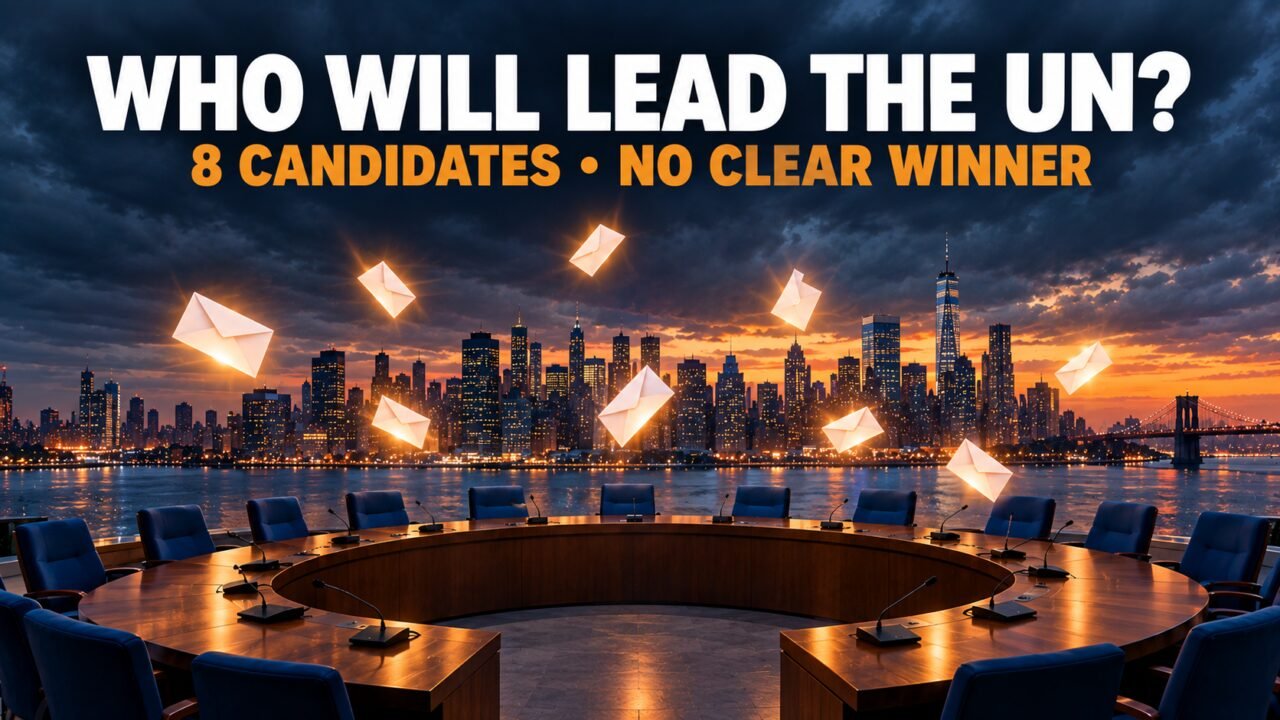
The race to become the next UN Secretary-General is entering its most important stretch, and after three secret votes in the Security Council there is still no clear favourite. Eight candidates are in the running to replace António Guterres, whose second term ends on December 31, 2026. The last straw poll, held on September 18, put Costa Rica’s Rebeca Grynspan narrowly ahead, but the gap is small and diplomats openly talk about the chance of a late entrant.
The job matters well beyond New York. The Secretary-General runs the UN’s day-to-day work, speaks for it in crises, and sets the tone on everything from wars to climate talks to humanitarian aid. Here is how the choice is made, who the candidates are, what the voting has shown so far, and why Pakistan has a direct say this time.
Table of Contents
How the next UN Secretary-General is chosen
The rules are short. Article 97 of the UN Charter says the Secretary-General is appointed by the General Assembly on the recommendation of the Security Council. In practice, the 15 members of the Security Council decide, and the General Assembly confirms their choice.
For most of the UN’s history, that process happened almost entirely behind closed doors. That changed in 2016, when pressure from member states and civil society led to a more open process. Candidates were formally nominated, published their visions, and answered questions from member states in public sessions. That format has been kept for 2026.
This year, the candidates who had declared by spring appeared before the General Assembly on April 22 and 23 for open questioning, and later entrants took part in similar dialogues over the summer. The Security Council began its own voting on July 30. There is no official deadline for new nominations, so a candidate can still enter right up until the Council makes its recommendation.
A Secretary-General serves a five-year term. By convention, most have served two, and Guterres, a former prime minister of Portugal, has held the job since January 2017.
What a straw poll is, and why the results are secret
A straw poll is an informal, non-binding vote that the Security Council uses to test support before it makes a formal recommendation. Each of the 15 Council members receives one ballot per candidate, with three options: “encouraged”, “discouraged” or “no opinion expressed”.
According to Security Council Report, which follows the Council’s work closely, no Secretariat officials are present, no official record is kept, and the ballots are shredded afterwards. The results still reach journalists within hours, through diplomats who share them privately.
In early rounds, all 15 members use the same colour ballot, so nobody can tell whether a “discourage” vote came from a permanent member. Later in the process, the five permanent members, China, France, Russia, the United Kingdom and the United States, usually switch to coloured ballots. That is when a candidate can learn whether a veto is waiting for them, and it is often when the race narrows quickly.
The 8 candidates in the race
The current field is smaller than in 2016, when 13 people competed. Here is who is running for UN Secretary-General, with the date each was nominated, based on the list compiled by Security Council Report.
Rebeca Grynspan (Costa Rica)
An economist and a former vice president of Costa Rica, Grynspan leads the UN Conference on Trade and Development (UNCTAD) and previously headed the Ibero-American General Secretariat. She played a central role in the 2022 Black Sea Grain Initiative between Russia and Ukraine. Costa Rica nominated her on March 3.
Carolyn Rodrigues Birkett (Guyana)
A former foreign minister of Guyana, Rodrigues Birkett was nominated by her government on June 15. She was the biggest mover of the summer, rising to first place in the second straw poll.
Rafael Grossi (Argentina)
Grossi is director general of the International Atomic Energy Agency, the UN’s nuclear watchdog, which has put him at the centre of some of the world’s most sensitive crises. Argentina nominated him early, on November 26, 2025.
Michelle Bachelet (Chile)
A two-time president of Chile and a former UN High Commissioner for Human Rights, Bachelet was nominated jointly by Brazil, Chile and Mexico on February 2. Chile withdrew its nomination on March 24, but she remains a candidate with the backing of Brazil and Mexico.
María Fernanda Espinosa (Ecuador)
A former Ecuadorian foreign minister who served as President of the UN General Assembly in 2018 and 2019, Espinosa was nominated by Antigua and Barbuda on May 11.
Macky Sall (Senegal)
The former president of Senegal was nominated on March 2, not by his own country but by Burundi. He is the most prominent African candidate in the field.
Olara Otunnu (Uganda)
A former Ugandan foreign minister and a former UN special representative for children and armed conflict, Otunnu was nominated by Uganda on July 24. He recorded the sharpest rise in support in the second straw poll, according to PassBlue.
Ivonne A-Baki (Ecuador)
The Ecuadorian diplomat was the latest to enter, nominated on August 17, after the first straw poll had already taken place.
What three straw polls have shown so far
The first straw poll on July 30 put Grynspan in first place. The second, on August 21, saw Rodrigues Birkett narrowly overtake her, with Grossi close behind.
In the third round on September 18, Grynspan returned to the top. PassBlue reported, citing diplomats, that she received nine “encourage” votes, with Rodrigues Birkett one behind on eight. The National reported that Grynspan also drew five “discourage” votes. No date has been set for the next straw poll.
Two numbers tell the story of a race that is still open. Security Council Report found that about 34 percent of all ballots in the first straw poll were “no opinion” votes, compared with about 21 percent at the same stage in 2016. In the second round, that share barely moved, to about 32.5 percent. Nearly a third of the ballots, in other words, still reflect members holding back.
Meanwhile, “discouraged” votes rose from about 23 percent to 35 percent between the first two rounds. Council members are starting to say no to some candidates, but they have not yet said yes to one. That combination is why diplomats keep speculating about a new name the Council could unite behind.
Will the UN finally get a woman in charge?
Nine people have held the job since 1946, and all of them have been men. Several Security Council members have said publicly that they would like the next UN Secretary-General to be a woman, and many member states and campaign groups have pushed for the same outcome for more than a decade.
The current field reflects that pressure. Five of the eight candidates are women: Grynspan, Rodrigues Birkett, Bachelet, Espinosa and A-Baki. The two candidates who have led the straw polls so far are both women.
None of this guarantees the result. In 2016, several strong women candidates ran, including the then head of UNESCO, Irina Bokova, and New Zealand’s former prime minister Helen Clark, and the Council still chose Guterres. The difference this time is that the leading names in the polls are women, rather than candidates chasing the frontrunner.
Latin America’s claim to the job
The UN has no formal rule on regional rotation, but there is an informal expectation that the job moves between regions. Europe, Africa and Asia have each produced more than one Secretary-General. Latin America and the Caribbean has had only one, Javier Pérez de Cuéllar of Peru, who served from 1982 to 1991.
That history explains the shape of the field. Six of the eight candidates come from Latin America and the Caribbean: Grynspan, Rodrigues Birkett, Grossi, Bachelet, Espinosa and A-Baki. Many diplomats from the region argue that it is their turn.
A crowded regional field has a downside too. Candidates from the same region can split support, and a strong outsider such as Sall or Otunnu could benefit if the Latin American votes stay divided.
Why the veto powers matter most
The decisive voters in this race are the five permanent members. Any one of them can block a candidate by voting against the formal recommendation, and their private preferences shape the straw polls long before that final vote.
Each has its own concerns. Some want a Secretary-General who will be cautious about criticising them. Others want someone with strong management skills to deal with the UN’s budget problems and staff cuts. Relations between the United States and China, the war in Ukraine and conflicts in the Middle East all feed into how each permanent member sees each candidate.
This is also why a candidate who does well in the early straw polls can still fall away. Once coloured ballots reveal a permanent member’s opposition, that candidate usually has no route to the job, however many other members support them.
What the next Secretary-General will inherit
Whoever wins will take over an organisation under more financial pressure than at almost any point in its history. Many member states pay their regular dues late or only in part, and the UN has spent recent years dealing with a cash shortage that has forced hiring freezes and cuts to programmes.
In 2025, Guterres launched a reform drive called the UN80 Initiative, named for the organisation’s 80th anniversary. It aims to merge overlapping offices, move some staff out of expensive cities such as New York and Geneva, and cut costs. Parts of that work will still be unfinished on January 1, and the next UN Secretary-General will have to decide how far to take it.
There is also the question of credibility. The Security Council has been unable to agree on major decisions about the war in Ukraine and several conflicts in the Middle East, because permanent members sit on opposite sides. Humanitarian appeals for Gaza, Sudan, Afghanistan and other crises have been badly underfunded. Many governments in the Global South say the UN’s institutions, from the Security Council to the international financial system, do not reflect today’s world.
The Secretary-General cannot fix most of this alone. The job has very little formal power. Its main tools are persuasion, the ability to put issues on the Security Council’s agenda under Article 99 of the Charter, and the moral weight that comes from speaking for the whole organisation. That is why the personality and political skills of the winner matter so much, and why the permanent members pay such close attention to who gets it.
For candidates, this backdrop shapes the pitch. Management experience and a record of getting rival governments to agree carry more weight than grand speeches. Grynspan points to the grain deal she helped negotiate, and Grossi to years of dealing with nuclear crises. Bachelet and Espinosa lean on long UN careers. Sall presents himself as a voice for Africa and the Global South.
Pakistan’s seat at the table
Pakistan is one of the ten elected members of the Security Council for 2025 and 2026, which means it votes in every straw poll and in the final recommendation. The next UN Secretary-General will be chosen during Pakistan’s term, and Pakistani diplomats in New York have a direct part in the outcome.
Pakistan’s ballots are secret like everyone else’s, and the government has not said publicly which candidates it supports. Its priorities at the UN are well known, however: Kashmir, the rights of developing countries in trade and finance, climate funding for vulnerable countries, and the UN’s role in conflicts in the Muslim world. It is reasonable to expect those issues to shape how Pakistan judges the candidates, particularly on development finance, where Grynspan’s UNCTAD background is relevant.
For Pakistani readers, the choice will matter in practical ways. The Secretary-General’s office plays a part in humanitarian appeals after disasters such as floods, and in how the UN responds to crises in Afghanistan and the wider region.
Lessons from the 2016 race
The last open contest offers some clues about how this one may end. In 2016, the Security Council held six straw polls between July and early October. Guterres came first in every one of them, which made him the clear favourite well before the permanent members switched to coloured ballots.
In the final straw poll on October 5, 2016, he received 13 “encourage” votes and no “discourage” votes from any permanent member. The Council formally recommended him the next day, and the General Assembly appointed him on October 13.
This year looks different. No candidate has led every round. The lead has changed hands twice in three polls, and the number of members holding back is much higher. That points to a longer race, and perhaps to a candidate who is not yet in the field, if the Council fails to settle on one of the current eight.
What happens next, and when
The Council has not announced a date for its fourth straw poll. With world leaders gathered in New York for the General Assembly’s high-level week in late September, much of the real campaigning is happening in private meetings on the sidelines.
The usual pattern is a series of further straw polls through the autumn, a switch to coloured ballots for the permanent members, and then a formal vote in a private Council meeting to adopt a resolution recommending one name. The General Assembly then appoints that person, usually by acclamation.
In 2016, the Council agreed on Guterres in early October, which gave him nearly three months to prepare before taking office on January 1. Security Council Report has noted that how much time the next Secretary-General gets to prepare is becoming a concern this year. Every week without a decision shortens the handover.
If you want to follow each round, 1 for 8 Billion, a campaign for a more open selection process, tracks the straw poll results as they are reported.
Next UN Secretary-General: common questions
When will the next UN Secretary-General take office?
On January 1, 2027. António Guterres’s term ends on December 31, 2026.
Who is leading the race?
Rebeca Grynspan of Costa Rica led the third straw poll on September 18 with nine “encourage” votes, one ahead of Carolyn Rodrigues Birkett of Guyana. The results are unofficial and the race remains open.
How many candidates are there?
Eight, as of late September 2026. More can still enter, because there is no formal deadline.
Has a woman ever been UN Secretary-General?
No. All nine Secretaries-General since 1946 have been men.
Does Pakistan vote in the selection?
Yes. Pakistan is an elected member of the Security Council for 2025 and 2026, so it takes part in every straw poll and the final recommendation.
Can a permanent member block a candidate?
Yes. China, France, Russia, the United Kingdom and the United States can each veto the Council’s formal recommendation.
We will update this story after the next straw poll. For more world and politics coverage, see our latest stories and the politics section.