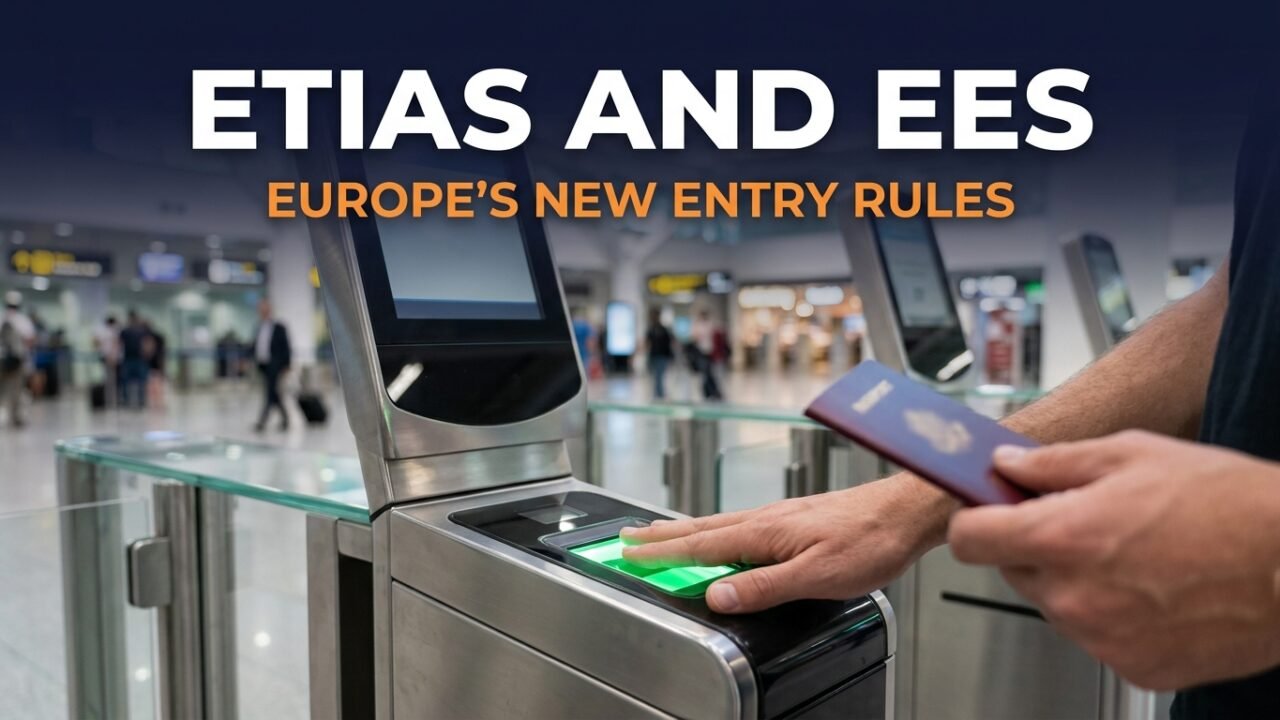
ETIAS and EES are the two biggest changes to European border rules in decades, and together they change how Americans, Britons and other visa-free travelers enter most of Europe. The Entry/Exit System, or EES, is already running, replacing passport stamps with fingerprints and face scans at the border. The European Travel Information and Authorisation System, or ETIAS, is the next step: an online travel authorization that visa-free visitors will need before they fly.
Neither system is a visa, and for most travelers the process should be quick. But the details matter, especially for anyone planning a trip for the holidays or next summer. This guide explains how each system works, what it costs, who needs it and how to avoid the scams that have already appeared.
Table of Contents
ETIAS and EES in one minute
Here is the short version:
- EES is a digital border record. When you enter or leave the Schengen area, your fingerprints, a photo of your face and your passport details are recorded. It replaces manual passport stamping.
- ETIAS is a pre-travel authorization. Visa-exempt travelers, including U.S. and U.K. citizens, will apply online and pay a fee before their trip.
- EES has been in operation since October 2025. ETIAS is due to follow, with the EU pointing to a launch in the final part of 2026.
If you are traveling to Europe soon, you will encounter EES at the border. Check the official site before booking to see whether ETIAS is required for your travel dates.
What is the Entry/Exit System?
The Entry/Exit System started on Oct. 12, 2025, and was phased in over about six months, becoming fully operational in spring 2026. It applies to non-EU citizens traveling for short stays, including Americans, Britons, Canadians and Australians.
The first time you cross a border covered by EES, officers or self-service kiosks collect your fingerprints and a facial image, along with your passport details. After that, each entry and exit is logged electronically. The system automatically calculates how many days you have spent in the Schengen area, which makes it easier for border officers to spot overstays.
Children under 12 do not need to give fingerprints, although their faces are photographed. Your data is generally stored for three years, so frequent visitors only need to register fully once in that period.
Which countries use EES?
EES covers the countries of the Schengen area, which includes most EU members plus Iceland, Liechtenstein, Norway and Switzerland. Ireland does not take part, because it is not in the Schengen area, and has its own arrangements with the United Kingdom.
If your trip includes several Schengen countries, you only go through EES when you first enter the area and when you finally leave it. Travel between Schengen countries normally has no border checks.
What EES means at the border
For first-time registration, border crossings can take longer than before, because each traveler’s biometrics must be recorded. Many airports have installed self-service kiosks to speed this up, followed by a short check with a border officer.
Travelers from the U.K. face a particular pinch point. At the Port of Dover, the Eurostar terminal at London St Pancras and the Channel Tunnel terminal at Folkestone, French border checks take place on British soil before departure. That means EES registration happens before you board, and at busy times queues can be long. Allow extra time, especially during school holidays.
Once you are registered, later crossings should be quicker, and some airports use automated gates.
What is ETIAS?
ETIAS is an electronic travel authorization, similar in spirit to the American ESTA system and the U.K.’s Electronic Travel Authorisation. It will be required for citizens of around 60 countries who do not need a visa to visit Europe, including the United States, the United Kingdom, Canada, Australia and Japan.
You will apply online, answer questions about your identity, passport, travel plans, criminal record and any past immigration problems, and pay a fee. Most applications are expected to be approved within minutes. Some will take longer, and a small number may need extra information or an interview.
Once approved, an ETIAS authorization is linked to your passport and is valid for three years, or until your passport expires, whichever comes first. You can use it for multiple trips during that time.
How much does ETIAS cost?
The fee is set at 20 euros. Travelers under 18 and over 70 are exempt from paying, although they still need an authorization.
That is cheaper than the U.K.’s ETA, which costs Americans £16, and much cheaper than the U.S. ESTA, which rose to $40 in 2025. It is still worth budgeting for, especially for families.
When will ETIAS start?
ETIAS has been delayed several times. The EU has said it expects the system to launch in the last quarter of 2026, after EES was fully in place. When it starts, the EU plans a transition period during which travelers who do not have an authorization may still be allowed in, followed by a grace period before strict enforcement begins.
Because dates can change, check the official EU travel website before you book, and again before you travel.
Which countries require ETIAS?
ETIAS will cover 30 European countries: the Schengen members plus Cyprus. Ireland is not included.
For travelers from the United Kingdom, that means ETIAS will be needed for most European holidays, from Spain and Portugal to Greece and Italy, but not for trips to Ireland.
The 90/180-day rule explained
Neither EES nor ETIAS changes how long you can stay. Visa-free visitors can spend up to 90 days in any 180-day period in the Schengen area. The 180 days are a rolling window, not a calendar year, so time spent in Europe months ago can still count.
EES makes this rule much easier to enforce, because every entry and exit is recorded electronically. People who used to rely on unstamped passports or inaccurate records will find that the system now counts their days precisely. If you split your time between Europe and home, keep your own record too, and use the EU’s online short-stay calculator if you are unsure.
Passport rules to check now
For Schengen travel, your passport must generally have been issued within the last 10 years and be valid for at least three months after the date you plan to leave. British travelers have been caught out by the 10-year rule, particularly those whose passports were issued with extra months added from a previous renewal.
If your passport is close to either limit, renew it before you book. It is also worth checking that your airline has your details correctly, as airlines may check ETIAS status at check-in once the system is live.
Beware of ETIAS scams
Whenever a new travel document appears, fake websites follow. Some charge far more than the official fee for “help” filling in a simple form. Others steal card details or personal data.
Apply only through the official EU website or its official app, and be wary of sites that appear at the top of search results with paid adverts. The same applies to the U.K. ETA and the U.S. ESTA, which should only be bought from official government sites. Our guide on how to spot a scam text covers the warning signs of fake payment requests.
Coming the other way: UK ETA and US ESTA
Europe is not alone in tightening entry rules. Since January 2025, U.S. citizens have needed an Electronic Travel Authorisation to visit the United Kingdom, including for short trips and some transit journeys. It costs £16 and is valid for two years or until the passport expires.
Visitors from the U.K. and most of Europe traveling to the United States under the Visa Waiver Program need an ESTA, which now costs $40. For domestic flights once in the U.S., foreign visitors use their passport as ID. Americans flying at home need a compliant license or passport. Our guide to REAL ID requirements explains the new TSA rules.
Tips for a smooth trip to Europe
A few simple steps help:
- Check your passport’s issue and expiry dates against Schengen rules
- Allow extra time at the border for your first EES registration
- Check whether ETIAS is required for your travel dates, and apply well ahead of time once it opens
- Use only official websites for travel authorizations
- Keep a record of your days in Europe if you travel often
- Carry proof of accommodation, return travel and enough money for your stay, in case border officers ask
If you are traveling with children, make sure each child has their own passport and, once required, their own ETIAS authorization.
Traveling with children and families
Families should plan a little more carefully. Every traveler needs their own valid passport, including babies, and once the new authorization is required, each child will need one of their own even though under-18s do not pay the fee. Parents can usually apply on behalf of their children.
At the border, children under 12 are photographed but not fingerprinted during registration. Younger children may find the kiosks confusing, so be ready to help, and expect the first crossing to take a little longer than you are used to.
If a child is traveling with only one parent, or with grandparents or another adult, carry a signed letter of consent from the absent parent or parents, with contact details. It is not always required, but border officers can ask for proof that the trip is authorized.
Frequent travelers and business trips
People who visit Europe several times a year will notice the benefits sooner than occasional travelers. After the first registration, later crossings can be faster, particularly at airports with automated gates. The three-year validity of the upcoming authorization also means one application can cover many trips.
The main risk for frequent visitors is the 90/180-day limit. Business travelers who spend a week or two in Europe each month can reach the limit faster than they expect. Keep a simple log of your entry and exit dates and check it before booking each new trip.
If you need to stay longer, or you will be working in Europe rather than attending meetings, you may need a visa or work permit from the country concerned. Visa-free status covers tourism and short business visits, not employment.
What if your application is refused?
Most applications for the new travel authorization are expected to be approved quickly. If yours is refused, you will be told the reason and how to appeal. Appeals are handled by the country that made the decision.
Refusals are most likely where there is a serious criminal record, a previous immigration violation such as an overstay, or a security concern. Minor issues, such as a spelling mistake, can usually be fixed by applying again with the correct information.
If you are refused and need to travel urgently, you may be able to apply for a visa from the embassy or consulate of the country you want to visit.
Cruises, trains and land borders
The new rules are not limited to airports. Cruise passengers who enter the Schengen area at a port are also registered, often by border officers who come on board or at the cruise terminal. If your cruise starts outside Europe and stops at Schengen ports, check how your cruise line is handling registration.
Travelers crossing into the Schengen area by land, for example from the Balkans, will go through the same process at road and rail border crossings. Expect longer waits at busy land borders, particularly during summer.
Dual citizens and European residents
If you hold citizenship of an EU country as well as the United States or the United Kingdom, travel on your EU passport. EU citizens are not covered by the new system and use the EU lanes at the border.
People who live in a Schengen country with a valid residence permit or long-stay visa are also exempt. So are some family members of EU citizens who hold residence cards. If you are in one of these groups, carry your permit or card whenever you travel, as it proves you are exempt.
What happens to your data
The new systems collect more personal information than a passport stamp ever did, so it is fair to ask how it is used. Under the Entry/Exit System, your name, passport details, fingerprints, facial image and travel dates are stored in a central European database, generally for three years after your last exit, or longer in some cases such as overstays.
The travel authorization will check applicants against European security and immigration databases, as well as some international databases, before a decision is made. The data is protected under European data protection law, which gives you rights to ask what information is held about you and to have mistakes corrected.
Privacy groups have raised concerns about the scale of the data collection and how long it is kept. If you are worried, the official EU travel website explains how the systems handle personal data and how to contact the authorities responsible.
Why Europe is making these changes
The EU says the new systems will strengthen security, make it easier to detect people who overstay or use false identities, and speed up border crossings in the long run by replacing manual stamping with automated checks. ETIAS also lets authorities screen travelers against security databases before they arrive, rather than at the border.
Critics have raised concerns about privacy and data protection, the cost and complexity of the systems, and the potential for long queues during the rollout. For regular travelers, the changes are a sign that visa-free travel increasingly comes with a digital check first.
The move mirrors a global trend, including the U.S. ESTA and the U.K. ETA. For more on how international relationships are shifting, see our guide to the G20 summit 2026.
ETIAS and EES: common questions
Do Americans need a visa for Europe?
No. Americans can visit the Schengen area for up to 90 days in any 180-day period without a visa. Once ETIAS starts, they will need an ETIAS authorization.
How much does ETIAS cost?
The fee is 20 euros. Travelers under 18 and over 70 do not pay.
When does ETIAS start?
The EU has pointed to a launch in the last quarter of 2026. Check the official EU travel website for the latest date.
Is EES already in use?
Yes. The Entry/Exit System began on Oct. 12, 2025, and was phased in over the following months.
Do I need ETIAS for Ireland?
No. Ireland is not part of ETIAS or the Schengen area.
Check your passport dates tonight and bookmark the official EU travel site before you plan your next European trip. For more world coverage, see our world section.