Every year, people in Islamabad lose savings on plots in housing schemes that were never allowed to sell them. The Capital Development Authority (CDA) keeps a public list of illegal schemes, and in September 2026 it named close to 100 of them, mostly on Lehtrar Road, Simly Dam Road, Kuri Road, Park Road and the Islamabad Expressway. In May 2026 the CDA sealed the offices of two such schemes in Zone IV, Shaheen Town and Islamabad Green Paradise.
The good news is that telling CDA approved housing societies apart from illegal housing schemes takes about half an hour, and the official information is free. This guide explains how CDA approval works, what each status on the CDA register means for a buyer, and the steps to take before you pay anything.
Table of Contents
Why buying in CDA approved housing societies matters
Buying in an unapproved scheme can go wrong in several ways. The CDA has told utility companies not to provide electricity and gas connections to illegal schemes, and it has said that the sale and purchase of land in them is not allowed. Development can stop halfway when the sponsor runs out of money or faces legal action. Transfers may not be registered properly, which makes the plot hard to sell later. In the worst cases, structures are demolished.
Approval does not guarantee profits or good management. It does mean the scheme has gone through the CDA’s planning process and that the authority has allowed the sponsor to develop and sell plots.
How CDA approval works for housing societies
The CDA regulates private housing schemes in Islamabad Capital Territory under the CDA Ordinance 1960 and the ICT Zoning Regulations 1992. Approval comes in two steps, and a third certificate follows at the end:
- Layout plan (LOP) approval. The CDA approves the scheme’s design: where roads, plots, parks and services go.
- No objection certificate (NOC). Once the sponsor completes the remaining formalities, the CDA issues an NOC for development. Only after the NOC can the sponsor start development and sell plots.
- Completion certificate. Issued after development is finished according to the approved layout, designs and specifications.
In short, an approved layout plan is not enough. For CDA approved housing societies, the NOC is what allows plot sales.
The statuses on the CDA register, and what they mean
The CDA’s register of private housing schemes lists each scheme with its LOP and NOC status. You will see these combinations:
- LOP approved, NOC issued. The strongest position for a private scheme. The sponsor is allowed to develop and sell.
- LOP approved, NOC not issued. The design is approved, but the scheme has not completed the formalities to sell plots. Treat sales here with great caution.
- LOP approved, NOC cancelled. The scheme once had permission and lost it.
- LOP cancelled. The approval process has failed.
Schemes that never applied at all do not appear in this register. They appear, if the CDA has noticed them, on its separate list of illegal housing schemes.
Why you must check the exact phase
Large projects are often approved phase by phase, and one name can cover very different legal positions. Bahria Enclave is a useful example. At the time of writing, the CDA register lists Bahria Enclave-II Agro Farming Scheme and Bahria Enclave-II Phase-II Housing Scheme with their NOCs issued, while Bahria Enclave Phase-I Housing Scheme shows an approved layout plan but no NOC.
The same applies to Bahria Town, whose phases in Islamabad appear in the register with different statuses. When a dealer says a society is “CDA approved”, ask which phase, which block and which plot, and check that exact entry.
It also matters whether the plot falls inside the approved area. Some developers market more land than the CDA has approved. Ask for the approved layout plan and confirm that your plot number appears on it.
Step-by-step: how to check CDA approved housing societies
- Find out who regulates the land. Inside Islamabad Capital Territory it is the CDA. Many schemes marketed with “Islamabad” in the name are actually in Rawalpindi district, where the Rawalpindi Development Authority (RDA) or another Punjab authority is responsible. The Defence Housing Authority works under its own law.
- Search the CDA register of private housing schemes for the exact scheme and phase, and note the LOP and NOC status.
- Search the CDA list of illegal schemes. Check spelling variations, because some illegal schemes use names similar to approved ones.
- Confirm the plot is in the approved layout plan. Ask the society for the approved plan and the plot’s location on it.
- Verify ownership. Check the allotment letter, transfer documents and the seller’s identity, and get a no-demand certificate from the society showing no unpaid dues.
- Visit the site. Look at roads, electricity poles, water and sewerage. Development on the ground tells you more than a brochure.
- Ask a property lawyer to review the documents before you pay more than a token amount.
Red flags that point to illegal housing schemes
- Prices far below neighbouring approved schemes.
- Pressure to pay quickly to “lock” a price or a ballot.
- “Files” with no plot number, sold before the scheme has an NOC.
- A site office but no visible development.
- A name close to a well-known approved scheme, or the word “Enclave” attached to a famous brand without the developer’s involvement.
- Dealers who cannot show the CDA register entry or the approved layout plan.
Which kinds of projects are the safest
Not all projects carry the same legal risk:
- CDA sectors such as the E, F, G, H and I series are developed by the CDA itself. Title is strong, but new sectors can take many years to develop.
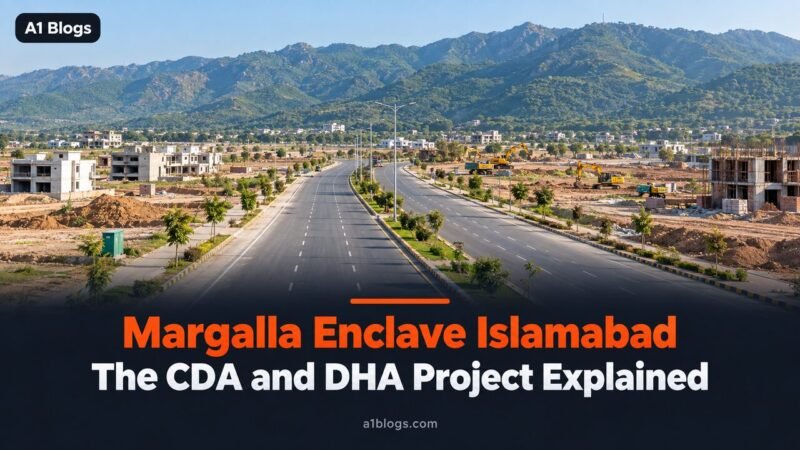
- CDA joint ventures such as Margalla Enclave, developed by the CDA and DHA together, have the land-owning authority as a partner. Read our guide to Margalla Enclave Islamabad for details.
- DHA Islamabad operates under its own act of parliament and does not need a CDA NOC for its own phases.
- Private schemes are only as safe as their CDA status and the developer’s record. Our comparison of Bahria Enclave, Park View City and DHA looks at three popular options.
A quick checklist to keep on your phone
Before you hand over a token payment, you should be able to answer yes to each of these:
- I know whether the land is under the CDA, the RDA or DHA.
- The exact scheme and phase appear on the CDA register with an issued NOC, or the project is a CDA sector, a CDA joint venture or a DHA phase.
- The scheme is not on the CDA list of illegal housing schemes, under any spelling.
- My plot number appears on the approved layout plan.
- I have seen the seller’s original allotment and transfer documents and checked their identity card.
- The society has confirmed in writing that there are no unpaid dues.
- A lawyer has reviewed the paperwork.
If any answer is no, wait. Good plots in CDA approved housing societies will still be there next week; money paid into an illegal scheme is very hard to recover.
If you have already bought in an unapproved scheme
Start by collecting every document and receipt. Check the scheme’s current status with the CDA, because some schemes regularise later and others lose approval. Speak to a property lawyer before paying further instalments, and contact other buyers, since group complaints and legal action are usually more effective than individual ones. Be careful of anyone who offers to “get it approved” for a fee.
Frequently asked questions
Where can I find the list of CDA approved housing societies?
On the CDA website, under Media Center and Housing Schemes. The page for private housing schemes shows each scheme’s layout plan and NOC status, and a separate page lists illegal schemes alphabetically. Dealer websites often copy these lists, but they can be out of date, so always check the CDA site itself.
Is a layout plan approval enough to buy safely?
No. The CDA says sponsors can start development and sell plots only after receiving the NOC. A scheme with an approved layout plan but no NOC has not completed the approval process.
Are societies with “Islamabad” in their name always in Islamabad?
No. Several large projects marketed as Islamabad schemes are in Rawalpindi district and are regulated by Punjab authorities, not the CDA. Check the jurisdiction first.
How often is the CDA list updated?
The CDA updates its lists when schemes are approved, cancelled or found to be illegal. Check them on the day you pay, not just when you start looking.
What else should I budget for?
Taxes and transfer charges add a meaningful amount to the price. Our guide to property tax in Islamabad explains the 2026-27 rates. An Urdu version of this checklist is available in our guide اسلام آباد میں پلاٹ خریدنے سے پہلے.