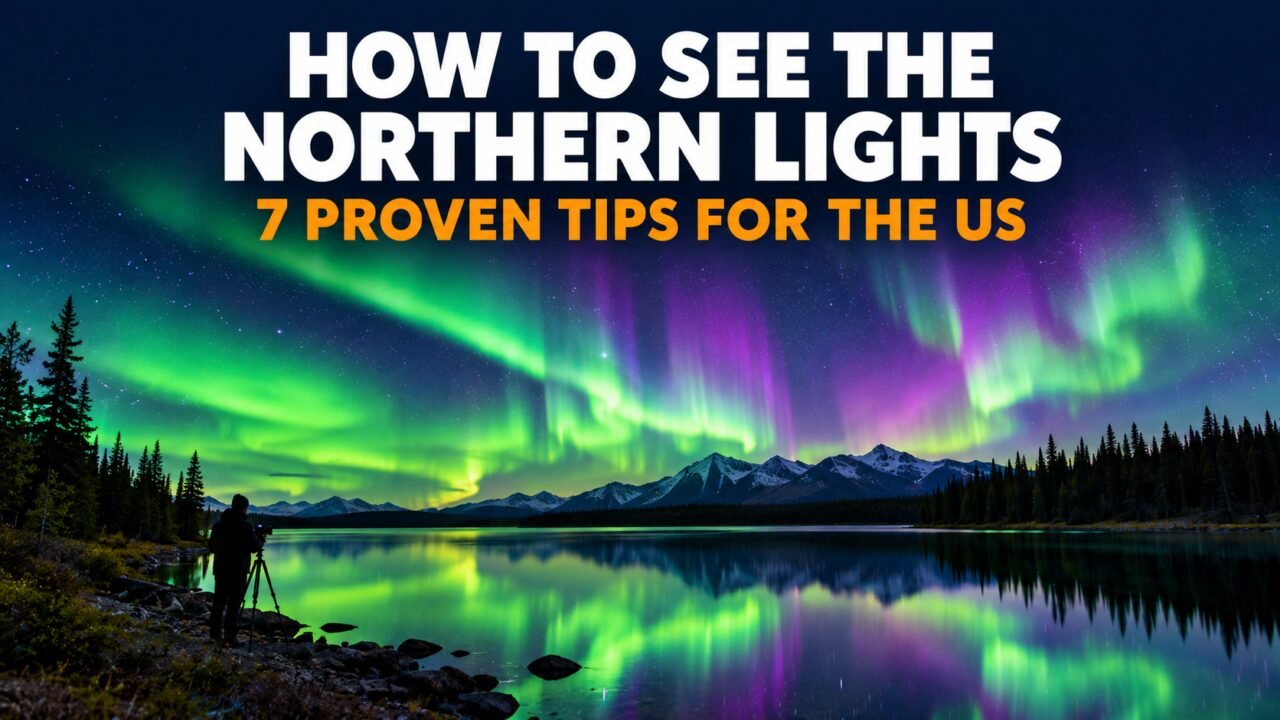
Learning how to see the northern lights used to mean planning an expensive trip to Alaska, Iceland or northern Norway. Over the past two years, that changed for millions of Americans. During strong solar storms in 2024, the aurora appeared over backyards and parking lots across much of the country, including places where almost nobody alive had seen it before.
The sun is still in a very active phase, and the fall months are among the best times of year for auroras. You do not need special equipment, but you do need good timing, a dark sky and a little patience. This guide explains what causes the lights, how to read an aurora forecast, the best places to go in the United States, and seven proven tips for seeing and photographing them.
Table of Contents
What causes the northern lights?
The northern lights, or aurora borealis, start at the sun. The sun constantly sends out a stream of charged particles called the solar wind, and sometimes it throws off huge clouds of charged gas called coronal mass ejections. When these reach Earth, our planet’s magnetic field funnels some of the particles toward the polar regions.
There, the particles collide with oxygen and nitrogen in the upper atmosphere and make them glow. The most common color, green, comes from oxygen at roughly 60 to 180 miles above the ground. Red comes from oxygen at even higher altitudes, and blue and purple tints come from nitrogen.
In the Southern Hemisphere, the same process produces the southern lights, or aurora australis. The two often happen at the same time, like mirror images at opposite ends of the planet.
Why the aurora has been visible so far south
The sun goes through a cycle of rising and falling activity that lasts about 11 years. At its peak, called solar maximum, the sun has more sunspots and produces more of the eruptions that trigger strong auroras. In October 2024, NASA and the National Oceanic and Atmospheric Administration announced that the sun had reached the solar maximum period of its current cycle.
That helps explain what happened on May 10 and 11, 2024, when the first extreme geomagnetic storm since 2003 lit up skies across the country. People reported seeing the aurora far into the southern states, and many saw it for the first time in their lives. Another severe storm in October 2024 produced similar scenes.
Solar maximum is not a single moment. Activity usually stays high for a year or two after the peak, and some of the strongest storms in past cycles have come during this declining phase. That means the next few years should still offer good chances, especially for people in the northern half of the country.
Understanding the aurora forecast
Aurora forecasts can look confusing at first, but they come down to a few numbers. The most common is the Kp index, a scale from 0 to 9 that measures how disturbed Earth’s magnetic field is. The higher the number, the farther south the aurora can be seen.
NOAA’s Space Weather Prediction Center also uses a storm scale from G1 (minor) to G5 (extreme). As a rough guide for the United States:
- Kp 4: aurora possible in Alaska and sometimes along the Canadian border
- Kp 5 (G1): visible in parts of the northern states, such as northern Minnesota, Michigan’s Upper Peninsula and Maine
- Kp 6 to 7 (G2 to G3): possible across much of the northern tier and sometimes into the Midwest and Northeast
- Kp 8 to 9 (G4 to G5): can reach deep into the southern states, as happened in May 2024
The Space Weather Prediction Center publishes a three-day forecast, a short-term aurora map that updates every few minutes, and alerts when a storm is underway. Free apps built on that data can send you a notification when conditions look good.
Best places to see the northern lights in the US
Alaska is in a class of its own. Fairbanks sits under the auroral oval, the ring around the magnetic pole where auroras are most common, and visitors between late August and April have a good chance of seeing them on clear nights, even during quiet periods.
In the lower 48 states, the best odds are along the northern border and in places with truly dark skies:
- Northern Minnesota, including Voyageurs National Park and the North Shore of Lake Superior
- Michigan’s Upper Peninsula, especially the Keweenaw Peninsula and Marquette area, plus Headlands International Dark Sky Park near Mackinaw City
- Northern Maine, including Aroostook County and Acadia National Park
- North Dakota and northern Montana, where Glacier National Park offers huge, dark skies
- Northern Wisconsin, Idaho and Washington, away from city lights
- Upstate New York’s Adirondacks and northern Vermont and New Hampshire
During strong storms, dark-sky parks farther south, such as Cherry Springs State Park in Pennsylvania, also report sightings. The key is less about latitude than about getting away from light pollution with a clear view of the northern horizon.
Why fall is a good time to look
Auroras can happen year-round, but the weeks around the spring and fall equinoxes tend to be more active. Scientists link this to the way Earth’s magnetic field lines up with the solar wind at those times of year, which makes it easier for solar particles to disturb the field.
Fall has practical advantages too. Nights are getting longer, so there are more hours of darkness. In most of the northern U.S., late September through early November also brings cool, crisp nights without the deep cold of midwinter. Mosquitoes and summer haze are gone.
The moon matters as well. A bright full moon can wash out faint auroras. In the rest of 2026, the darkest nights fall around the new moons of Oct. 10, Nov. 9 and Dec. 9. The full moons on Oct. 26 and Nov. 24 will make faint displays harder to see, though a strong storm can still shine through.
7 proven tips for amazing views
1. Watch the forecast, not the calendar
Auroras follow solar activity, which can change within hours. Check the Space Weather Prediction Center or a trusted aurora app every afternoon when you are planning to go out, and sign up for alerts. A geomagnetic storm watch issued a day or two ahead is your best signal.
2. Get away from lights
City lights and even a single nearby streetlight can hide a moderate aurora. Drive at least 30 minutes to an hour from a large town if you can, and look for parks, lakeshores or open farmland with a low northern horizon.
3. Look north, then look up
In most of the U.S., the aurora starts low on the northern horizon as a pale glow or arc. During stronger storms, it can spread overhead and even into the southern sky. Face north first, but keep looking around.
4. Go out between 10 p.m. and 2 a.m.
The most active period is often in the hours around local midnight. That said, storms can peak at any hour, so if an alert comes in during the early evening, go out right away.
5. Let your eyes adjust
It takes about 20 to 30 minutes for your eyes to adapt fully to the dark. Avoid looking at bright screens, and use a red light if you need to see your way around.
6. Use your phone camera
This is the biggest change of recent years. Modern phone cameras with night mode can pick up auroral colors that look faint or gray to the naked eye. Many people during the 2024 storms only realized what they were seeing after taking a photo. If you are unsure, point your phone north and take a picture.
7. Dress warmly and be patient
Auroras come and go in waves. A quiet glow can suddenly erupt into moving curtains for 10 or 20 minutes, then fade again. Bring warm layers, a chair or blanket and a hot drink, and plan to stay at least an hour once conditions look good.
How to photograph the northern lights
For phone photos, turn off the flash, turn on night mode and hold the phone as still as possible, or rest it against something solid. Many phones will take a three- to ten-second exposure automatically. A small phone tripod makes a big difference.
With a DSLR or mirrorless camera, use a sturdy tripod and a wide-angle lens. Set the focus manually to infinity, using a bright star to check. A good starting point is an ISO between 1600 and 3200, the widest aperture your lens allows and an exposure of five to 15 seconds. Use shorter exposures when the aurora is bright and moving fast, so the curtains do not blur.
Include something in the foreground, such as trees, a lake or a barn, to give the picture a sense of place. Reflections on still water can make a good aurora photo spectacular.
What the aurora actually looks like to the eye
Photos can set unrealistic expectations. To the naked eye, a moderate aurora often looks like a faint gray or pale green glow, sometimes mistaken for a thin cloud. The vivid pinks and reds in many photos come from the camera’s long exposure.
During strong storms, the view changes completely. Bright green curtains ripple and pulse across the sky, rays shoot upward, and red and purple colors become visible even without a camera. These displays are less common, but they are the ones people remember for the rest of their lives.
You may also see STEVE, short for Strong Thermal Emission Velocity Enhancement. It appears as a narrow purple or white ribbon, sometimes with green “picket fence” streaks below it. Citizen scientists helped identify and name it in 2016, and it often shows up during strong aurora displays.
Famous aurora storms in American history
The biggest solar storm on record is the Carrington Event of September 1859. Auroras were reported as far south as the Caribbean, and in parts of the United States the sky was so bright that people reportedly got up in the middle of the night thinking it was dawn. Telegraph systems, the high technology of the day, sparked and failed, and some operators found they could send messages even with their batteries disconnected.
In March 1989, a severe storm caused a blackout across the Canadian province of Quebec that left millions of people without power for hours. The northern lights that night were seen as far south as Texas and Florida.
The Halloween storms of 2003 were the last extreme event before 2024. They disrupted satellites, forced airlines to reroute flights over the poles and produced auroras across much of the United States. The May 2024 storm reached the same top level on NOAA’s scale, which is why so many people who had never seen the northern lights suddenly found them overhead.
Can space weather affect you?
The same solar activity that creates beautiful auroras can also cause problems for technology. Strong geomagnetic storms can disturb GPS signals, interfere with high-frequency radio used by aircraft and ships, and increase drag on satellites in low orbit. In February 2022, a relatively modest storm caused dozens of newly launched Starlink satellites to fall back into the atmosphere before they could reach their operating orbit.
During the May 2024 storm, some farmers reported that the precision GPS systems guiding their tractors stopped working properly in the middle of planting season. Power grid operators also watch storms closely, because intense geomagnetic activity can induce currents in long transmission lines and damage transformers.
For most people, the effects are minor or invisible. Grid operators and satellite companies receive alerts from the Space Weather Prediction Center and take precautions. But the same forecasts that warn engineers about risks are also the ones that tell skywatchers to head outside.
Safety tips for night sky watching
Aurora hunting usually means driving on dark rural roads late at night. Park only in safe, legal places, fully off the road, and avoid stopping on highway shoulders. Wear something reflective if you are walking near roads.
Tell someone where you are going, bring a charged phone and a flashlight, and check the weather. In northern states, fall nights can drop below freezing even when afternoons are mild. In remote areas, be aware of wildlife and stay on established paths.
Respect private property. Farm fields and lake shores may look empty at night, but they belong to someone. Public parks, beaches and designated dark-sky areas are the safest choices.
Planning a trip to Alaska for the aurora
If you want the best odds, Alaska is the place. Fairbanks and the areas north of it offer a strong chance of seeing the aurora on clear nights from late August to April. Many visitors plan three or four nights to improve their chances, since clouds can block the view for days at a time.
March and late September are popular, because the weather is milder than in midwinter and the equinox months tend to be active. Local lodges and tour operators offer aurora viewing cabins and wake-up calls when the lights appear, which means you do not have to stand outside all night.
When you are planning, check both the aurora forecast and the cloud forecast. A clear sky with modest activity usually beats a strong storm behind thick clouds.
How to see the northern lights: common questions
Can you see the northern lights in the US?
Yes. Alaska offers the most reliable views, and the northern states see auroras several times a year. During strong solar storms, the aurora can be visible across much of the country.
What Kp index do I need to see the aurora?
In the northern border states, a Kp of 5 or higher gives a good chance. Farther south, you usually need Kp 7 or above.
What time of night is best?
The hours around midnight, roughly 10 p.m. to 2 a.m., are often best, but strong storms can peak at any time after dark.
Why do my photos show more color than my eyes?
Cameras collect light over several seconds and are more sensitive to red and purple. Your eyes see faint auroras mostly in gray and pale green.
Is the sun still at solar maximum?
NASA and NOAA said the sun entered its solar maximum period in 2024. Activity typically stays elevated for a year or more afterward, so strong storms are still possible.
Can people in southern states see the northern lights with the naked eye?
During the strongest storms, yes. In May 2024, many people in southern states saw a pink or red glow with their own eyes, although the colors were often clearer in phone photos. During moderate storms, the aurora may only appear as a faint glow low on the northern horizon, or show up only on camera. The farther south you live, the more you depend on a major storm, a dark location and a clear view to the north. Watch for NOAA alerts of G3 storms or stronger.
Sign up for a space weather alert tonight, so the next strong storm does not catch you asleep. For more night sky guides, see our Orionid meteor shower guide and our science section.