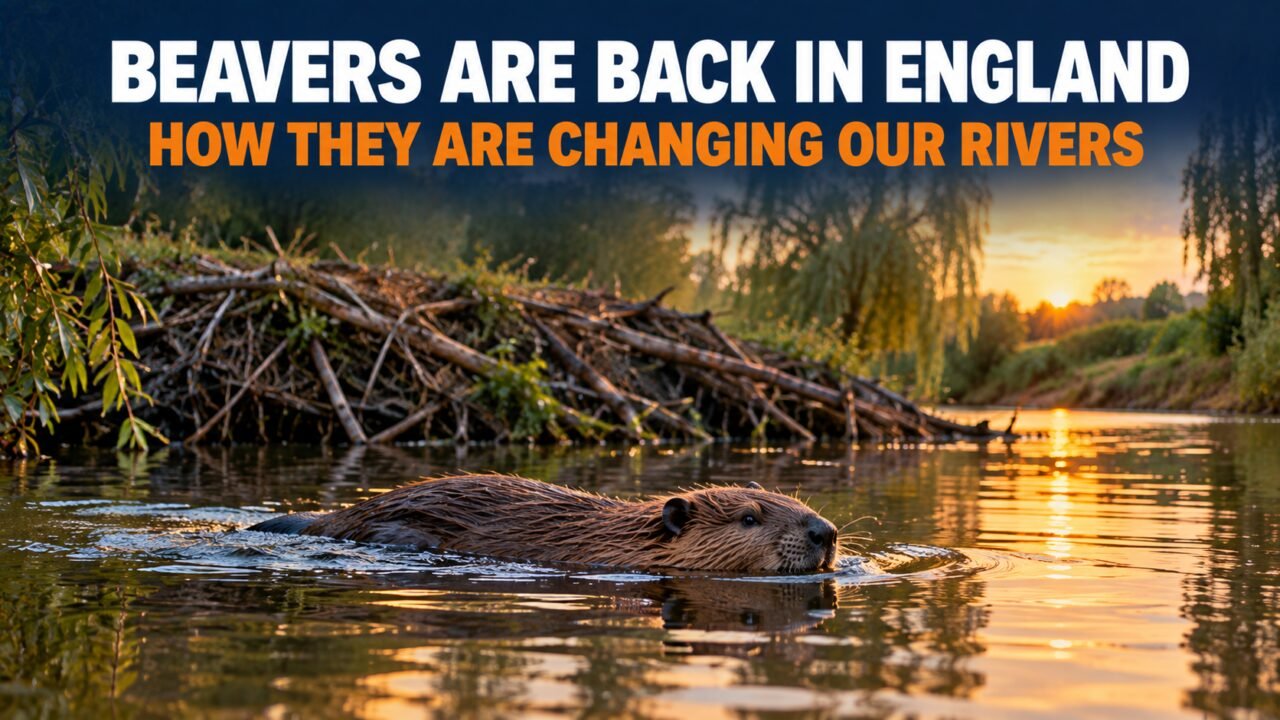
Beaver reintroduction in England has moved from a handful of experiments to official policy. Four hundred years after the animals were hunted out of Britain, the government now allows licensed releases of wild beavers into English rivers, and the first animals have already been set free. Scientists, farmers and conservationists are watching closely to see what happens next.
The beaver is sometimes called an ecosystem engineer, because few animals change the landscape around them as dramatically. Their dams slow rivers, create wetlands and change which plants and animals can thrive. That brings real benefits, and some real headaches for landowners. This guide explains how beavers came back, what the science says about their effects, and where you might see one.
Table of Contents
Why Britain lost its beavers
The Eurasian beaver once lived across much of Britain. Place names such as Beverley in Yorkshire are thought to come from the old word for the animal. By around the 16th century, beavers had been hunted to extinction here, prized for their thick fur, their meat and castoreum, a secretion from glands near the tail that was used in perfumes and medicines.
The same pressures pushed the Eurasian beaver close to extinction across Europe and Asia. By the early 20th century, only a few thousand survived in scattered populations. Legal protection and reintroduction programmes across the continent have since helped numbers recover to more than a million animals.
Britain was one of the last countries in Europe to bring them back.
How beavers returned to Scotland first
Scotland led the way. An official trial began at Knapdale in Argyll in 2009, where beavers from Norway were released under close scientific monitoring. At around the same time, a separate population appeared in Tayside, descended from animals that had escaped from captivity or been released without permission.
After years of debate, the Scottish Government decided that beavers could stay, and they became a legally protected species in Scotland in 2019. Since then, Scotland has moved to relocate beavers to new areas where they are welcome, rather than culling animals in places where they cause problems for farmers.
The Devon beaver trial that changed England’s mind
In England, the story began on the River Otter in east Devon. Around 2008, people noticed beavers living wild on the river, with no one sure where they had come from. The government initially planned to remove them, but after local campaigning, the animals were allowed to stay as part of the River Otter Beaver Trial, which ran from 2015 to 2020.
The trial, led by the Devon Wildlife Trust, studied the beavers’ effects on the river, local wildlife, flooding and farming. Its findings were largely positive, and in 2020 the government decided that the Devon beavers could remain permanently. It was the first time an extinct native mammal had been given legal permission to live wild in England.
Beavers became a protected species in England in 2022, which means they cannot be killed or disturbed without a licence.
Licensed wild releases begin
For several years after the Devon decision, beavers in England could only be released into large fenced enclosures, many run by conservation charities, farmers and landowners. In early 2025, the government confirmed that licensed releases into the wild would be allowed, subject to approval from Natural England, the government’s nature adviser.
Applicants must show that they have consulted local people, assessed the risks, and put a plan in place to manage any problems. In March 2025, the National Trust released beavers into the wild at Purbeck in Dorset, in what was widely reported as the first licensed wild beaver release in England.
More releases have been proposed in other parts of the country. Each one goes through the licensing process, which means beaver reintroduction is likely to be gradual rather than sudden.
5 amazing ways beavers change rivers
1. They slow floodwater
Beaver dams hold back water and spread it across the floodplain. During heavy rain, that can reduce the peak flow of water heading downstream. Research from the Devon trial found that beaver dams reduced peak flows during storms, which could lower flood risk for communities further down the valley.
Beavers are not a replacement for flood defences, but they can add to them, especially in smaller streams and upper catchments.
2. They store water in dry spells
The same ponds that hold back floods can act like sponges in dry weather. Water held behind dams and in surrounding wetland soil is released slowly, which can help keep streams flowing in summer droughts.
With climate change bringing both heavier rain and hotter, drier summers to Britain, that dual effect has made beavers increasingly interesting to water managers.
3. They clean up the water
As water slows behind dams, soil and silt settle out. Studies have found that beaver ponds can trap sediment and reduce levels of some pollutants, such as nitrogen and phosphorus washed off farmland. That can improve water quality downstream.
4. They create homes for other wildlife
Beaver ponds and wetlands support a wide range of other species. Insects, frogs, toads, newts, dragonflies, bats, water birds and otters often increase where beavers are active. The standing dead trees left behind by flooding become homes for woodpeckers and beetles.
Fish can also benefit from the deeper pools and cover that dams create, although some anglers worry about dams blocking migrating fish such as salmon and trout. The evidence suggests fish usually find a way past, especially during high water.
5. They reshape the landscape
Over time, beavers turn straight, fast-flowing channels into a patchwork of ponds, side channels and wet woodland. This is closer to what many British rivers looked like before centuries of drainage and straightening for farming.
For people who want to restore nature, beavers do a lot of the work for free. For people who farm the land next to rivers, the changes can be less welcome.
The problems beavers can cause
Beavers do not always choose sensible places to build. A dam can flood a field, back water up into a road drain or block a culvert under a lane. Beavers also fell trees, including ones people value, and sometimes burrow into riverbanks or flood defences.
Farmers worry about losing productive land to flooding and waterlogging. Some landowners feel that decisions about beaver reintroduction are being made by conservation groups and government without enough say for the people who live and work along rivers.
The Beaver Trust and other groups argue that most conflicts can be managed with simple techniques: protecting valuable trees with wire, installing pipes that lower the water level behind a dam, or moving a dam that causes trouble. Natural England’s approach allows licensed management, including removing dams and, as a last resort, relocating animals.
Beaver facts
The Eurasian beaver is Europe’s largest rodent. Adults can weigh up to around 30 kilograms and measure more than a metre long including the flat, scaly tail. Beavers are herbivores. They eat bark, twigs, leaves and water plants, and they do not eat fish.
Their front teeth are orange because the enamel contains iron, which makes it tougher. The teeth keep growing throughout their lives, so constant gnawing keeps them the right length.
Beavers live in family groups, usually a breeding pair and their young from the past year or two. Kits are born in spring and stay with their parents for up to two years before leaving to find their own territory. Families live in lodges built from sticks and mud, or in burrows dug into riverbanks, with underwater entrances for safety.
Where you can see beavers in Britain
Beavers are mostly active at dusk and during the night, which makes them hard to spot. Your best chance is a quiet evening by the water in an area where they are known to live, such as parts of the River Otter in Devon, Knapdale in Argyll or the rivers around Tayside.
Several wildlife trusts and farms run guided evening walks to see beavers in the wild or in enclosures. These are a good way to learn about their signs even if you do not see the animals themselves.
Look for gnawed tree stumps with pointed, pencil-like tips, piles of wood chips, dams across small streams, and paths where beavers slide into the water. If you do see one, stay still and quiet, and keep dogs on a lead.
What the US can teach Britain
The North American beaver is a close cousin of the Eurasian species and has recovered strongly across much of the United States and Canada. American scientists and land managers have been using beavers to restore rivers for years.
In the western US, some projects build simple structures called beaver dam analogues, which mimic natural dams to encourage beavers to settle and to hold water in drying streams. Researchers have also found that beaver-dammed areas can stay green and wet during wildfires, acting as natural refuges for plants and animals.
Those lessons are relevant in Britain, where summer droughts and even wildfires on moorland have become more common.
How a licensed wild release works
Releasing wild beavers in England is not as simple as opening a crate by a river. Anyone who wants to carry out a release must apply to Natural England for a licence and show that the plan is well thought through.
Applicants usually need to assess the whole river catchment, not just the release site, because beavers move along rivers and can travel many kilometres to find new territory. They must consult landowners, farmers, water companies, anglers and local communities, and set out how they will deal with problems such as flooded fields or blocked drains.
The animals themselves are also checked. Beavers for release usually come from existing British populations or approved sources, and they are health screened before release to reduce the risk of spreading disease. After release, projects are expected to monitor where the beavers go and what effect they have, and report back.
This careful approach is one reason beaver reintroduction in England has moved slowly compared with some other European countries.
Beavers and farming: finding a balance
Farmers are among the people most affected by beaver reintroduction, and their views are mixed. Some welcome beavers, particularly on land that is already wet or not very productive, and see opportunities in wildlife tourism or payments for nature recovery. Others fear losing valuable fields and having to spend time and money dealing with dams.
The most successful projects in Scotland and on the continent have tended to involve farmers early and give them quick access to practical help. That can mean a local beaver officer who visits within days, equipment to lower water levels behind a problem dam, or permission to remove a dam that threatens crops or property.
Many conservationists now talk about wetland buffer strips along rivers, where land is set aside for beavers and other wildlife, with landowners paid for the space. If that becomes common, conflicts could shrink considerably.
What beaver reintroduction costs
Compared with traditional engineering, beavers are cheap. A pair of beavers can build and maintain dams for years at no cost, whereas man-made flood storage schemes and wetland creation projects can run into millions of pounds.
That does not mean beaver reintroduction is free. Projects need money for planning, consultation, health checks, monitoring and management. Tree protection, water level devices and staff time to help landowners all cost money, and someone has to pay for them.
For now, much of the funding comes from conservation charities, grants and landowners themselves. As the number of wild beavers grows, pressure is likely to build for longer-term public funding to support the people who live alongside them.
How you can support wild beavers
If you live near a river with beavers, or plan to visit one, a few simple steps help:
- Report sightings and signs to your local wildlife trust, which helps scientists track populations
- Keep dogs on a lead near rivers where beavers live, especially in spring when kits are young
- Never feed beavers or try to approach a lodge
- Respect any signs or closures around release sites
- Volunteer with local projects, which often need help with surveys and tree protection
The more people understand wild beavers, the easier it becomes to find solutions when they cause problems.
What happens next for beaver reintroduction
Beaver reintroduction in England will be closely watched over the coming years. Scientists will measure the effects on flooding, water quality and wildlife in areas where wild beavers have been released. Farmers’ groups will be watching for problems and for how quickly they can get help when things go wrong.
Funding is likely to play a big role. Landowners who host beavers may need support to manage conflicts, and some argue they should be paid for the flood and water benefits their land provides to communities downstream.
What seems clear is that beavers are back for good. The question now is how Britain learns to live with them.
Lessons from wild beavers in Europe
Britain is learning from countries that brought beavers back decades ago. In Bavaria in southern Germany, where wild beavers have lived again for many years, a network of trained advisers and volunteers helps landowners deal with problems, from protecting trees to managing beaver dams that flood farmland. Farmers can call on help quickly, which reduces conflict.
The Netherlands, Poland and other countries also have large populations of wild beavers living close to towns and farmland. Their experience suggests that most problems are local and manageable, and that beaver dams bring the biggest benefits in small streams and wetlands rather than large rivers. It also shows that public support tends to grow once people see the wildlife and water benefits for themselves.
Beaver reintroduction: common questions
Are beavers native to Britain?
Yes. The Eurasian beaver lived in Britain for thousands of years before being hunted to extinction around the 16th century.
Are wild beavers protected in England?
Yes. Beavers have been a protected species in England since 2022.
Do beavers eat fish?
No. Beavers are herbivores and eat bark, leaves, twigs and water plants.
Can beavers help with flooding?
Research suggests beaver dams can reduce peak flows during storms and hold water back, which may lower flood risk downstream in some areas.
Where was the first wild beaver release in England?
The National Trust released beavers into the wild at Purbeck in Dorset in March 2025, reported as the first licensed wild release in England.
If you want to see a beaver, plan a quiet evening walk along a river where they are known to live, and look for gnawed stumps before you look for the animal. For more science and nature stories, see our science section and our opinion piece on urban trees.