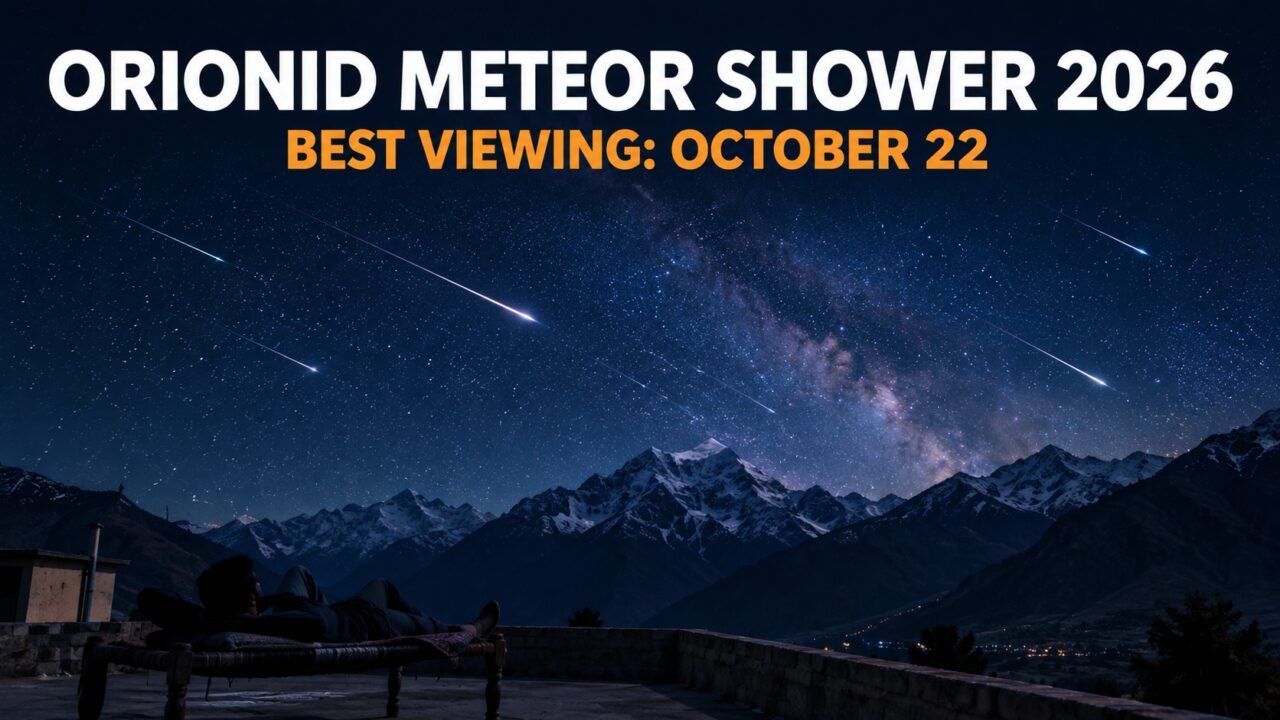
The Orionid meteor shower 2026 peaks in the early hours of October 22, and it is one of the few sky events that asks nothing of you except a dark place, a warm shawl and some patience. You do not need a telescope or binoculars. You need to get away from city lights, lie back, and look up.
The meteors you will see are tiny pieces of Halley’s comet, the most famous comet in history, hitting our atmosphere at around 66 kilometres per second. Each one burns up in a fraction of a second. Some leave glowing trails that hang in the sky for a moment after the streak itself is gone.
This guide covers when to watch, what the moon will do this year, how many meteors to expect, and how to get a decent photo with a camera or even a phone.
Table of Contents
When is the Orionid meteor shower 2026?
The Orionids are active for about five weeks each year, roughly from the first days of October to early November, according to the International Meteor Organization. For most of that time you will only catch the odd meteor. The rates build slowly through mid-October and reach their peak around October 21 and 22.
For 2026, the best night is expected to be the night of Wednesday, October 21, running into the pre-dawn hours of Thursday, October 22. The shower has a fairly broad peak, so the nights on either side are also worth your time, especially if clouds or plans get in the way.
If you can only go out once, choose the early morning of October 22. If you are keen, try the mornings of October 20 to 23.
What the moon means for this year’s show
Moonlight is the biggest enemy of meteor watching. A bright moon washes out all but the brightest meteors, and in some years the Orionids are almost ruined by a full moon sitting in the middle of the sky.
In 2026, the new moon falls on October 10 and the full moon on October 26. On the night of the peak, the moon will be a bright waxing gibbous, a little more than three quarters lit. That sounds bad, but the timing helps. A waxing gibbous moon is high in the evening and sets in the early hours of the morning, while the Orionids are at their best in the hours before dawn.
For most of Pakistan, the moon should set somewhere around 2 a.m. on the peak night. From then until the sky starts to brighten, roughly between 5 and 5:30 a.m., you get a moon-free window of two to three hours. A moonrise and moonset app for your own city will give you the exact times.
Where the Orionids come from: Halley’s comet
Every meteor shower comes from a comet or, less often, an asteroid. As a comet travels around the Sun, it sheds dust and small pieces of rock that spread out along its orbit. When Earth passes through that trail of debris, the particles hit our atmosphere and burn up as meteors.
The Orionids come from Comet 1P/Halley, the comet that returns to the inner solar system roughly every 76 years. It was last seen from Earth in 1986 and is due back in 2061. Most of us will never see the comet itself, but we pass through its dust twice a year: in May, when it produces the Eta Aquariids, and in October, when it produces the Orionids.
The particles are small, most no larger than a grain of sand. What makes them visible is speed. Orionid meteors are among the fastest of any annual shower, hitting the upper atmosphere at about 66 kilometres per second, or more than 230,000 kilometres per hour. At that speed, even a speck of dust heats the air around it until it glows, around 100 kilometres above the ground.
NASA’s page on the Orionids has more on the science, including why some Orionid meteors leave trains that glow for a second or two after the meteor has gone.
How many meteors can you expect to see?
Astronomers describe meteor showers using the zenithal hourly rate, or ZHR. For the Orionids, the ZHR is usually around 20. That number assumes a perfectly dark sky with the radiant directly overhead, which almost never happens in real life.
In practice, from a reasonably dark rural site, you might see 10 to 15 Orionids an hour during the best part of the morning. From the edge of a city, expect a handful. Meteors also arrive in clumps: you might wait ten minutes and see nothing, then catch three in a minute.
The Orionids have had surprise years. Between 2006 and 2009, rates were well above normal, with observers reporting 50 to 70 an hour at times. Nobody can promise a repeat, but it is one more reason to go out.
You will also see a few meteors that do not belong to the shower. These are called sporadic meteors. You can tell an Orionid apart by tracing its path backwards: if it points back toward the constellation Orion, it is part of the shower.
The best time to watch from Pakistan
The point in the sky where the Orionids seem to come from is called the radiant. It sits near the top of Orion, close to the bright orange star Betelgeuse. From Pakistan, Orion rises in the east around 10 to 11 p.m. in late October and climbs higher through the night. It is highest in the south just before dawn.
The higher the radiant, the more meteors you see, which is why the best time to watch the Orionid meteor shower is always after midnight. This year, with the moon setting around 2 a.m., the sweet spot is the stretch between moonset and the first light of dawn.
A simple plan for the peak night looks like this:
- Sleep early on the evening of October 21
- Set an alarm for about 1:30 a.m.
- Be at your viewing spot and settled by 2 a.m.
- Watch until the sky begins to brighten, around 5 a.m.
You do not have to look directly at Orion. Meteors can appear anywhere in the sky. Many people find it best to face east or south and look about halfway up, so the radiant is in view but not in the centre.
Finding a dark sky near you
Light pollution matters more than anything else you can control. From central Lahore or Karachi, only the brightest meteors will cut through the glow. From a dark village an hour outside the city, the same shower can look completely different.
If you live in Islamabad or Rawalpindi, even a drive out along the GT Road toward the Salt Range, or up into the hills away from the main towns, will give you a noticeably darker sky. People in Lahore can head well outside the city toward rural Punjab. In Sindh, the desert areas of Tharparkar have some of the darkest skies in the country, and in the north, places like Deosai and the valleys around Skardu are famous among astrophotographers.
Wherever you go, safety comes first. Go with family or friends, tell someone where you are going, park only in safe and legal spots, and avoid isolated places you do not know. A rooftop in a small town with no streetlights nearby is often good enough, and much easier than a long drive.
What to bring
Meteor watching is mostly sitting still in the dark, and late October nights can feel cold, especially outside the cities and in the hills. Pack for comfort:
- A reclining chair, a charpai or a thick mat, so you can lie back without straining your neck
- A warm jacket, shawl or blanket, even if the afternoon was hot
- A flask of tea and some snacks
- Mosquito repellent, because it is still dengue season in much of Pakistan
- A torch with a red filter, or red cellophane taped over a normal torch
- A fully charged phone, kept in your pocket as much as possible
The repellent is not a joke. Late October is still peak dengue season in Punjab and Islamabad. Our guide to dengue symptoms and prevention explains how to protect yourself.
How to watch: a simple routine for the night
When you arrive, switch off every light you can and let your eyes adjust. It takes 20 to 30 minutes for your night vision to reach its best. A single glance at a bright phone screen resets much of that progress, which is why a red light is better for finding your way around.
Lie back and take in as much of the sky as possible. Try not to stare at one spot. Relax your gaze and let your eyes wander. Meteors often catch the corner of your vision before you look straight at them.
Give it time. People often give up after 15 minutes because they have seen only one meteor. If you stay out for an hour or two in the moon-free window, you will almost certainly see several, and there is a chance of a bright fireball that lights up the ground for a moment.
If you are watching with others, make it a game: whoever spots a meteor calls out the direction. It keeps everyone awake and looking.
Photographing the Orionids with a camera or phone
Catching a meteor on camera takes luck and patience, but the method is simple.
With a DSLR or mirrorless camera, use a sturdy tripod and the widest lens you have. Set the focus manually to infinity, using a bright star to check it. Start with an ISO between 1600 and 3200, the lens wide open, and exposures of 15 to 25 seconds. Then set the camera to take photos continuously, using an intervalometer or the camera’s built-in interval timer, and point it about 45 degrees away from Orion rather than straight at it. Meteors look longer and more striking a little away from the radiant.
Let the camera run for an hour or more. Most frames will show only stars, and that is normal. Photographers often shoot hundreds of frames to catch a few meteors.
Modern phones can also try. Use night mode on a tripod or propped against something solid, and turn off the flash. Some phones have astrophotography modes that take long exposures automatically. You are more likely to get a lovely photo of the stars than a meteor, but every now and then a bright one lands in the frame.
Watching with children
A meteor shower is one of the best ways to get children interested in space, and the Orionids come with a good story. Telling a child that they are watching dust from Halley’s comet, and that the comet will be back in 2061 when they are grown up, tends to stick.
The early morning timing is harder with children. For them, it may be better to go out in the evening of October 21 for an hour after dark, even though rates are lower and the moon is up. Seeing one or two meteors can be enough to start a lifelong interest. Keep it short, keep them warm, and bring snacks.
Other meteor showers to plan for this year
If clouds spoil the Orionids, the rest of 2026 offers two more chances. The Leonids peak around November 17 and 18, with the moon near first quarter and setting around midnight, leaving the pre-dawn hours dark. They are usually modest, with a ZHR of about 15.
The best show of the year comes in December. The Geminids peak around December 13 and 14, and in 2026 the new moon falls on December 9, so the moon will be a thin crescent that sets early in the evening. Under dark skies, the Geminids can produce more than 100 meteors an hour at their peak, and they are active in the evening as well as the early morning, which makes them the easiest shower of the year for families.
Why meteor showers return on the same dates every year
People are often surprised that the Orionids arrive in late October every single year, as reliably as a festival on the calendar. The reason is that the shower is tied to a place in space, not to a date.
Halley’s comet has left its dust spread along its orbit like litter along a road. Earth’s own orbit crosses that road at the same point every year. Because Earth reaches that point at the same time each year, we meet the dust at the same time too. The exact day can shift by a day or so because of leap years and the way the calendar lines up with the orbit, but the shower never wanders far.
The dust itself does change. Streams of particles released on different passes of the comet drift apart over centuries, pulled slightly by the gravity of Jupiter and the other planets. Some years, Earth runs through a denser strand of old debris, which is why the Orionids produced unusually high rates in the late 2000s. Other years, we pass through thinner parts of the stream and the shower is quieter.
The same logic explains why the radiant sits in Orion. All the particles in the stream are travelling in roughly parallel paths. When they hit the atmosphere, perspective makes those parallel paths appear to spread out from a single point, the same way railway tracks seem to meet in the distance. That point happens to lie in front of the constellation Orion, so the shower takes its name.
Knowing this makes a night of watching feel different. Each streak you see is a particle that may have left the comet hundreds or even thousands of years ago and spent all that time circling the Sun, until it met Earth on this particular morning.
It also means you can plan years ahead. Every Orionid meteor shower will peak around October 21, and all that changes is the moon, the weather and how dense the dust happens to be that year.
Orionids FAQ
What time is best to see the Orionid meteor shower in 2026?
After moonset, roughly from 2 a.m. until dawn on October 22. The nights of October 20 to 23 are also good.
Do I need a telescope to see the Orionids?
No. Telescopes and binoculars show too small a patch of sky. Your eyes are the best tool.
Which direction should I look?
Meteors appear all over the sky. Face east or south, look about halfway up, and take in as wide a view as you can.
Can I see the Orionids from a city?
You may see a few of the brightest ones, but a dark rural sky will show you many more.
Are the Orionids dangerous?
No. The particles are tiny and burn up about 100 kilometres above the ground.
When will Halley’s comet return?
Halley’s comet is expected back in the inner solar system in 2061.
Mark the morning of October 22 on your calendar now, and check the weather the day before. For more science stories, see our latest coverage or join the A1 Blogs newsletter.