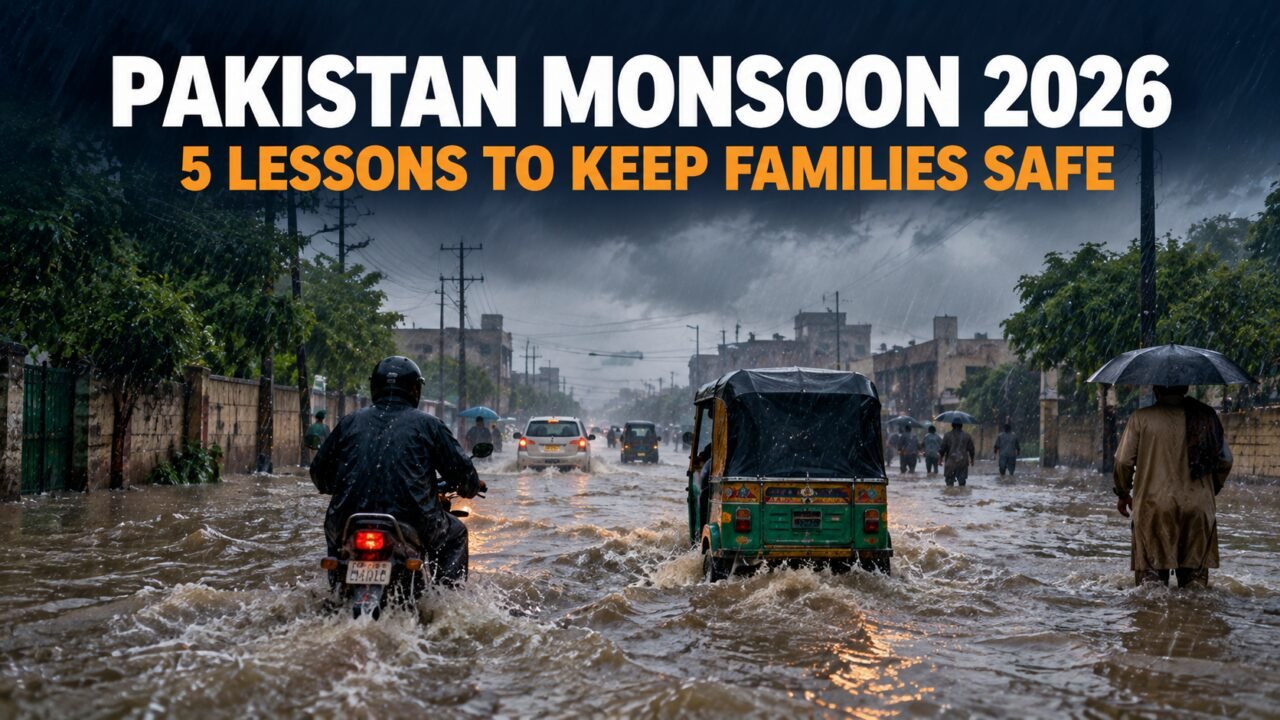
The Pakistan monsoon 2026 season is winding down, and the damage it leaves behind follows a pattern the country knows too well. Since the rains began on June 26, houses have collapsed, streets have turned into rivers, and families in Khyber Pakhtunkhwa, Punjab and Gilgit-Baltistan have buried relatives. This year was not as catastrophic as 2022 or 2025, but the way people died, and where, says a lot about what still needs fixing.
This report brings together the official figures from the National Disaster Management Authority (NDMA), explains where the rains hit hardest, and sets out five lessons that officials, city planners and ordinary households can act on before the next monsoon arrives.
Table of Contents
Pakistan monsoon 2026 in numbers
The NDMA counts monsoon casualties from June 26. By July 27, Al Jazeera reported, citing the authority, that heavy rains and floods had killed at least 107 people and injured 344. More than half of those deaths were caused by houses or roofs collapsing.
The toll kept rising through a very wet end of July. By July 31, Arab News reported that 122 people had died, with Khyber Pakhtunkhwa worst affected at 55 deaths, followed by Punjab with 46, Azad Jammu and Kashmir with 10, Balochistan with 8, Sindh with 2 and Gilgit-Baltistan with 1. Two days later, the NDMA’s count reached 126.
The rains did not stop in August. By early September, NDMA figures cited in local reports put the season’s toll at 180 deaths and 509 injuries, with more than 1,700 houses damaged and nearly 1,500 livestock lost.
Behind each number is a household. Many of those killed were children and elderly people asleep at home when a wall or roof gave way. Others were electrocuted in flooded streets or swept away while trying to cross a swollen stream.
Where the rains hit hardest
Khyber Pakhtunkhwa recorded the highest number of deaths for most of the season. Its mountain valleys are prone to flash floods, where a stream that looks harmless in the morning can become a torrent within an hour after a cloudburst upstream.
Punjab had the most injuries and some of the worst urban flooding. In late July, a Punjab irrigation official described the situation as “very alarming” as roughly 400 square kilometres of Lahore and Gujranwala districts went under water, and authorities in Lahore set up at least 17 relief camps for families forced out of their homes. The NDMA also warned of urban flooding in Rawalpindi, Gujranwala, Sialkot, Jhelum, Faisalabad and other Punjab cities as a strong wet spell moved in at the start of August.
In Gilgit-Baltistan, the death count stayed low but the damage to property was heavy, with hundreds of houses damaged and large numbers of livestock lost. For families in high valleys, a dead cow or a destroyed store of grain can wipe out a year’s savings.
Sindh and Balochistan were spared the worst this year, although the NDMA issued repeated warnings for hill torrents in Dera Ghazi Khan and northern Balochistan, and for urban flooding in Hyderabad and other Sindh towns.
Why so many monsoon deaths happen at home
When people outside Pakistan think of floods, they picture rivers bursting their banks. Those floods do happen, and they cause enormous damage. But in a season like this one, most monsoon deaths happen much closer to home.
The NDMA’s situation reports list the same causes again and again: house collapses, electrocution, flash floods and drowning. Roof and wall collapses are at the top of the list. Many homes in rural Punjab and Khyber Pakhtunkhwa, and in older parts of cities, are built with mud, unfired brick or weak mortar. Days of rain soak the walls and the heavy roofs above them until something gives.
Electrocution is the second silent killer. Loose wires, open junction boxes and poorly earthed electricity poles become deadly when streets flood. Every monsoon brings reports of people, often young men and children, killed by current running through water in the street.
These are not the deaths that make international headlines, but they are the ones that ordinary households and local governments can do most to prevent.
How this season compares with 2022 and 2025
Pakistan’s recent history sets a grim benchmark. In 2022, record monsoon rains and glacial melt caused floods that killed more than 1,700 people and affected over 33 million, with a third of the country under water at the peak. In 2025, Al Jazeera noted, floods killed 1,037 people and displaced two million.
Set against those years, the 2026 monsoon has been less deadly. That should be treated with caution rather than relief. Before the season began, the NDMA forecast rainfall 22 to 26 percent above the previous year, and the country’s exposure has not changed. Pakistan ranks 18th of 191 countries on the INFORM Risk Index for disasters, while producing less than 1 percent of global greenhouse gas emissions.
A quieter year mostly means the heaviest rain fell in the right places. It does not mean the country is safer.
Lesson 1: Weak houses kill more people than rivers
The single largest cause of monsoon deaths this year was the collapse of homes. That makes housing safety the most direct way to save lives.
Much can be done without rebuilding whole villages. Local governments and NGOs can run pre-monsoon inspections of the weakest houses, especially those with visible cracks, sagging roofs or walls damaged in earlier years. Cheap measures, such as waterproofing roofs, clearing drainage from around the foundations and reinforcing roof beams, reduce the risk of collapse.
For families, the advice is simple: if a wall or roof has cracked or started to lean, do not sleep under it during heavy rain. Move to the strongest room, or to a relative’s house, until the rain stops and someone has checked the structure.
Lesson 2: Cities need drains, not just pumps
Urban flooding in Lahore, Rawalpindi and other Punjab cities has become a yearly event. Low-lying neighbourhoods fill with water after a few hours of heavy rain, traffic stops, and water enters homes and shops.
Part of the problem is the drains themselves. Storm drains and nullahs fill up with plastic bags, construction waste and household rubbish during the dry months, and are not cleaned in time. Encroachments narrow the channels. In Rawalpindi, the Nullah Leh has flooded neighbourhoods along its banks in several recent seasons.
Pumping stations and emergency teams help, and they have improved in recent years. But pumps treat the symptom. Keeping drains clear year-round, enforcing rules against building on drainage channels, and adding green spaces that absorb rainwater would reduce the problem at its source. Residents can help too, by not dumping rubbish into drains and by reporting blocked ones before the season begins.
Lesson 3: Warnings only work if people get them and trust them
The NDMA and the Pakistan Meteorological Department issued detailed warnings throughout this season, naming districts at risk of urban flooding, hill torrents and landslides days in advance. The NDMA’s website publishes situation reports and advisories, and alerts are also sent by SMS in many areas.
The gap is at the last mile. A warning in Urdu or English on a website does not reach a shepherd in a high valley or an elderly couple in a village without a smartphone. Warnings also lose force if they are issued so often that people start to ignore them.
Local mosques, union council offices, schools and WhatsApp groups can carry warnings to people who never visit a government website. Clear, specific messages work best: which area, what time, and exactly what to do.
Lesson 4: Electrocution is preventable
Many electrocution deaths during the monsoon involve faults that can be spotted in advance: hanging wires, damaged poles, open meters and illegal connections. Power distribution companies can inspect and fix the worst of these before the rains, particularly in markets and crowded neighbourhoods.
Households can reduce their own risk. Switch off the main power supply if water enters the house. Do not touch electrical poles, wires or metal gates in flooded streets. Keep children away from standing water near electrical equipment. If a wire has fallen, report it to the power company and keep people away until it is repaired.
Lesson 5: Monsoon risk belongs in every budget
The floods of 2022 and 2025 showed how quickly a disaster can wipe out years of development spending. Roads, bridges, schools and clinics built without accounting for flood risk end up being rebuilt again and again.
For governments, that means treating monsoon preparation as a regular budget item rather than an emergency expense: drain cleaning, embankment repair, early warning systems and safer building rules for flood-prone areas. For families and small businesses, it means keeping some savings aside for the season, storing important documents in waterproof bags, and knowing where to go if the house becomes unsafe.
Why flash floods are getting harder to predict
Forecasters can now see a strong wet spell coming several days ahead, and the warnings issued this summer named the right regions again and again. What remains hard is predicting exactly where a cloudburst will dump its water, and how fast a small mountain stream will rise as a result.
Part of the reason is physics. Warmer air can hold more water vapour, roughly 7 percent more for every degree Celsius of warming. When that air is pushed up against the mountains of Khyber Pakhtunkhwa, Azad Kashmir and Gilgit-Baltistan, it can release extreme amounts of rain over a very small area in a short time. A valley can be flooded while the next valley stays dry.
The north also faces a second risk from its glaciers. According to the UNDP, Pakistan has more than 3,000 glacial lakes, and a number of them are considered at risk of bursting suddenly. When one does, a wall of water, mud and rock can travel down a valley with little warning, destroying bridges, roads and houses in its path.
Early warning systems in some of these valleys, including river gauges and sirens installed with international support, have already saved lives. Extending them to more valleys, and keeping them maintained after the funding cycle ends, is one of the most cost-effective investments the country can make.
Farmers and livestock: the losses that last longest
Death and injury figures capture the immediate cost of a flood, but for many rural families the longer damage is economic. The season this year killed nearly 1,500 animals, according to the figures cited in local reports, and for a smallholder family a buffalo or a few goats can be their main savings.
Flooded fields bring their own losses. Standing water can rot crops before harvest, and silt and debris left behind can delay the next planting. Families who lose a crop often borrow to buy seed and fertiliser for the next one, and that debt can follow them for years.
Support that reaches farmers quickly, such as livestock replacement, seed distribution and short-term cash help, makes a large difference to how fast a village recovers. So does crop and livestock insurance, which remains rare among small farmers in Pakistan.
What families can do before next year’s monsoon
Most of these steps cost little and can be done in the dry months, when there is time to do them properly:
- Check roofs and walls for cracks, leaks and sagging, and repair them before June
- Clear the drains, gutters and roof outlets around your house
- Raise electrical sockets and the main switchboard if your area floods regularly
- Keep ID cards, property papers and school certificates in a waterproof bag
- Save emergency numbers, including Rescue 1122, in every family member’s phone
- Agree on a meeting place in case the family is separated
- Keep a small stock of drinking water, dry food, medicines and a torch with spare batteries
- Plan a safe route out of the neighbourhood if water rises quickly
After the water goes down: dengue and health risks
The end of the monsoon brings its own dangers. Standing water left in pots, tyres, coolers and blocked drains becomes a breeding ground for the Aedes mosquito, which spreads dengue. In Punjab and Islamabad, dengue cases usually rise in September and peak in October and November. Our guide to dengue symptoms and warning signs explains what to look out for and how to stop mosquitoes breeding at home.
Floodwater also carries sewage and waste. Diarrhoea, typhoid, skin infections and eye infections become more common after floods. Drink boiled or treated water, wash hands often, and see a doctor if a child develops diarrhoea with signs of dehydration.
Clean-up is safer in daylight and with the power switched off. Wear shoes and gloves when clearing mud and debris, and throw away food that has been in contact with floodwater.
How to help flood-affected families
If you want to help, give through organisations with a track record and a clear presence on the ground. Established charities, provincial relief funds and the relief arms of well-known welfare organisations are usually the safest route. Cash donations are often more useful than goods, because they let aid workers buy what families actually need, close to where they live.
Be careful with appeals that arrive through forwarded WhatsApp messages or new social media pages. Scammers follow every disaster. Before sending money, check that the organisation is registered, look at its past work, and use official bank accounts or payment channels listed on its own website rather than personal account numbers shared in a message.
Volunteering can help too, but coordinate with an organisation first. Unplanned visits to flood-hit areas can block roads that rescue teams need.
Pakistan monsoon 2026: common questions
How many people died in the 2026 monsoon in Pakistan?
The NDMA reported 126 deaths by early August. Figures cited in local reports put the toll at 180 deaths and 509 injuries by early September. Final numbers will be confirmed when the NDMA closes its season report.
Which province was worst affected?
Khyber Pakhtunkhwa recorded the highest number of deaths for most of the season. Punjab had the most injuries and severe urban flooding in Lahore, Gujranwala and other cities.
What was the main cause of monsoon deaths?
House and roof collapses caused more than half of the deaths reported by late July. Electrocution, flash floods and drowning were the other main causes.
When does the monsoon end in Pakistan?
The monsoon usually withdraws from Pakistan in late September, although heavy rain can continue into early October in some years.
Where can I find official flood warnings?
The NDMA and the Pakistan Meteorological Department publish warnings and situation reports on their websites, and provincial disaster management authorities issue local alerts.
How does 2026 compare with the 2022 floods?
The 2022 floods killed more than 1,700 people and affected over 33 million. The 2026 monsoon has been far less deadly, but the causes of death, especially collapsing homes, have been similar.
The next monsoon will arrive in about nine months. For ongoing coverage from A1 Blogs, follow our latest news, and read our report on the race for the next UN Secretary-General, whose office leads the UN’s appeals after disasters like these.