Lists of free backlinks are some of the most shared posts in blogging: profile pages, bookmarking sites, directories and forums, each promising a “do-follow” link in five minutes. Some of those links exist. Very few of them help a site rank, and some can count against it.
This guide explains which links Google treats as spam, the difference between do-follow and nofollow, and twelve free ways to earn backlinks that help.
Table of Contents
What makes a backlink worth having
A useful backlink comes from a real site with real readers, on a related topic, where someone chose to link to you because your page helps their readers. A link inside an article on a relevant site is worth far more than hundreds of links on profile pages nobody visits.
What Google’s spam policies say about links
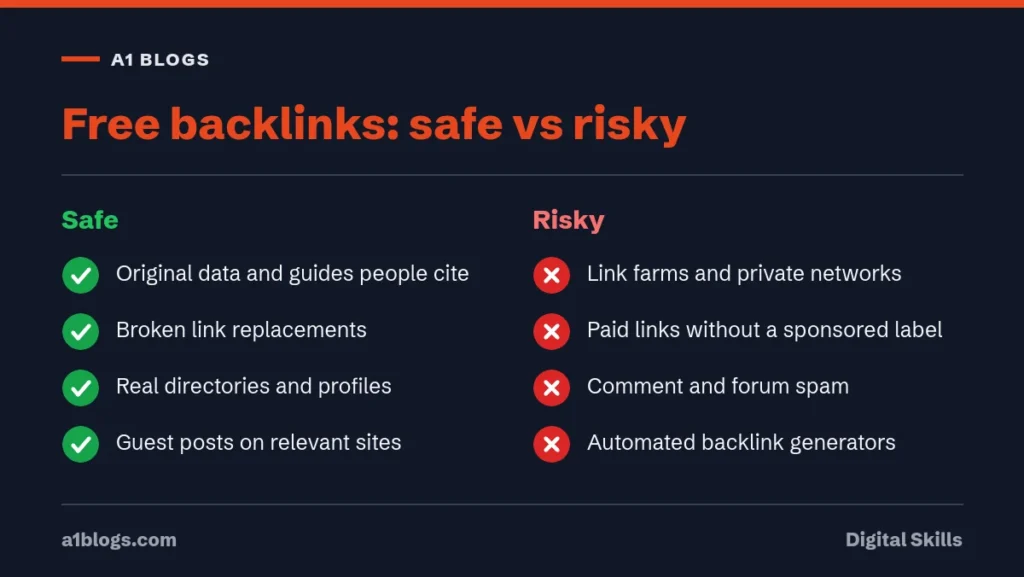
Google’s spam policies list examples of link spam, including (Google Search spam policies):
- Buying or selling links for ranking purposes
- Excessive link exchanges (“link to me and I’ll link to you”)
- Using automated programs or services to create links to your site
- Low-quality directory or bookmark site links
- Forum comments with optimized links in the post or signature
Many “free do-follow backlink” lists are made of exactly these. At best Google ignores them; at worst they put your site at risk.
Do-follow vs nofollow links
Sites can mark links with rel=”nofollow”, rel=”ugc” (user-generated content) or rel=”sponsored” (paid). Google explains these attributes in its documentation on qualifying outbound links. A nofollow link from a busy site can still send visitors, which is often worth more than a do-follow link on a page nobody reads. Paid links should always carry rel=”sponsored”.
12 free ways to earn backlinks
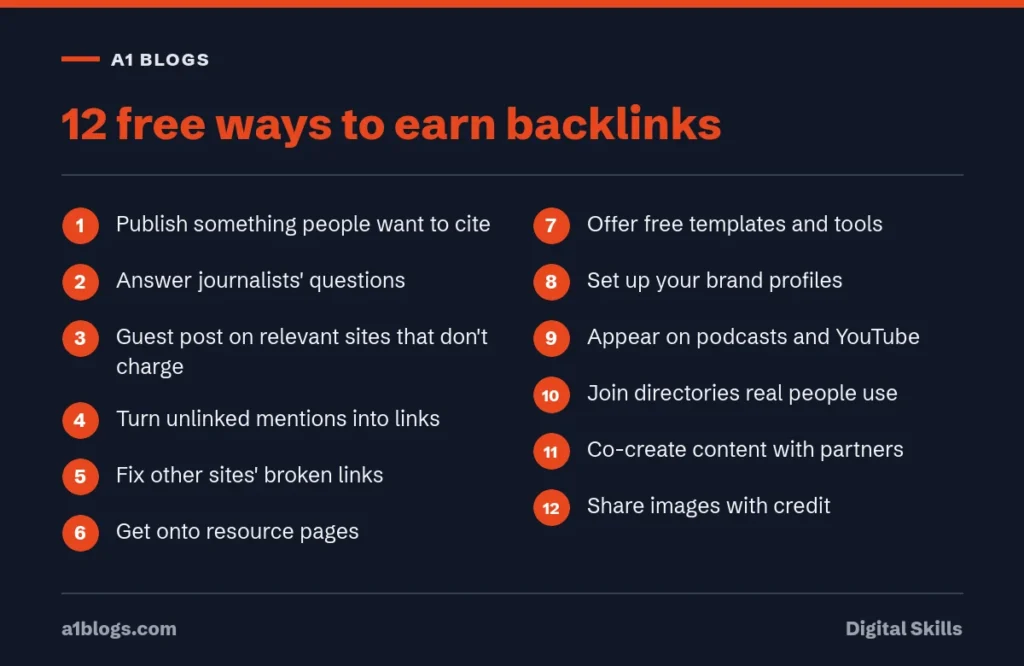
1. Publish something people want to cite
Original data, a calculator or a ranked list with sources gives other writers a reason to link. Our electricity bill calculator and our list of the richest people in Pakistan are the kind of pages others reference.
2. Answer journalists’ questions
Free services such as Source of Sources, and free tiers of Qwoted and Featured, send journalists’ requests for expert comment. A useful answer can earn a mention and a link from a news site.
3. Write guest posts for relevant sites that don’t charge
Pitch an original article to a site in your field that publishes contributors on merit. If a site asks for payment to publish your link, that is a paid link and needs rel=”sponsored”.
4. Turn unlinked mentions into links
Search for your brand or name in quotes. When a site mentions you without linking, send a short, polite email asking them to add the link.
5. Fix other sites’ broken links
Find resource pages in your niche with dead links. Tell the owner, and suggest your page if it covers the same thing well.
6. Get onto resource pages
Universities, associations and clubs keep pages of useful links for members. If your guide helps their readers, ask to be considered.
7. Offer free templates and tools
Checklists, spreadsheets and simple tools get shared and linked when they save people time.
8. Set up your brand profiles
LinkedIn, Facebook, X and other profiles mostly carry nofollow links, but they confirm who you are and send visitors. Fill them in once and keep them current.
9. Appear on podcasts and YouTube channels
Guests usually get a link in the show notes or description. Small shows in your niche are easier to reach and their audiences are more relevant.
10. Join directories real people use
A professional association’s member list or a city business directory is useful. Mass-submission directories are the low-quality kind Google warns about.
11. Co-create content with partners
Write a guide with an organisation, school or business in your field and publish it on both sites, each linking to the other’s version.
12. Share images and infographics with credit
If you make an original chart or infographic, ask people who use it to credit you with a simple link. Keep the link text plain, such as your site name, not keyword-stuffed.
Free tools to track your backlinks
Google Search Console’s Links report shows which sites link to you, for free. Bing Webmaster Tools also has a free backlinks report. Check them once a month rather than chasing numbers every day.
A 90-day link building plan for a new site
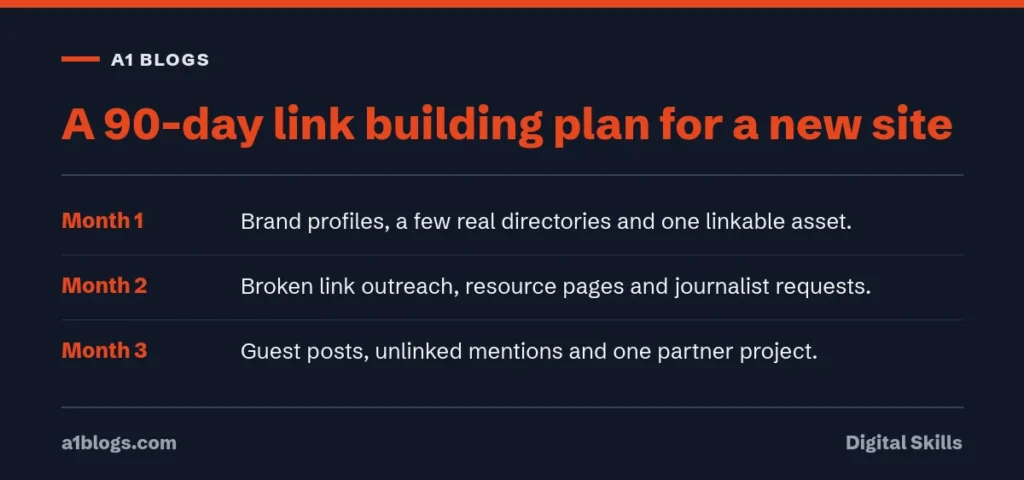
Link building works best as a steady routine rather than a one-off push. This plan assumes about five hours a week and a site with at least 15 to 20 useful posts. If you have fewer, spend the first month writing instead, because there is little to link to yet.
Month 1: foundations
Create your brand profiles on the platforms where your audience spends time, such as Facebook, LinkedIn, YouTube, Pinterest and X. Add your site to the few directories that real people in your field use. Then build one linkable asset: a free template, a calculator, an original survey, or the most complete guide on one narrow topic. This is the page you will point most of your outreach at.
Month 2: outreach
Find 30 resource pages and articles in your niche that link to similar content, and check them for broken links. Email the owners about any broken links you find and suggest your page as a replacement if it truly fits. Sign up to two or three journalist request services and answer every relevant request within a few hours, because reporters pick fast responses.
Month 3: partnerships
Pitch three guest posts to relevant sites that accept contributions without payment. Look for unlinked mentions of your brand or name and ask for a link. Reach out to one or two businesses or creators about a joint guide, survey or webinar. By day 90 you should have a small number of genuine backlinks, a list of contacts and a process you can keep running every month.
Don’t measure success by the number of links. Five relevant backlinks from real sites in your niche do more than 500 from directories nobody visits.
How to write an outreach email that gets replies
Site owners receive a lot of link requests, and most are ignored because they are generic. A good outreach email is short, specific and useful to the person reading it. Here is a structure that works.
Subject: a clear, specific line, such as “Broken link on your scholarship resources page”.
First line: show you actually read their page. Mention the article by name and one thing you found useful in it.
The point: explain the problem or opportunity in one or two sentences. For example, the link to a government fee schedule in their list now returns an error.
Your offer: suggest your page as a replacement only if it covers the same thing, and say why it helps their readers, such as being updated for this year.
Close: thank them and keep it short. No pressure, no repeated follow-ups. One polite reminder after a week is enough.
A few rules make a big difference:
- Send emails one at a time, written for that person. Mass templates are easy to spot.
- Use your real name and a domain email address, not a free webmail address if you can avoid it.
- Never offer money for a link unless you expect it to be marked as sponsored. Paid links without that label break Google’s spam policies.
- Track who you contacted in a simple spreadsheet so you don’t email anyone twice.
How to judge whether a site is worth a link
Not all backlinks are equal. Before you spend time getting a link from a site, check it against this list.
- Relevance. Does the site cover your topic or your audience? A link from a Pakistani education blog matters more to a scholarship guide than one from a car forum.
- Real readers. Does the site get comments, shares or social followers? Free tools give rough traffic estimates. A site with no visible audience is often a link farm.
- Real authors and contact details. Look for named writers, an about page and a way to reach the owner.
- Editorial standards. If every post links out to unrelated casinos, loan sites and essay services, the site is selling links. Avoid it.
- Indexed by Google. Search for site: followed by the domain. If almost nothing appears, Google may not trust the site.
- Natural linking. The site should link to sources because they help readers, not because someone paid.
If a site fails two or more of these checks, move on. One bad link rarely harms you, because Google says it ignores most spammy links, but chasing them wastes time you could spend on real link building.
Anchor text: keep it natural
Anchor text is the clickable text of a link. Years ago people stuffed exact keywords into anchors, and Google’s spam policies now treat that pattern as a warning sign.
In practice, most of your backlinks should use your brand name, your page title, a plain URL or natural phrases like “this guide” or “according to A1 Blogs”. When you write guest posts or ask for links, let the site owner choose wording that fits their sentence. A profile full of identical keyword anchors looks bought, even when it wasn’t.
The same applies to links you give. Link out to sources that help your readers, with descriptive anchors, as Google’s own link best practices recommend.
Internal links: the links you fully control
While you wait for backlinks, use the links you control. Internal links help Google find new pages, understand how your content fits together and pass value from your strongest pages to newer ones.
- Link every new post from at least two or three older, related posts.
- Build hub pages for your main topics that link to every guide in that topic.
- Use descriptive anchor text, such as “how to get free YouTube subscribers”, rather than “click here”.
- Check for orphan pages, which no other page links to, and connect them.
On A1 Blogs, for example, our guide to free YouTube subscribers links to related growth guides so readers and search engines can follow the topic.
What to do about spammy backlinks
Almost every site picks up strange backlinks from scraper sites and spam directories. You didn’t ask for them, and Google has said it is good at ignoring them, so there is usually nothing to do.
Use Google’s disavow tool only in two situations: you have a manual action for unnatural links in Search Console, or you knowingly bought or built links that break the rules and want to clean them up. Disavowing good backlinks by mistake can hurt you, so leave it alone unless one of those applies.
To see your links, open the Links report in Google Search Console. Bing Webmaster Tools has a free backlinks report too, which often shows links that Search Console doesn’t.
Link building mistakes that waste time
- Buying packages of free backlinks or cheap bulk links. They usually come from link farms or private blog networks that Google ignores or penalises.
- Blog comment and forum spam. These links are nofollow or ugc, get deleted quickly and can get your domain flagged as spam.
- Automated backlink generators. Sites that promise hundreds of free backlinks in minutes create pages nobody reads.
- Link exchanges at scale. Swapping links with every site that asks is listed in Google’s spam policies as excessive link exchange.
- Ignoring content quality. No amount of link building will save thin or copied content. Make pages that deserve links first.
- Giving up too early. Outreach replies come slowly. Most of the backlinks you earn will come from relationships built over months.
Linkable asset ideas for Pakistani sites
A linkable asset is a page other sites want to reference. It is the most reliable way to earn free backlinks, because people link to it without being asked once they find it. Here are ideas that suit sites writing for Pakistani readers.
- Calculators. Electricity bill, income tax, zakat, loan instalment or property tax calculators get linked from forums, news articles and Facebook groups, as long as they are kept up to date with the latest rates.
- Deadline trackers. A regularly updated page of scholarship, admission or exam deadlines gets bookmarked and shared by students and teachers.
- Original surveys. Ask 200 freelancers how they get paid, or 300 students how they prepare for entry tests, and publish the results with charts. Journalists and bloggers cite fresh local data.
- Price trackers. Monthly prices for phones, petrol, gold or building materials, with the date and source for every figure.
- Complete guides to official processes. Step-by-step guides with screenshots for passports, CNIC renewal or tax filing often become the page people send each other.
- Free templates. CV templates for Pakistani job applications, budget sheets or invoice templates for freelancers.
Whatever you build, put a clear date on it and update it. An outdated calculator loses backlinks as quickly as it earned them, because site owners replace links that send their readers to wrong numbers.
Once the asset is live, mention it in your outreach, share it in relevant groups and add it to your brand profiles. That gives your link building a page worth pointing to.
Frequently asked questions
Are free backlinks safe?
Earned links from real sites are safe. Links from mass profile sites, bookmarking sites, link exchanges and automated tools match Google’s examples of link spam.
Do nofollow backlinks help?
They can send real visitors, and a natural mix of links is normal. Don’t build them in bulk for rankings.
How many backlinks does a new site need?
There is no fixed number. A few links from relevant, trusted sites help more than hundreds from unrelated ones.
Can I get backlinks by commenting on blogs?
Blog comment links are usually nofollow, and Google lists forum comments with optimized links as link spam. Comment only when you have something useful to add.
How long do backlinks take to work?
Google needs to crawl the linking page first, which can take days or weeks. The effect on rankings usually builds over months and depends on how relevant and trusted the linking site is.
Are .edu and .gov backlinks better?
Not because of the domain ending. Google judges links by context and relevance. A university page linking to your guide because it helps students is valuable, but so is a link from a respected blog in your niche.
Do social media links count as backlinks?
Most social media links are nofollow, so they pass little ranking value directly. They still bring visitors and help people discover content that they later link to from their own sites.
Is it safe to use free backlinks from directory lists?
A few directories that real people use, such as major business listings in your country or industry, are fine. Long lists of free backlinks from random directories add little and can look spammy if you submit to hundreds at once.
How many backlinks do I need to rank?
There is no fixed number. It depends on how competitive the search is and how strong the pages already ranking are. For many local, specific searches, a well-written page with a few relevant backlinks and good internal links can rank. For broad, competitive topics you will need more, earned over time.
Should I pay for guest posts?
If a site charges for a guest post, the link must be marked rel=”sponsored” to follow Google’s rules. Paid placements without that label count as link spam and can lead to a manual action.