
New bloggers often go looking for free website traffic in the wrong places: traffic exchanges, “10,000 free visitors” generators and auto-surf sites. They do raise the visitor count. They also fill your analytics with bots, and if you run ads, they can put your AdSense account at risk.
This guide explains why fake traffic is dangerous, then covers ten free sources that send real readers to a new site.
Table of Contents
Why traffic generators are a trap
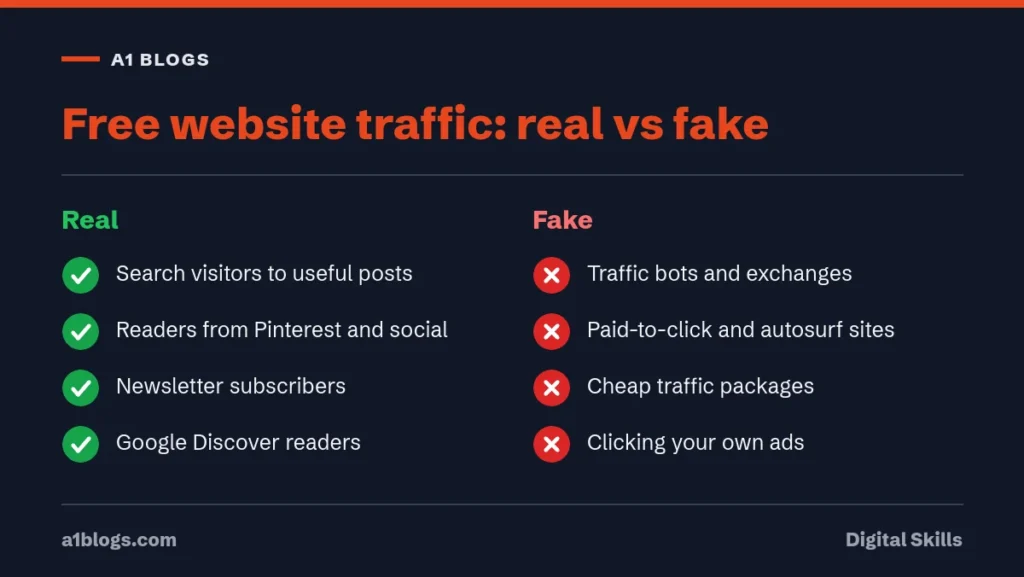
Google AdSense defines invalid traffic as clicks or impressions that may artificially inflate an advertiser’s costs or a publisher’s earnings, and lists automated clicking tools or traffic sources, robots and other deceptive software as examples. If invalid traffic is high, Google may limit ad serving or suspend or close the account (AdSense invalid traffic).
Even without ads, bot visits make your numbers useless. You can’t tell which posts readers like when half your visitors are scripts that leave after one second.
10 free sources of real website traffic
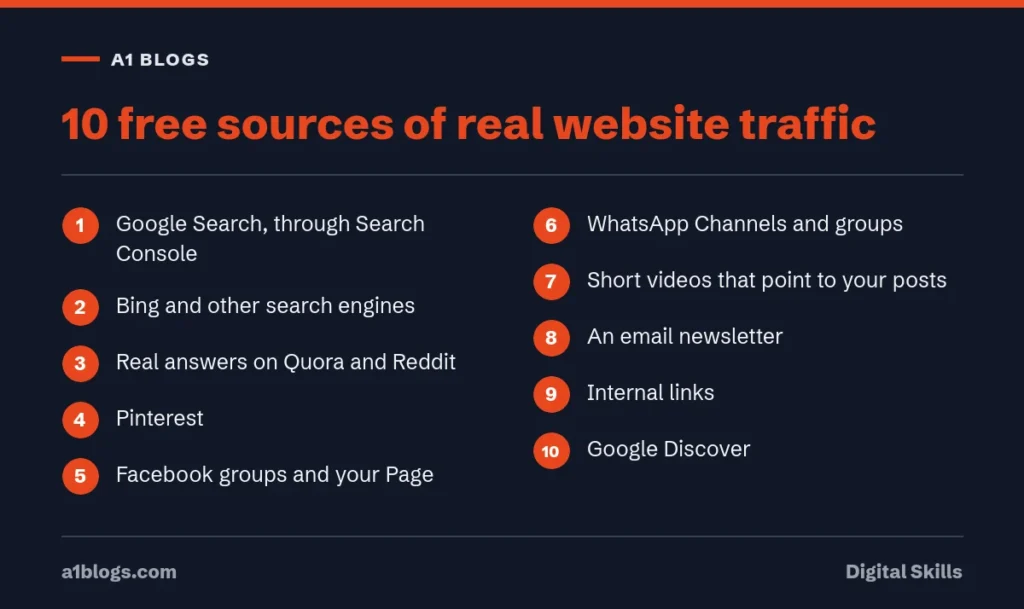
1. Google Search, through Search Console
Add your site to Google Search Console, submit your sitemap and check the Pages report for errors. Use URL Inspection to request indexing for important new posts. Search is slow to build but keeps sending visitors for years.
2. Bing and other search engines
Bing Webmaster Tools can import your site from Search Console in a few clicks. Turning on IndexNow, which many SEO plugins support, tells participating search engines about new and updated pages straight away.
3. Answer real questions on Quora and Reddit
Find questions your posts answer well. Write a complete answer first, then link to your post for readers who want more. Each subreddit has its own rules on self-promotion; read them before posting.
4. Pinterest
Pinterest works like a visual search engine for ideas, recipes, guides and checklists. Tall images with a clear headline, linked to your post, can bring visitors for months.
5. Facebook groups and your Page
Share posts in groups where they help members and the rules allow it. Our guide to free Facebook followers covers growing a Page that sends traffic.
6. WhatsApp Channels and groups
WhatsApp is where many readers in Pakistan spend their time. A channel for your blog lets followers get each new post without searching for it.
7. Short videos that point to your posts
Turn a post into a 30-second TikTok, Reel or Short and mention where the full guide lives. Our guide to free TikTok followers explains how to grow those accounts safely.
8. An email newsletter
Email is the one channel no algorithm controls. Add a simple sign-up box and send your best posts once a week.
9. Internal links
Link each post to two or three related ones. Visitors who arrive for one article read more, which means more pageviews from the traffic you already have.
10. Google Discover
Discover shows articles in the Google app’s feed without a search. Google recommends large images at least 1,200 pixels wide, enabled with the max-image-preview:large setting, and titles that capture the content without clickbait (Google Discover guidance).
Links bring traffic too
A link from a popular site sends visitors directly, as well as helping search rankings. Our guide to free backlinks covers twelve legit ways to earn them.
How long does it take to get traffic?
Social and community traffic can start the day you post. Search traffic usually takes weeks to months for a new site, because Google needs time to crawl, index and trust your pages. Most blogs that grow keep publishing useful posts and promoting each one, rather than waiting for search alone.
Find topics people actually search for
Most free website traffic comes from search, and search traffic starts with choosing topics people type into Google. You don’t need paid tools to find them.
- Google autocomplete. Type the start of a question, such as “how to apply for”, and note the suggestions. Add letters (a, b, c) after your phrase to see more.
- People also ask. The question boxes in search results show what people want to know next. Each one can become a section or a whole post.
- Search Console queries. Once your site has a few weeks of data, the Performance report shows searches where you already appear on page two or three. Those are your quickest wins.
- Google Trends. Compare topics, see seasonal peaks such as admissions or budget announcements, and filter by Pakistan.
- Forums and groups. Questions asked again and again in Facebook groups, Reddit or Quora show demand that search tools often miss.
New blogs should target specific, longer searches, such as “how to check gas bill online in Lahore”, rather than broad terms like “gas bill”. There is less competition, and the people searching know exactly what they want, so they stay and read.
Write posts that rank and keep readers
Google’s guidance on helpful content is simple: write for people first. In practice, posts that bring steady blog traffic share a few habits.
- Answer the question early. Give the short answer in the first paragraph, then explain the details.
- Match what the searcher wants. Someone searching “best free AI tools” wants a list with comparisons, not a history of AI.
- Add something new. Screenshots of the real process, your own test results, local prices or a worked example make your page more useful than ten others saying the same thing.
- Use clear headings. Readers skim, and headings help Google understand each section.
- Show who wrote it and when. An author name, a publish date and a last updated date build trust.
- Link to sources. Official sites, data and help pages show readers where facts come from.
A single post written this way can bring website traffic for years, while ten thin posts on the same topic often bring none.
Technical basics that block website traffic
Sometimes good posts get no visitors because something technical is stopping them. Check these once a month.
- Indexing. In Google Search Console, open the Pages report to see which pages are indexed and why others are not.
- Sitemap. Submit your XML sitemap in Search Console and Bing Webmaster Tools so new posts are found quickly.
- Noindex mistakes. SEO plugins sometimes set categories, tags or even posts to noindex. Make sure your important pages are indexable.
- Speed on mobile. Most Pakistani readers use phones on mobile data. Compress images, limit heavy scripts and test pages with PageSpeed Insights.
- Broken links and errors. Fix 404 errors on pages that used to get visitors, or redirect them to the closest matching page.
None of these will bring website traffic on their own, but each can quietly cut it off.
Protect your AdSense account from fake traffic
If you run AdSense or any ad network, fake visitors are more than a waste of time. Google’s AdSense policies prohibit invalid traffic, which includes automated visits, traffic exchanges, paid-to-click schemes and anything that inflates clicks or impressions artificially.
When Google detects invalid traffic, it can withhold earnings, limit how many ads appear on your site or disable your account. Publishers are responsible for their traffic even when someone else sent it, so a cheap traffic package from a seller can put your whole income at risk.
Stay safe with a few habits:
- Never buy traffic packages or join traffic exchange sites.
- Don’t click your own ads or ask friends to click them.
- Check Google Analytics for sudden spikes from one country, one referrer or with near-zero time on page, and investigate them.
- If you run paid promotion, use reputable platforms like Google Ads or Meta ads, where visitors are real people.
Real blog traffic grows more slowly, but it is the only kind that pays reliably.
A 90-day plan to grow blog traffic
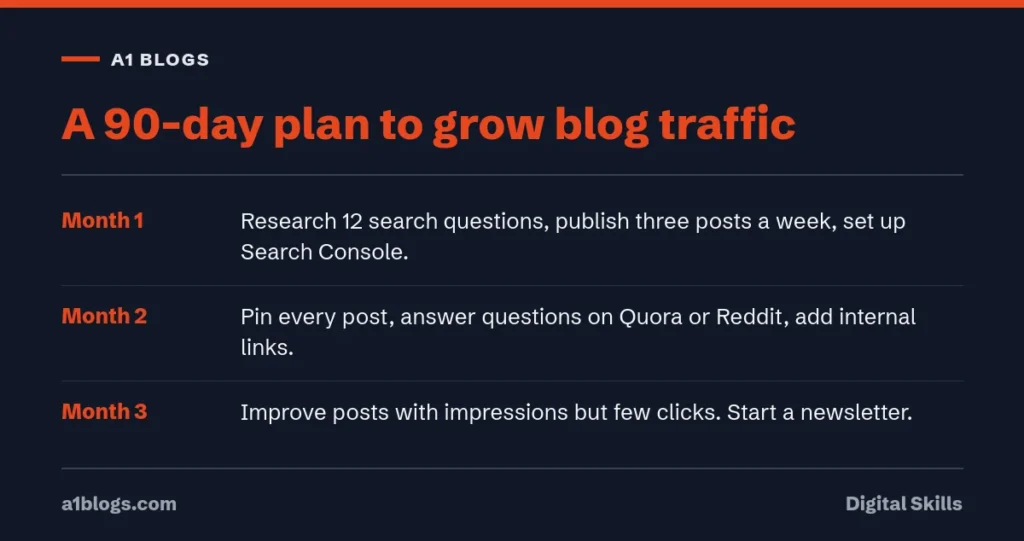
This plan suits a new blog with a clear topic and a few hours a week.
Month 1: research and publish
Pick 12 specific search questions from your keyword research and write one thorough post for each, three a week. Set up Search Console, Bing Webmaster Tools and Google Analytics, and submit your sitemap.
Month 2: distribute
Make a Pinterest pin for every post, answer five relevant questions on Quora or Reddit with genuinely helpful answers, and share each post on your Facebook Page and WhatsApp Channel with a short summary. Link each new post from two or three older ones.
Month 3: improve and repeat
Open Search Console and find posts with impressions but few clicks. Rewrite their titles and meta descriptions, add missing sections and update facts. Start a simple email newsletter and invite readers at the end of each post. Then plan the next 12 posts around the searches that are already showing up.
After 90 days most new blogs see their first steady website traffic from search, though competitive niches take longer.
Update old posts for more traffic
Updating existing posts is one of the fastest ways to grow free website traffic, because the pages are already indexed. Every few months, pick posts that have lost clicks or sit just off page one.
- Check that every fact, price, date and screenshot is current.
- Add sections that answer questions from People also ask or your comments.
- Improve the title so it matches the search better and gives a reason to click.
- Add internal links from newer posts.
- Change the last updated date only when you have made real changes.
Don’t change the URL of a post that already ranks. If you must, add a 301 redirect from the old address.
Measure what matters
Two free tools tell you almost everything about your website traffic.
- Google Search Console shows searches, impressions, clicks, click-through rate and average position. Use it to find topics that are close to page one and pages that need better titles.
- Google Analytics shows where visitors come from, which pages they read and how long they stay. Engagement rate and engaged sessions matter more than raw pageviews.
Check both once a week and keep a simple monthly log: total visitors, top five pages and top five search queries. Over a few months that log shows which kinds of posts bring blog traffic, so you can write more of them. If links are your next step, read our guide to free backlinks.
Why new blogs get no traffic
If you have published for a few months and see almost no visitors, one of these is usually the reason. Work through them before you write anything new.
- Topics nobody searches for. Posts based on what you want to say, rather than what people ask, rarely bring website traffic. Check each topic against autocomplete and People also ask before writing.
- Topics only big sites can win. Broad searches like “how to lose weight” are dominated by large, trusted sites. Go narrower and more local.
- Thin or copied content. Short posts that repeat what is already ranking give Google no reason to show yours. Add your own steps, examples, screenshots or data.
- Too many unrelated topics. A blog covering cricket, crypto, recipes and visas looks like it has no expertise. Group posts into a few clear topics and link them together.
- Pages not indexed. Check the Pages report in Search Console. If many posts are “Crawled, currently not indexed”, Google has found them but doesn’t think they are worth showing yet. Improve or merge them.
- Not enough time. New sites often take several months before search website traffic picks up. Keep publishing on a schedule while you wait.
Turn one post into five sources of traffic
Every post you publish can bring visitors from more than one place. Repurposing takes less time than writing new posts and spreads your blog traffic across several channels, so one algorithm change doesn’t wipe you out.
- A Pinterest pin with a tall image and a clear title that matches the post.
- A short video for Reels, Shorts or TikTok covering the single most useful tip, with the post mentioned at the end.
- A Facebook post with a short summary and the link, shared on your Page and in groups that allow it.
- A WhatsApp Channel update with two lines on why the post matters and the link.
- An answer on Quora or Reddit where someone asks the same question, giving the full answer and linking for details only where the rules allow.
Track each source in Google Analytics under traffic acquisition. After a month you will see which channel sends readers who stay, and you can put more effort there. Our guides to free Facebook followers and free YouTube subscribers explain how to grow those channels too.
Free website traffic checklist
Run through this list every time you publish, and your blog traffic will build on itself month after month.
- The topic is something people search for, checked in autocomplete or Search Console.
- The first paragraph answers the question.
- The post adds something original, such as steps, screenshots, prices or examples.
- Two or three older posts link to it.
- Important posts are submitted for indexing in Search Console.
- You made a pin, a short video and a Facebook post from it.
- It went out on your WhatsApp Channel and in your newsletter.
- A reminder is set to update it in three to six months.
None of these steps costs money. Together they are how free website traffic grows: one useful post at a time, each sending readers on to the next. Sites that follow a routine like this never need traffic generators, because their website traffic comes from people who chose to visit.
Frequently asked questions
Is free website traffic from traffic exchanges safe?
No. Exchanges and generators mostly send automated or uninterested visits, which AdSense treats as invalid traffic and which make your analytics meaningless.
What is the fastest free website traffic source?
Communities where your readers already gather, such as relevant Facebook groups, WhatsApp channels, Quora and Reddit, send visitors the same day. Search is slower but lasts longer.
Does social media traffic help SEO?
Not directly, but it helps people discover your posts, and some of them will link to or share your content, which does help.
How many posts do I need before I get traffic?
There is no set number. Twenty useful posts on one clear topic usually do better than a hundred thin posts on everything.
How much website traffic do I need for AdSense?
Google doesn’t publish a minimum. AdSense approval depends on original, useful content, a working site and following the program policies. Earnings depend on traffic, so a small site can be approved but will earn little until visitors grow.
Does posting every day increase blog traffic?
Only if every post is useful. Three thorough posts a week usually bring more website traffic than seven rushed ones, and they are easier to keep updated.
Why is my website traffic dropping?
Common causes are a Google core update, a technical problem such as pages being deindexed, outdated content, seasonal interest or competitors publishing better pages. Compare the dates in Search Console with Google’s update announcements and your own changes.
Is paid traffic worth it for a new blog?
Paid ads from Google or Meta can test whether a post converts, but they rarely pay for themselves on an ad-supported blog. Build free website traffic first, then use paid promotion for products or email sign-ups.
How long does it take for a new blog to get traffic from Google?
Many new blogs see little search traffic for the first three to six months, then steady growth if they keep publishing useful posts. Social channels and communities can send free website traffic sooner while search catches up.
Is Google Discover traffic reliable?
Discover can send large spikes of blog traffic, but it rises and falls quickly. Treat it as a bonus on top of search, not your main source. Large, high-quality images and timely topics help posts appear there.