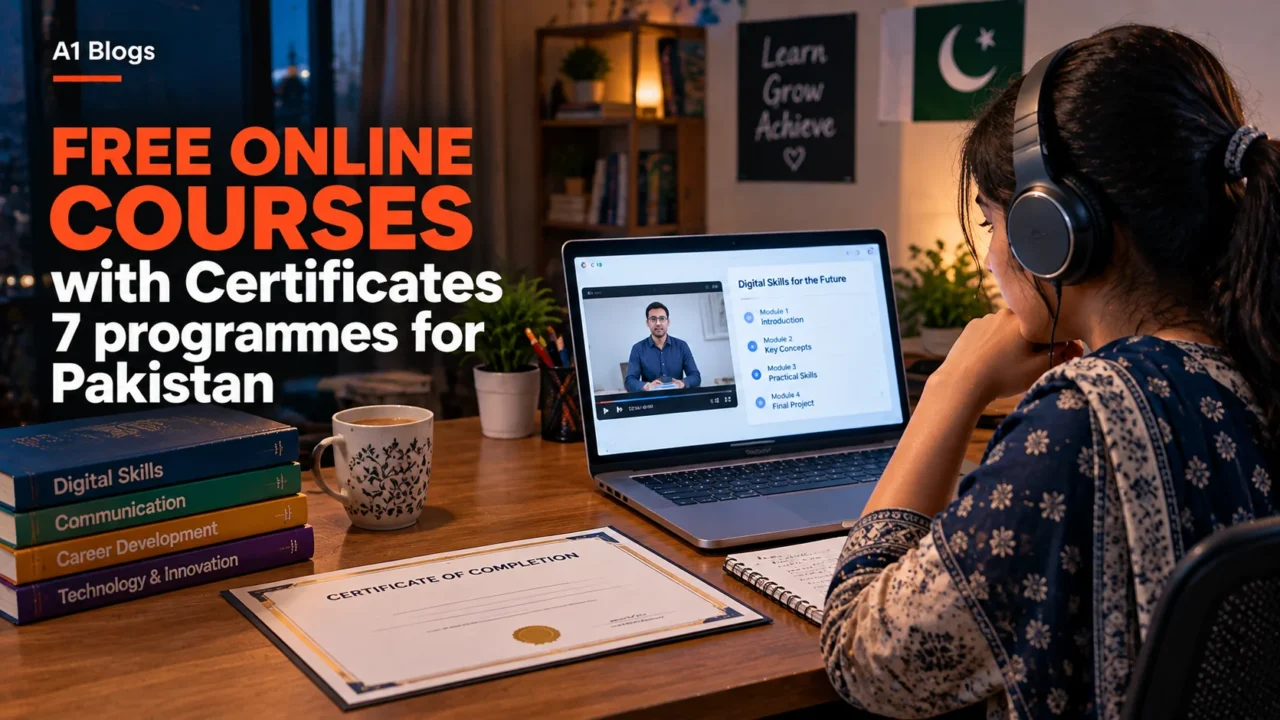
Free online courses with certificates are one of the easiest ways for students and job seekers in Pakistan to learn skills that pay: digital marketing, design, coding, bookkeeping and freelancing. Some of the best options are run by the government or by the companies whose tools you will use at work, and they cost nothing.
This guide lists seven programmes, what each certificate is worth, and how to avoid paying for something that should be free.
Table of Contents
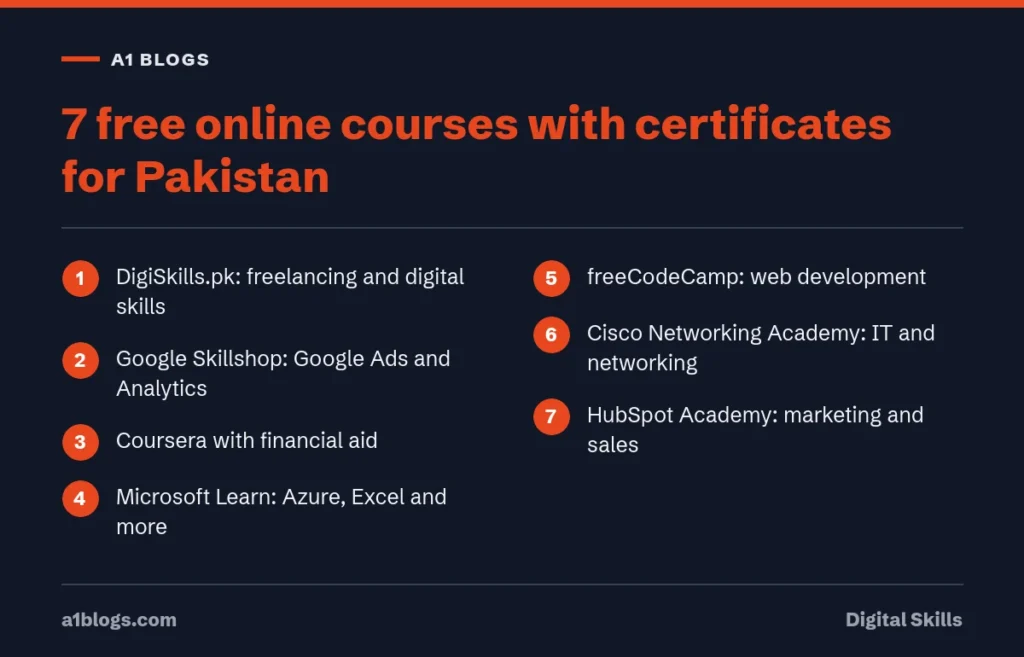
1. DigiSkills.pk
DigiSkills is led by the Ministry of Information Technology and Telecommunication through Ignite and run by the Virtual University of Pakistan. It was launched on 1 February 2018 (Wikipedia). Courses include freelancing, digital marketing, WordPress, graphic design, SEO, e-commerce management, QuickBooks, AutoCAD and creative writing.
The programme is free. It currently lists 24 courses, and you can take at most two per batch. People who complete a course get a verified e-certificate from the Virtual University; there is no hard copy. Enrolment for Batch 5 of DigiSkills 3.0 was expected to open in November 2026 (Pakera, 2 October 2026). Register only on the official DigiSkills website. Anyone charging a fee for a seat or a certificate is not part of the programme.
2. Google Skillshop
Google Skillshop has free training and certifications for Google’s own tools, including Google Ads, Google Analytics and YouTube. These are useful for anyone offering marketing services, because clients recognise the names.
3. Coursera with financial aid
Coursera hosts courses from universities and companies. Many courses can be audited for free, and learners who can’t afford the certificate fee can apply for financial aid on eligible courses. Apply early, because approval is not instant.
4. Microsoft Learn
Microsoft Learn offers free learning paths on Excel, Azure, Power BI and more. The training is free; official Microsoft certification exams cost money, so treat the free modules as preparation.
5. freeCodeCamp
freeCodeCamp is a nonprofit with a free coding curriculum and free certifications in areas such as responsive web design and JavaScript. Each certification requires you to build projects, which also gives you a portfolio.
6. Cisco Networking Academy
Cisco Networking Academy has free self-paced courses, such as introductions to cybersecurity and networking, with digital badges or certificates on completion. Good for anyone heading toward IT support or networking jobs.
7. HubSpot Academy
HubSpot Academy offers free courses and certifications in inbound marketing, content marketing, email marketing and sales. They are well known among marketing agencies.
How to make a free certificate count
A certificate shows you finished a course; it doesn’t prove you can do the work. Pair each one with something you built: a website, a campaign, a spreadsheet model or a design set. Add certificates to LinkedIn and your freelancing profiles, and mention the project in your proposals. Our guides to freelancing on Fiverr and remote job websites show where to use them, and our guide to making money with AI covers skills clients are paying for now.
Watch out for fake “free course” offers
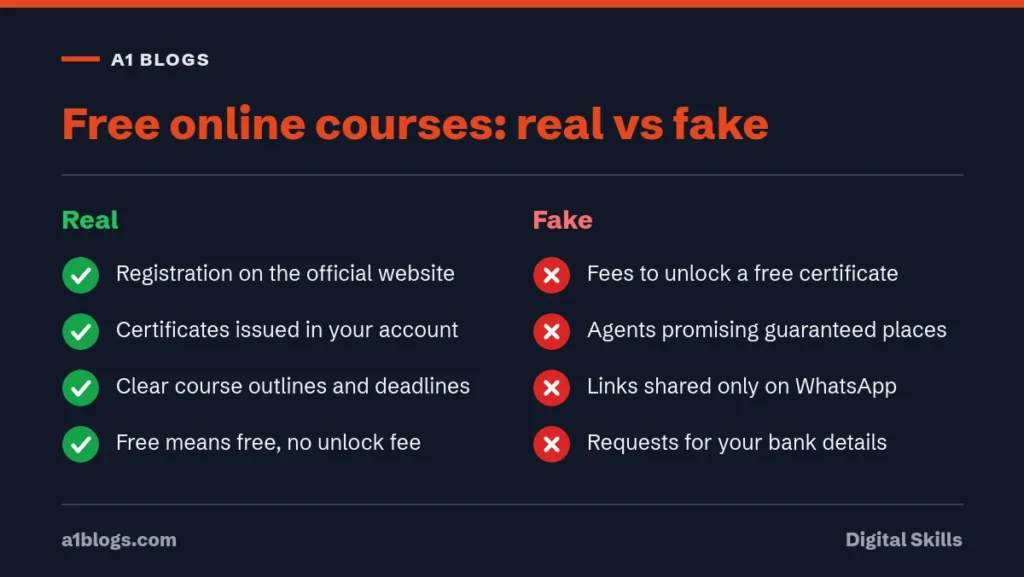
- Pages that copy a government programme’s name but ask for a registration or certificate fee
- WhatsApp messages promising guaranteed jobs after a free course
- Sites asking for your CNIC copy and bank details before you can start
Check the official website of the programme, and never pay for a certificate that the organiser says is free.
Which free course should you choose?
The best free online courses with certificates are the ones that match a clear goal. Pick your goal first, then the course.
- Start freelancing: DigiSkills courses in Freelancing, Digital Marketing, Graphic Design or WordPress teach skills clients pay for on Fiverr and Upwork, in Urdu, with a structured schedule.
- Get a marketing or sales job: Google Skillshop and HubSpot Academy certificates are known to marketing agencies and look good on a CV next to a small portfolio.
- Move into IT or networking: Cisco Networking Academy and Microsoft Learn build a foundation for paid certifications later.
- Learn programming: freeCodeCamp gives free certifications based on real projects you build.
- Study a university-level subject: Coursera with financial aid gives access to courses from well-known universities and companies.
Don’t sign up for five courses at once. Finishing one course and using the skill is worth more than five half-done certificates.
How to register for DigiSkills step by step
DigiSkills is the most popular of the free courses in Pakistan, run under the Ministry of IT and Telecom. Courses run in batches, so timing matters.
- Check the batch dates. Visit DigiSkills.pk and look for the current or upcoming batch. Registration opens for a limited period before each batch starts.
- Create an account. You will need a valid email address, a mobile number and your CNIC details.
- Choose your courses. Read each course outline before you pick. Popular options include Freelancing, Digital Marketing, Graphic Design, WordPress, Search Engine Optimisation, E-Commerce Management, Creative Writing, QuickBooks and AutoCAD.
- Follow the weekly schedule. Lessons are released week by week, with quizzes and assignments that have deadlines. Missing them can stop you from passing.
- Pass and download your certificate. Once you complete the requirements, your DigiSkills certificate appears in your account.
DigiSkills lessons are mostly in Urdu, which makes them easier to follow for many learners than English-only platforms. The website works on a phone, but a laptop makes assignments easier.
A 12-week plan to finish a course and use it
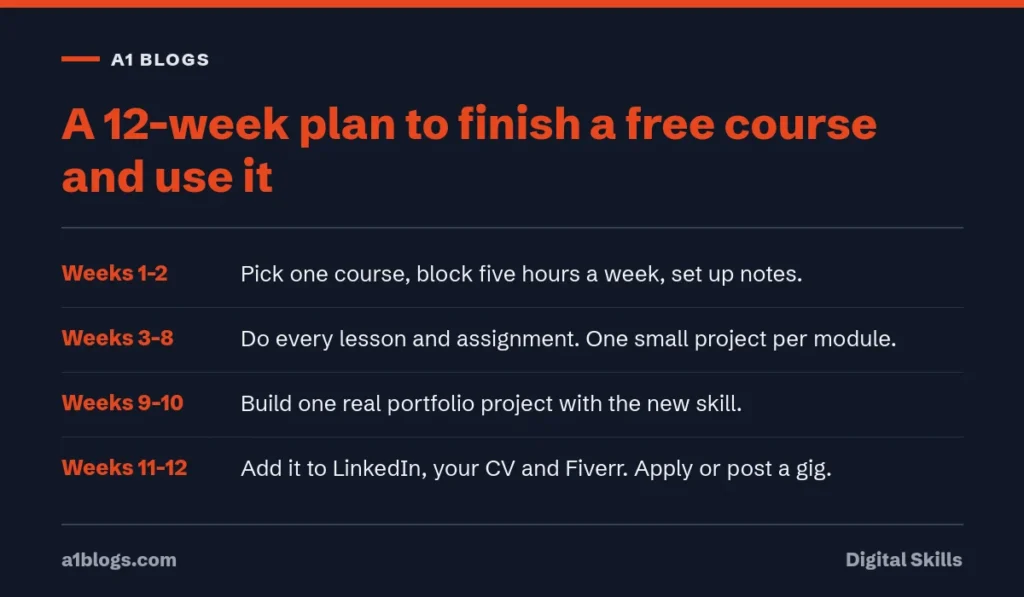
Most people who start free online courses with certificates never finish them. A plan with a clear end product fixes that.
Weeks 1 to 2: set up
Choose one course, block out five or six hours a week in your calendar and tell someone your goal. Set up a simple notebook or document for notes and a folder for assignments.
Weeks 3 to 8: learn and practise
Follow the lessons every week and do every assignment, even optional ones. After each module, make one small practice project: a logo, a social post, a WordPress page, a spreadsheet or a short piece of code.
Weeks 9 to 10: build a portfolio piece
Combine what you learned into one real project. For example, design a full set of social posts for a local shop, build a website for a relative’s business or write three sample blog posts. A finished project proves the certificate means something.
Weeks 11 to 12: show it and apply
Add the certificate and the project to LinkedIn, your CV and your freelancing profile. Apply to five jobs or post one gig that uses the new skill. Then choose your next course based on what clients or employers asked for.
How to show certificates on LinkedIn, Fiverr and your CV
A certificate only helps if the right people see it, presented well.
- LinkedIn: add it under Licences and certifications with the issuing organisation, issue date and a credential link if one is given. Share a short post about what you built during the course, not just the certificate image.
- Fiverr and Upwork: add relevant certificates to your profile, and mention the skill in your gig or profile description. Clients care more about samples, so link to your portfolio.
- CV: list certificates in a short “Certifications” section with the course name, provider and year. Put the most relevant ones first and leave out unrelated ones.
- Interviews: be ready to explain what you did in the course and show a project. That conversation matters more than the paper.
If you plan to freelance, our guide to starting freelancing on Fiverr explains how to turn a new skill into your first orders.
Study with weak internet and load-shedding
Power cuts and slow connections are real obstacles for learners across Pakistan. A few habits help you keep going.
- Download lessons when you can. The Coursera app lets you download videos to watch offline, and many platforms provide transcripts or slides you can save.
- Use lower video quality. Switching to 360p or 480p saves data and keeps videos playing on slow connections.
- Study at off-peak times. Early mornings often have faster internet and fewer power cuts.
- Keep a power bank charged so a load-shedding slot doesn’t end your study session.
- Write assignments offline in a document first, then paste them in when you are connected, so you don’t lose work if the connection drops.
- Use free office tools. Our guide to free Microsoft Office covers legal ways to get Word and Excel for assignments.
What is free and what costs money
The word free means different things on different platforms. Know the difference before you start.
- DigiSkills: training and certificates are free.
- Google Skillshop and HubSpot Academy: courses and certifications are free.
- freeCodeCamp: completely free, including certifications.
- Microsoft Learn: training is free, and some Applied Skills credentials are free, but most Microsoft certification exams cost money.
- Cisco Networking Academy: many self-paced courses and badges are free, but industry certifications such as CCNA require a paid exam.
- Coursera: you can often audit course content for free, but certificates need payment unless you are approved for financial aid.
None of these should ask for a fee to unlock a free certificate through WhatsApp or an unknown website. If someone does, it is a scam.
Other free courses in Pakistan worth checking
Government and provincial bodies also run free training from time to time, often with in-person or blended classes. Programmes open and close frequently, so check official sources rather than social media posts.
- NAVTTC, the national vocational training body, announces free technical and vocational courses in batches.
- Provincial IT boards, such as PITB in Punjab and KPITB in Khyber Pakhtunkhwa, run digital skills and freelancing programmes.
- Universities sometimes offer free short courses and workshops open to the public, especially in IT and entrepreneurship.
Apply only through official websites, and never pay an agent to secure a place in free courses in Pakistan.
Where to learn each skill for free
If you already know which skill you want, this quick guide points you to free places to learn it. Several also give free certificates.
- Graphic design: the DigiSkills Graphic Design course, plus Canva’s free Design School lessons for practical layouts and social posts.
- Digital marketing and SEO: DigiSkills, Google Skillshop and HubSpot Academy. Practise by growing a real Facebook Page or blog while you study.
- Web development: freeCodeCamp for certifications, and The Odin Project for a full free curriculum built around projects.
- Data analysis: Kaggle Learn has short free courses with certificates of completion in Python, SQL and data visualisation. Microsoft Learn covers Excel and Power BI.
- Artificial intelligence basics: Elements of AI, created by the University of Helsinki, is free and gives a certificate when you finish.
- Networking and cybersecurity: Cisco Networking Academy’s free self-paced courses.
- Office skills: Microsoft Learn for Word, Excel and PowerPoint, which you can practise using the free web apps.
Whichever you choose, pair the course with a real task. Skills you use stay with you, and they give you something to show beyond the certificate.
Mistakes that waste free courses
Free courses cost nothing to join, which makes them easy to abandon. Avoid these common mistakes.
- Collecting certificates instead of skills. Ten certificates with no projects look weaker than two certificates with a strong portfolio.
- Skipping assignments. The assignments are where you actually learn. Watching videos alone feels productive but rarely sticks.
- Choosing courses at random. Pick courses that build on each other towards one goal, such as freelancing in design or a junior marketing job.
- Ignoring deadlines. Batch-based programmes like DigiSkills have fixed dates. Missing a few weeks can mean failing the course.
- Paying for “free” certificates. Genuine free programmes don’t ask for unlock fees through WhatsApp or unknown sites.
- Not updating your profiles. A certificate sitting in your email does nothing. Add it to LinkedIn, your CV and your freelancing profile the day you receive it.
Treat free online courses with certificates the way you would treat a paid course: set a schedule, finish it and use what you learned.
How employers and clients view free certificates
A certificate is evidence that you started and finished something, which already says a lot about your discipline. On its own, though, it rarely wins a job.
Hiring managers at Pakistani agencies, software houses and startups tend to look for three things together: a certificate that shows you learned the basics, a project that shows you can apply them, and a short explanation of what you would do differently next time. Freelance clients care even more about samples, reviews and how quickly you reply.
Certificates from well-known providers, such as Google, Microsoft, Cisco or HubSpot, are easier for employers to recognise. DigiSkills is widely known in Pakistan, especially for freelancing and digital marketing roles. Whatever the provider, the safest strategy is the same: finish the course, build something real with it and be ready to talk about it.
Frequently asked questions
Are DigiSkills courses really free?
Yes. DigiSkills courses are free, and successful learners get a verified e-certificate from the Virtual University of Pakistan.
Which free online courses with certificates are best for freelancing?
DigiSkills’ freelancing and digital marketing courses, Google Skillshop and HubSpot Academy certifications are a strong start for marketing work. freeCodeCamp suits web development.
Are free certificates accepted by employers?
They help, especially from well-known names such as Google, Microsoft, Cisco or the Virtual University, but employers care most about what you can show. Add a project to each certificate.
Can I get a Coursera certificate for free?
You can audit many courses for free. For the certificate, apply for financial aid on eligible courses.
Can I do DigiSkills courses on my phone?
Yes. You can follow DigiSkills lessons on a phone browser, and there is also a mobile app. A laptop is easier for assignments that need software like WordPress, Canva or QuickBooks.
Do free online courses with certificates help you get a job abroad?
They help most as proof of a skill alongside experience and a portfolio. Employers abroad usually value recognised certificates, such as those from Google, Microsoft or Cisco, more than unknown ones, and they still ask about real projects.
Are there free courses in Pakistan in Urdu?
Yes. DigiSkills teaches mostly in Urdu, and many provincial programmes offer Urdu instruction. On international platforms, look for Urdu subtitles or translated transcripts.
Do DigiSkills certificates expire?
No. A DigiSkills certificate records that you completed the course, and it doesn’t need renewing. Skills change quickly, though, so keep learning and refresh your portfolio with recent work.
Can I take free online courses with certificates while studying full time?
Yes, if you choose one course at a time and keep to a weekly schedule. Most free courses need four to six hours a week, which fits around university or school if you plan for it.
Which free certificate is best for a fresh graduate?
Choose one that matches the jobs you are applying for. Marketing graduates benefit from Google Skillshop or HubSpot, IT graduates from Cisco or Microsoft Learn, and anyone planning to freelance from DigiSkills. One relevant certificate with a project beats several unrelated ones.